
Infectious Gastroenteritis: Causes and Management
Key points
- Gastroenteritis: acute inflammation of the stomach and intestines from infection, causing diarrhoea with or without vomiting, usually self-limiting.
- Commonest causes: viral - norovirus in adults and rotavirus in unvaccinated children; bacterial causes are led by Campylobacter in the UK.
- Mainstay of treatment: oral rehydration and supportive care; most cases need no antibiotics and no stool testing.
- Incubation clues: vomiting within 6 hours suggests a preformed toxin (S. aureus, B. cereus); bloody diarrhoea after days suggests invasive bacteria.
- Bloody diarrhoea: suggests Campylobacter, Shigella, Salmonella, EHEC or amoebiasis - always send stool cultures.
- E. coli O157: avoid antibiotics, which increase the risk of haemolytic uraemic syndrome; watch for falling urine output and anaemia.
- Notification: suspected infectious bloody diarrhoea and food poisoning are notifiable to UKHSA; advise 48 hours off work or school after symptoms settle.
- Red flags: severe dehydration, bloody diarrhoea with reduced urine output, immunosuppression, recent antibiotics, and sepsis.
Introduction
Infectious gastroenteritis is acute inflammation of the gastrointestinal tract caused by a viral, bacterial or parasitic pathogen, producing diarrhoea (three or more loose stools per day, or more frequently than is normal for that person) with or without vomiting, abdominal pain and fever.1
It is extremely common and in the great majority of cases is self-limiting, resolving within a few days without specific treatment. The clinical priorities are therefore to assess and correct dehydration, identify the minority of patients who need investigation or antibiotics, exclude important mimics such as surgical pathology or inflammatory bowel disease, and give appropriate public health and infection control advice.
Causative organisms
Viral
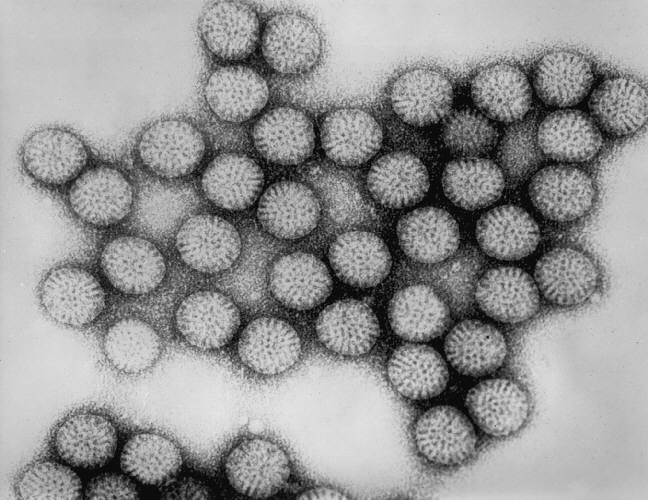
Viruses cause the majority of gastroenteritis. Norovirus is the commonest cause in adults, is highly contagious, and characteristically causes outbreaks in hospitals, care homes and cruise ships, with prominent vomiting and a short illness of 1-3 days. Rotavirus was the leading cause of severe childhood gastroenteritis before the introduction of routine infant immunisation in the UK in 2013, which has substantially reduced its incidence. Adenovirus and astrovirus also cause illness in children.
Bacterial and parasitic
| Organism | Incubation | Typical features and associations |
|---|---|---|
| Norovirus | 12-48 hours | Prominent vomiting, short illness, institutional outbreaks, highly contagious |
| Campylobacter jejuni | 2-5 days | Commonest bacterial cause in the UK. Undercooked poultry and unpasteurised milk. Severe crampy abdominal pain that can mimic appendicitis, then bloody diarrhoea. Associated with Guillain-Barré syndrome and reactive arthritis |
| Salmonella (non-typhoidal) | 12-72 hours | Poultry, eggs, meat. Diarrhoea, fever, vomiting; may cause bacteraemia in the vulnerable |
| Shigella | 1-3 days | Person-to-person spread, low infectious dose. Bloody diarrhoea (dysentery) with fever and tenesmus |
| E. coli O157 (EHEC/STEC) | 1-7 days | Undercooked beef, unpasteurised milk, farm contact. Bloody diarrhoea, usually without fever. Shiga toxin causes haemolytic uraemic syndrome - do not give antibiotics |
| Enterotoxigenic E. coli (ETEC) | 1-3 days | The commonest cause of travellers' diarrhoea; watery, non-bloody |
| Staphylococcus aureus (toxin) | 1-6 hours | Preformed toxin in cold meats, dairy, rice. Rapid-onset severe vomiting, short-lived |
| Bacillus cereus (toxin) | 1-6 hours (emetic), 8-16 hours (diarrhoeal) | Classically reheated rice. Emetic form causes rapid vomiting; diarrhoeal form comes later |
| Clostridioides difficile | Variable, after antibiotics | Antibiotic-associated diarrhoea, pseudomembranous colitis; see the dedicated article |
| Giardia lamblia | 1-3 weeks | Contaminated water, travel, nurseries. Prolonged watery diarrhoea, bloating, flatulence, steatorrhoea and weight loss |
| Entamoeba histolytica | 1-4 weeks | Tropical travel. Gradual-onset bloody diarrhoea; may cause liver abscess |
| Cryptosporidium | 2-10 days | Water-borne, farm and swimming pool contact. Prolonged severe diarrhoea in immunocompromised, especially HIV |
Clinical features and assessment
History
- Onset, duration, frequency and consistency of stools, and the presence of blood or mucus
- Vomiting - whether it dominates, and its timing relative to food
- Food history in the preceding days, including takeaways, reheated rice, poultry, eggs, shellfish and unpasteurised dairy
- Travel history, including destination and timing
- Recent antibiotics or hospital admission - consider C. difficile
- Contact with others who are unwell, or an institutional outbreak
- Occupation - food handlers, healthcare and childcare workers have exclusion requirements
- Immunosuppression, HIV status, pregnancy, age and comorbidity
- Fever, abdominal pain, and features suggesting an alternative diagnosis
Assessing dehydration
This is the single most important part of the examination and determines management. Look for tachycardia, hypotension or postural drop, prolonged capillary refill, dry mucous membranes, reduced skin turgor, sunken eyes, reduced urine output, weight loss and altered consciousness. In children, additional signs include a sunken fontanelle, absence of tears and lethargy or irritability.2
Abdominal examination should be performed to exclude peritonism, and to identify significant tenderness or distension that would suggest a surgical cause or a complication such as toxic megacolon.
Differential diagnosis
It is important not to assume that acute diarrhoea and vomiting is always gastroenteritis:
- Surgical causes: appendicitis (Campylobacter enteritis is a classic mimic), diverticulitis, bowel obstruction, mesenteric ischaemia
- Inflammatory bowel disease: a first presentation of ulcerative colitis or Crohn's disease can look identical, and infection can precipitate a flare
- Clostridioides difficile colitis: particularly after antibiotics or hospitalisation
- Overflow diarrhoea from faecal impaction, especially in older or immobile patients
- Systemic infection: urinary tract infection, pneumonia, sepsis and, in children, otitis media can all present with diarrhoea and vomiting
- Diabetic ketoacidosis, Addisonian crisis and hypercalcaemia
- Drug-related: many drugs, including metformin, laxatives, PPIs, colchicine and chemotherapy
- Coeliac disease, thyrotoxicosis and malabsorption in more chronic presentations
Investigations
Most patients with mild, self-limiting symptoms need no investigation at all.1
Stool testing
Send stool for microscopy, culture and sensitivity if any of the following apply: the patient is systemically unwell or septic; there is blood or mucus in the stool; the patient is immunocompromised; symptoms have persisted beyond 7 days; there has been recent travel abroad; there is recent antibiotic use or hospital admission (also request C. difficile toxin); the patient works in a high-risk occupation such as food handling or healthcare; or a public health outbreak is suspected.
Request stool ova, cysts and parasites where there is relevant travel history or prolonged symptoms, and specify a request for Giardia or Cryptosporidium if suspected, as these are not always covered by routine culture.
Blood tests and imaging
- Urea and electrolytes: to assess dehydration, acute kidney injury and electrolyte disturbance (hypokalaemia and hyponatraemia are common)
- Full blood count: anaemia and thrombocytopenia may signal haemolytic uraemic syndrome in the context of E. coli O157
- CRP and blood cultures if the patient is systemically unwell or febrile
- Blood glucose, and a venous gas with lactate in the acutely unwell
- Abdominal imaging: not routine, but indicated if there is significant abdominal tenderness, distension or suspicion of a surgical cause or toxic megacolon
- Faecal calprotectin and endoscopy: where symptoms persist and inflammatory bowel disease is suspected
Management
Rehydration and supportive care
Fluid replacement is the cornerstone of treatment. Most patients can be managed at home with oral rehydration solution, which contains a balanced combination of glucose and electrolytes that exploits sodium-glucose co-transport to maximise absorption. Encourage continued eating as tolerated; in children, breastfeeding and normal feeding should continue.2
Intravenous fluids are required if there is severe dehydration or shock, persistent vomiting preventing oral intake, or reduced consciousness. Electrolytes should be monitored and replaced, particularly potassium.
Antimotility agents and antiemetics
Loperamide may be used for symptomatic relief in mild, watery, non-bloody diarrhoea in adults, but should be avoided if there is bloody diarrhoea, fever, or suspected C. difficile or E. coli O157, since slowing transit retains toxin and increases the risk of toxic megacolon and haemolytic uraemic syndrome. It is not recommended in children. Antiemetics may help where vomiting prevents oral rehydration.
Antibiotics
Antibiotics are not indicated for most cases, since illness is usually viral or self-limiting, and treatment can prolong carriage of Salmonella and precipitate haemolytic uraemic syndrome in E. coli O157.1 Consider antibiotics when:
- The patient is systemically unwell, septic or immunocompromised
- There is confirmed or strongly suspected Shigella or Campylobacter with severe illness (clarithromycin or azithromycin for Campylobacter)
- Giardiasis or amoebiasis is confirmed - metronidazole or tinidazole
- C. difficile - oral vancomycin first-line
- Enteric fever, cholera, or severe travellers' diarrhoea
- Never give antibiotics for suspected E. coli O157
Public health and infection control
Food poisoning and suspected infectious bloody diarrhoea are notifiable diseases in England, reportable to the UK Health Security Agency.3 Advise scrupulous hand hygiene with soap and water (alcohol gel is ineffective against norovirus and C. difficile spores), and that patients should stay away from work, school or nursery until 48 hours after the last episode of diarrhoea or vomiting. Food handlers, healthcare workers and those caring for vulnerable people may need longer exclusion and microbiological clearance. Advise avoiding swimming pools for 2 weeks after cryptosporidiosis.
Complications
- Dehydration, hypovolaemic shock and acute kidney injury - the commonest and most important complications
- Electrolyte disturbance: hypokalaemia, hyponatraemia and metabolic acidosis
- Haemolytic uraemic syndrome: the triad of microangiopathic haemolytic anaemia, thrombocytopenia and acute kidney injury, following Shiga toxin-producing E. coli O157 or Shigella - most common in young children
- Guillain-Barré syndrome following Campylobacter infection
- Reactive arthritis following Campylobacter, Salmonella, Shigella or Yersinia
- Post-infectious irritable bowel syndrome and transient secondary lactose intolerance
- Toxic megacolon and perforation, particularly with C. difficile, Shigella or if antimotility agents are misused
- Bacteraemia and metastatic infection (osteomyelitis, endocarditis, mycotic aneurysm) with Salmonella, especially in the immunosuppressed or those with sickle cell disease
- Amoebic liver abscess following Entamoeba histolytica infection
- Malnutrition and growth faltering in children with prolonged or recurrent illness
Red flags
Prognosis
The great majority of infectious gastroenteritis is self-limiting with an excellent prognosis, resolving within a few days for viral illness and within about a week for most bacterial causes, provided hydration is maintained.1 Parasitic infections such as giardiasis run a more prolonged course but respond well to treatment.
Serious outcomes are concentrated in identifiable groups: infants, frail older people, pregnant women and the immunocompromised, in whom dehydration and invasive infection carry real mortality. Specific sequelae - haemolytic uraemic syndrome, Guillain-Barré syndrome and reactive arthritis - are uncommon but important, and a proportion of patients develop lasting post-infectious irritable bowel syndrome or temporary lactose intolerance after the acute illness has resolved. Globally, gastroenteritis remains a leading cause of childhood death, which is why oral rehydration therapy and rotavirus vaccination are among the highest-impact public health interventions available.
References
- NICE Clinical Knowledge Summaries (CKS). Gastroenteritis. 2024. Available here
- NICE CG84. Diarrhoea and vomiting caused by gastroenteritis in under 5s: diagnosis and management. 2009. Available here
- UK Health Security Agency. Notifiable diseases and causative organisms: how to report. Available here
- CDC, Public domain, via Wikimedia Commons. Available here
- NHS. Diarrhoea and vomiting. 2024. Available here
- British Society of Gastroenterology. Guidelines for the investigation of chronic diarrhoea in adults. Gut. 2018. Available here
- UK Health Security Agency. Managing outbreaks of infectious diarrhoea and vomiting. Available here
This article is written for revision and education. It is not clinical guidance and must not be used to make decisions about the care of a patient. Always check current NICE guidance and local protocols.