
Viral Hepatitis: Hepatitis A to E
Key points
- Hepatitis A and E: faecal-oral transmission, acute illness only, never chronic. Hepatitis E is dangerous in pregnancy, with mortality up to 20%.
- Hepatitis B, C and D: blood-borne, and can all cause chronic infection leading to cirrhosis and hepatocellular carcinoma.
- Hepatitis B chronicity: highly age-dependent - around 90% of infected neonates become chronic carriers, but under 5% of infected adults.
- HBsAg: surface antigen indicates current infection; persisting beyond 6 months defines chronic hepatitis B.
- Anti-HBc IgG vs anti-HBs alone: anti-HBc positivity indicates past natural infection; isolated anti-HBs indicates vaccination.
- HBeAg: e antigen marks high viral replication and high infectivity; anti-HBe suggests lower replication.
- Hepatitis C: the commonest blood-borne chronic hepatitis; around 75% become chronic, but direct-acting antivirals cure over 95%.
- Hepatitis D: an incomplete virus requiring HBsAg to replicate, so occurs only with hepatitis B; co-infection or superinfection worsens outcomes.
Introduction
Viral hepatitis describes inflammation of the liver caused by one of five hepatotropic viruses, designated A to E. Although they produce a similar acute clinical picture, they differ fundamentally in their route of transmission, their capacity to cause chronic infection, and their long-term consequences.1
The single most useful organising principle is that the faecal-oral viruses (A and E) cause acute illness only and never become chronic, whereas the blood-borne viruses (B, C and D) can persist, causing chronic hepatitis, cirrhosis and hepatocellular carcinoma. Globally, chronic hepatitis B and C together account for the majority of liver cancer deaths.
| Virus | Type | Transmission | Chronic? | Vaccine? |
|---|---|---|---|---|
| Hepatitis A | RNA (picornavirus) | Faecal-oral: contaminated food and water, shellfish, travel, men who have sex with men | Never | Yes |
| Hepatitis B | DNA (hepadnavirus) | Blood-borne, sexual, vertical (perinatal) | Yes - age-dependent | Yes |
| Hepatitis C | RNA (flavivirus) | Blood-borne, chiefly injecting drug use; sexual and vertical transmission uncommon | Yes - around 75% | No |
| Hepatitis D | Incomplete RNA virus | Blood-borne; requires HBsAg to replicate, so only with hepatitis B | Yes | Indirectly, via hepatitis B vaccine |
| Hepatitis E | RNA (hepevirus) | Faecal-oral: contaminated water, undercooked pork and game | Only in the immunosuppressed | Yes (limited availability) |
Clinical features of acute viral hepatitis
Acute viral hepatitis produces a similar syndrome whichever virus is responsible, classically progressing through three phases:
- Prodromal (pre-icteric) phase: 1-2 weeks of non-specific symptoms - malaise, fatigue, anorexia, nausea, vomiting, myalgia, low-grade fever, and sometimes right upper quadrant pain. A distaste for cigarettes is classically described in hepatitis A
- Icteric phase: jaundice, dark urine (conjugated bilirubin excreted renally), pale stools, pruritus, and tender hepatomegaly. Paradoxically, the prodromal symptoms often improve as jaundice appears
- Convalescent phase: gradual resolution over weeks, though fatigue may persist for months
Many infections, particularly in children and in hepatitis C, are entirely asymptomatic or anicteric, which is why chronic infection is so often discovered incidentally years later. Extrahepatic features may include arthralgia, urticaria and, in hepatitis B, a serum-sickness-like illness or polyarteritis nodosa.
Chronic viral hepatitis
Chronic infection is typically asymptomatic for decades, with patients presenting either through screening, incidentally abnormal liver enzymes, or - too often - with established cirrhosis or hepatocellular carcinoma. Non-specific fatigue is common. Extrahepatic manifestations of chronic hepatitis C include cryoglobulinaemia, membranoproliferative glomerulonephritis, porphyria cutanea tarda, lichen planus and an association with non-Hodgkin lymphoma; chronic hepatitis B is associated with polyarteritis nodosa and membranous nephropathy.
Hepatitis A and E
Hepatitis A
Hepatitis A is transmitted faecal-orally, through contaminated food or water, shellfish, or person-to-person contact, and is associated with travel to endemic areas, poor sanitation, and transmission among men who have sex with men. The incubation period is 2-6 weeks.2
It causes an acute, self-limiting illness that never becomes chronic and confers lifelong immunity. Severity increases with age: infection is often asymptomatic in young children but causes significant illness in adults. Fulminant hepatic failure is rare (under 1%) but more likely in older patients and those with pre-existing liver disease. Diagnosis is by anti-HAV IgM (acute infection), with anti-HAV IgG indicating past infection or vaccination. Management is supportive. It is a notifiable disease. An effective vaccine is available and recommended for travellers to endemic areas, people with chronic liver disease, men who have sex with men, and people who inject drugs.
Hepatitis E
Hepatitis E is also faecal-oral, spread through contaminated water in endemic regions and, increasingly recognised in the UK and Europe, through undercooked pork and game as a zoonosis. It is now the commonest cause of acute viral hepatitis in the UK.
It is usually self-limiting, but has two important exceptions. First, it carries a mortality of up to 20% in pregnancy, particularly in the third trimester - a high-yield fact. Second, it can cause chronic infection in immunosuppressed patients, such as transplant recipients, in whom it may progress rapidly to cirrhosis and is treated with ribavirin and reduction of immunosuppression. Hepatitis E is also associated with extrahepatic neurological complications including Guillain-Barré syndrome and neuralgic amyotrophy. Diagnosis is by anti-HEV IgM and HEV RNA.
Hepatitis B
Hepatitis B is a DNA virus transmitted through blood and body fluids: perinatally (vertical transmission, the dominant route worldwide), sexually, through injecting drug use, needlestick injury, tattooing and unscreened transfusion. The incubation period is 6 weeks to 6 months.3
Risk of chronicity
The likelihood of an acute infection becoming chronic depends critically on age at exposure, because it reflects immune maturity:
- Neonates (vertical transmission): around 90% become chronic carriers
- Children aged 1-5: around 30%
- Immunocompetent adults: under 5%
This inverse relationship explains why global control depends on universal neonatal vaccination, which in the UK is delivered as part of the routine 6-in-1 vaccine from 2017, alongside antenatal screening and post-exposure prophylaxis for babies of infected mothers.
Interpreting hepatitis B serology
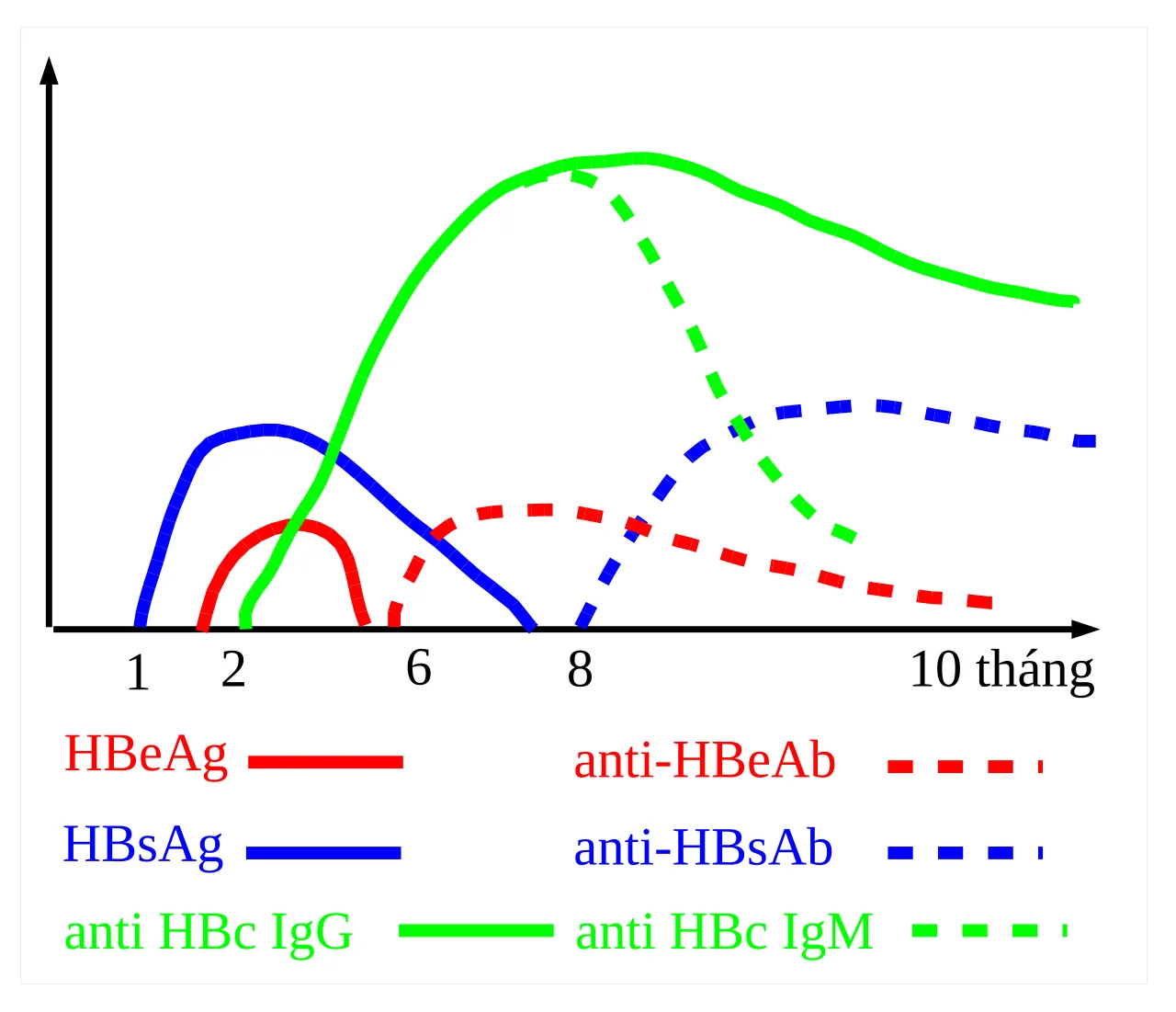
Hepatitis B serology is a favourite examination topic. Each marker answers a specific question:
| Marker | Meaning |
|---|---|
| HBsAg (surface antigen) | Current infection. Persisting beyond 6 months defines chronic hepatitis B |
| Anti-HBs (surface antibody) | Immunity - from either vaccination or resolved natural infection |
| Anti-HBc (core antibody) | Exposure to natural infection. Never produced by vaccination, so this is the marker that distinguishes past infection from immunisation |
| Anti-HBc IgM | Acute or recent infection (within about 6 months) |
| HBeAg (e antigen) | High viral replication and high infectivity |
| Anti-HBe | Seroconversion, usually indicating lower replication and infectivity |
| HBV DNA | Direct measure of viral load, used to guide and monitor treatment |
| Pattern | HBsAg | Anti-HBs | Anti-HBc | Interpretation |
|---|---|---|---|---|
| Susceptible | Negative | Negative | Negative | Never infected or vaccinated - offer vaccination |
| Vaccinated | Negative | Positive | Negative | Immune through vaccination (anti-HBc negative is the key) |
| Past infection, resolved | Negative | Positive | Positive (IgG) | Immune through natural infection |
| Acute infection | Positive | Negative | Positive (IgM) | Acute hepatitis B |
| Chronic infection | Positive over 6 months | Negative | Positive (IgG) | Chronic hepatitis B - assess for treatment |
Management of chronic hepatitis B
Not all chronic carriers need treatment. Antiviral therapy is indicated based on HBV DNA level, ALT, and the degree of fibrosis on elastography or biopsy.3 First-line agents are the nucleoside/nucleotide analogues tenofovir and entecavir, which suppress viral replication with a high barrier to resistance; peginterferon alfa is an alternative in selected patients. Treatment is usually long-term rather than curative, since cccDNA persists.
All patients need six-monthly hepatocellular carcinoma surveillance if cirrhotic, of Asian or African descent above certain ages, or with a family history - noting that HBV can cause HCC without cirrhosis. Household and sexual contacts should be screened and vaccinated. Patients receiving immunosuppression or chemotherapy (particularly rituximab) must be screened for hepatitis B beforehand, as reactivation can be fatal, and given prophylactic antivirals.
Hepatitis C and D
Hepatitis C
Hepatitis C is an RNA virus transmitted almost exclusively through blood-to-blood contact, with injecting drug use the dominant route in the UK. Other routes include unscreened blood products (before 1991 in the UK), needlestick injury, tattooing with unsterile equipment, and, much less efficiently than hepatitis B, sexual and vertical transmission.4
Acute infection is usually asymptomatic, and around 75% progress to chronic infection. Chronic hepatitis C causes slowly progressive fibrosis over decades, with roughly 20-30% developing cirrhosis after 20 years, accelerated by alcohol, HIV co-infection, male sex and older age at infection.
Testing is two-step: an anti-HCV antibody test indicates exposure but does not distinguish current from cleared infection, so a positive result must be followed by HCV RNA (PCR) to confirm active infection. This distinction matters because a person who spontaneously cleared the virus remains antibody-positive for life.
Treatment has been transformed by direct-acting antivirals (DAAs) - combinations such as sofosbuvir with velpatasvir - which are oral, well tolerated, taken for 8-12 weeks, and achieve cure (sustained virological response) in over 95% of patients across genotypes. Cure removes the risk of progression, though patients who already have cirrhosis still require ongoing HCC surveillance because the risk persists after viral clearance. There is no vaccine, and reinfection is possible, so harm reduction remains essential.
Hepatitis D
Hepatitis D is a defective, incomplete RNA virus that cannot replicate without the hepatitis B surface antigen, which it borrows as its envelope. It therefore occurs only in people who also have hepatitis B, in one of two patterns:
- Co-infection: simultaneous acquisition of hepatitis B and D. This causes a more severe acute illness with a higher risk of fulminant hepatitis, but the chronicity rate is similar to hepatitis B alone
- Superinfection: acquisition of hepatitis D by someone already chronically infected with hepatitis B. This carries a high rate of chronicity and markedly accelerated progression to cirrhosis and hepatocellular carcinoma - the more dangerous pattern
Diagnosis is by anti-HDV antibody and HDV RNA, and all patients with hepatitis B should be tested. Treatment options are limited: peginterferon alfa has modest efficacy, and bulevirtide, an entry inhibitor, is a newer option. Because hepatitis D depends on hepatitis B, the hepatitis B vaccine prevents hepatitis D.
Investigations
Liver blood tests
- ALT and AST markedly raised, often in the thousands in acute viral hepatitis - a hepatitic rather than cholestatic pattern, with ALT typically exceeding AST
- Bilirubin raised in the icteric phase, with a conjugated predominance
- ALP and gamma-GT mildly raised
- Prothrombin time / INR - the most important marker of severity; a rising INR signals impending acute liver failure and requires urgent specialist referral
- Albumin - usually normal in acute hepatitis, low in chronic liver disease
- Full blood count - thrombocytopenia suggests cirrhosis and portal hypertension
Virological testing
| Virus | Acute infection | Chronic infection / immunity |
|---|---|---|
| Hepatitis A | Anti-HAV IgM | Anti-HAV IgG (past infection or vaccination) |
| Hepatitis B | HBsAg and anti-HBc IgM | HBsAg over 6 months; then HBeAg/anti-HBe and HBV DNA |
| Hepatitis C | Anti-HCV antibody, then HCV RNA to confirm | HCV RNA positive; genotype where relevant |
| Hepatitis D | Anti-HDV antibody and HDV RNA | Test all HBsAg-positive patients |
| Hepatitis E | Anti-HEV IgM and HEV RNA | HEV RNA persisting over 3 months in the immunosuppressed |
Also test for HIV and other blood-borne viruses given shared risk factors, exclude other causes of hepatitis (autoimmune, drug-induced, alcohol, Wilson disease), and assess fibrosis in chronic infection with transient elastography and abdominal ultrasound.
Management and prevention
Acute hepatitis
Management is supportive for hepatitis A and E and for most acute hepatitis B: rest, adequate hydration and nutrition, avoidance of alcohol and hepatotoxic drugs, and analgesia with care (paracetamol is safe at reduced doses; avoid NSAIDs in advanced disease). Antivirals are considered in severe acute hepatitis B. Monitor INR and conscious level closely, and refer urgently to a liver unit if there is coagulopathy or encephalopathy, which define acute liver failure.
Prevention
- Vaccination: hepatitis A and hepatitis B vaccines are safe and effective. The UK gives hepatitis B universally to infants in the 6-in-1 vaccine; targeted vaccination covers healthcare workers, people who inject drugs, men who have sex with men, sex workers, prisoners, close contacts of carriers, people with chronic liver or kidney disease, and travellers
- Post-exposure prophylaxis for hepatitis B after needlestick or perinatal exposure: hepatitis B immunoglobulin plus an accelerated vaccine course
- Antenatal screening for hepatitis B, with antivirals in the third trimester for high viral load, and immunoglobulin plus vaccination for the neonate at birth
- Harm reduction: needle exchange, opioid substitution therapy, and safe injecting advice
- Universal blood product screening and infection control precautions
- Notification: acute viral hepatitis is a notifiable disease in the UK - report to UKHSA
- Travel advice: food and water hygiene, and hepatitis A vaccination
Complications
- Acute liver failure (fulminant hepatitis): coagulopathy with encephalopathy; rare but carries high mortality without transplantation. Most associated with hepatitis B, hepatitis D superinfection, and hepatitis E in pregnancy
- Chronic hepatitis (B, C, D) with progressive fibrosis
- Cirrhosis and its decompensation - ascites, varices, encephalopathy
- Hepatocellular carcinoma - note that hepatitis B can cause this without cirrhosis
- Cholestatic hepatitis and relapsing hepatitis after hepatitis A
- Extrahepatic disease: cryoglobulinaemia, membranoproliferative glomerulonephritis and porphyria cutanea tarda in hepatitis C; polyarteritis nodosa and membranous nephropathy in hepatitis B
- Guillain-Barré syndrome and neuralgic amyotrophy with hepatitis E
- Reactivation of hepatitis B during immunosuppression or chemotherapy, which can be fulminant
- Maternal and fetal death with hepatitis E in the third trimester
Red flags
Prognosis
Hepatitis A and E in immunocompetent, non-pregnant people resolve completely with lifelong immunity and an excellent prognosis; fulminant failure is rare. Hepatitis E in pregnancy is the major exception.
Hepatitis B outcomes depend on age at acquisition and on treatment. Adults who acquire it usually clear it spontaneously, but chronic carriers - overwhelmingly those infected perinatally - face a lifetime risk of cirrhosis and hepatocellular carcinoma. Antiviral suppression substantially reduces, but does not abolish, that risk, and surveillance remains lifelong.3
Hepatitis C has been transformed. Once a leading indication for liver transplantation, it is now curable in over 95% of patients with a short oral course of direct-acting antivirals, and the WHO target of elimination as a public health threat is realistic where testing and treatment reach affected populations.4 The limiting factor is now case-finding rather than treatment efficacy. Patients cured after cirrhosis has developed still need ongoing HCC surveillance. Hepatitis D carries the worst prognosis of the chronic viral hepatitides, with the fastest progression to cirrhosis.
References
- World Health Organization. Hepatitis fact sheets. 2024. Available here
- NICE Clinical Knowledge Summaries (CKS). Hepatitis A. 2023. Available here
- NICE Clinical Knowledge Summaries (CKS). Hepatitis B. 2023. Available here
- NICE Clinical Knowledge Summaries (CKS). Hepatitis C. 2023. Available here
- Cao Xuan Kien, Public domain, via Wikimedia Commons. Available here
- UK Health Security Agency. Immunisation against infectious disease (the Green Book), Chapter 18: Hepatitis B. Available here
- NICE CG165. Hepatitis B (chronic): diagnosis and management. 2013 (updated 2017). Available here
This article is written for revision and education. It is not clinical guidance and must not be used to make decisions about the care of a patient. Always check current NICE guidance and local protocols.