
Constipation: Assessment and Management
Key points
- Constipation: infrequent, difficult or incomplete defecation - defined by stool frequency, consistency and effort rather than by frequency alone.
- Primary constipation: functional, with no identifiable underlying cause; subdivided into normal transit, slow transit and defecatory disorders.
- Secondary causes: drugs (especially opioids), metabolic (hypercalcaemia, hypothyroidism, hypokalaemia), neurological, obstructive and anorectal disease.
- Key drug causes: opioids, iron, calcium channel blockers, anticholinergics, tricyclic antidepressants, aluminium antacids and diuretics.
- Assessment: history including stool form (Bristol chart), abdominal and rectal examination, and a search for red flags suggesting malignancy or obstruction.
- First-line management: lifestyle measures - fibre, fluid and activity - then a bulk-forming laxative, adding an osmotic and then a stimulant laxative if needed.
- Opioid-induced constipation: avoid bulk-forming laxatives; use an osmotic plus a stimulant laxative, prescribed prophylactically whenever an opioid is started.
- Faecal impaction: may present paradoxically with overflow diarrhoea; treat with high-dose macrogols and, if needed, rectal measures.
Introduction
Constipation describes defecation that is unsatisfactory because of infrequent stools, difficulty passing stools, or a sense of incomplete evacuation.1 It is one of the commonest gastrointestinal complaints, affecting around 1 in 7 adults and a considerably higher proportion of older people, women, and those in institutional care.
Normal bowel frequency varies widely, from three times daily to three times weekly, so frequency alone is a poor definition. Patients and clinicians often mean different things by the word, so it is important to clarify exactly what the patient is experiencing - reduced frequency, hard stools, straining, or a feeling of incomplete emptying.
Constipation is classified as primary (functional), where no underlying cause is found, or secondary, where it results from a drug, systemic disease or structural lesion. Primary constipation is further divided into normal-transit constipation (the commonest), slow-transit constipation, and defecatory or evacuation disorders such as pelvic floor dyssynergia.
Causes
| Category | Examples |
|---|---|
| Drugs | Opioids, iron supplements, calcium channel blockers (verapamil), anticholinergics, tricyclic antidepressants, antipsychotics, antihistamines, aluminium-containing antacids, diuretics, calcium supplements, 5-HT3 antagonists |
| Metabolic and endocrine | Hypercalcaemia, hypothyroidism, hypokalaemia, diabetes mellitus (autonomic neuropathy), pregnancy, uraemia, hyperparathyroidism |
| Neurological | Parkinson's disease, multiple sclerosis, spinal cord lesions and cauda equina syndrome, stroke, autonomic neuropathy, Hirschsprung disease |
| Obstructive and structural | Colorectal cancer, strictures (diverticular, ischaemic, Crohn's), volvulus, extrinsic compression, adhesions |
| Anorectal | Anal fissure, haemorrhoids, rectal prolapse, rectocele, pelvic floor dysfunction - pain causes stool withholding |
| Lifestyle and functional | Low fibre intake, inadequate fluid, immobility, ignoring the call to stool, depression, low mood, unfamiliar or unsatisfactory toilet facilities |
| Connective tissue | Systemic sclerosis, amyloidosis |
In practice, drugs, immobility and inadequate fibre and fluid intake account for the majority of cases, but a new change in bowel habit in an older patient must always prompt consideration of colorectal cancer.
Clinical features and assessment
History
Establish what the patient means, and characterise the problem using the Bristol Stool Chart, which gives an objective description of stool form. Types 1 and 2 indicate constipation.
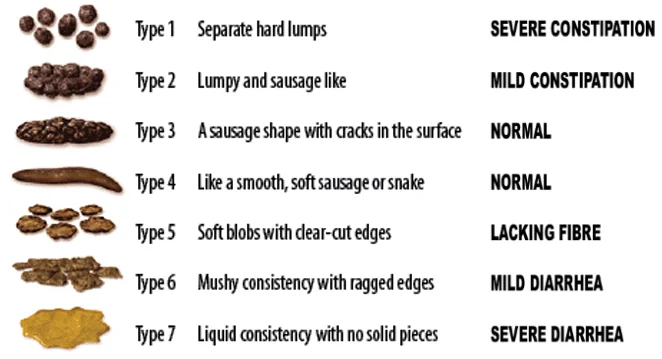
- Frequency, consistency, straining, and sense of incomplete evacuation
- Duration, and whether this is a change from the patient's normal pattern
- Need for digital evacuation or perineal support - suggests a defecatory disorder or rectocele
- Pain on defecation or bright red rectal bleeding - suggests an anal fissure or haemorrhoids
- Associated abdominal pain, bloating, vomiting or distension - consider obstruction
- Overflow diarrhoea: liquid stool leaking around impacted faeces, which is easily mistaken for simple diarrhoea and must not be treated with antimotility agents
- A full drug history, including over-the-counter preparations and analgesia
- Red flag symptoms (see below), and systemic symptoms suggesting hypothyroidism or hypercalcaemia
- Diet, fluid intake, mobility, mood, and toileting circumstances
Examination
Abdominal examination may reveal distension, palpable faecal loading in the left iliac fossa (typically indentable), or a mass. Digital rectal examination is an essential part of the assessment and should not be omitted: it identifies an empty or loaded rectum, hard impacted stool, a rectal mass, anal fissure, haemorrhoids, reduced anal tone, or the paradoxical anal contraction of pelvic floor dyssynergia. Neurological examination, including perianal sensation and anal tone, is required if cauda equina syndrome is a possibility.
Investigations
Most patients with typical functional constipation and no red flags require no investigation, and can be managed on clinical grounds alone.2 Where the history suggests a secondary cause or there are alarm features, consider:
- Full blood count: anaemia would raise concern about colorectal malignancy
- Urea, electrolytes and calcium: to detect hypercalcaemia and hypokalaemia
- Thyroid function tests: to exclude hypothyroidism
- Blood glucose or HbA1c
- Coeliac serology, where the presentation is compatible
- Faecal immunochemical test (FIT) to guide referral in symptomatic patients, per NICE
- Colonoscopy or CT colonography: for red flags, a persistent change in bowel habit, or a positive FIT
- Abdominal X-ray: not routine, but useful to assess faecal loading or to exclude obstruction in acute presentations
- Specialist tests: colonic transit studies, anorectal manometry and defecating proctography for refractory constipation, to distinguish slow transit from an evacuation disorder
Management
Address the cause and lifestyle
Review and, where possible, stop or substitute constipating drugs. Treat any underlying condition such as hypothyroidism or hypercalcaemia. Lifestyle advice forms the foundation of treatment:
- Gradually increase dietary fibre to around 30 g daily, warning that bloating and wind are common initially and settle with time
- Increase fluid intake
- Increase physical activity where feasible
- Advise responding promptly to the urge to defecate, and establishing an unhurried routine, ideally after a meal to exploit the gastrocolic reflex
- Optimise toileting posture: knees raised above the hips, for example using a footstool, with forward lean and relaxed abdominal bracing
Laxatives
Laxatives are introduced stepwise, titrated to produce a soft, formed stool passed without straining, and then gradually withdrawn once a regular habit is established.1
| Class | Examples | Mechanism and notes |
|---|---|---|
| Bulk-forming | Ispaghula husk, methylcellulose, sterculia | Increase faecal mass to stimulate peristalsis. First-line, but need adequate fluid intake and take days to work. Avoid in opioid-induced constipation and in suspected obstruction |
| Osmotic | Macrogols (polyethylene glycol), lactulose, phosphate enemas | Draw water into the bowel lumen. Macrogols are preferred; lactulose commonly causes bloating and flatulence |
| Stimulant | Senna, bisacodyl, sodium picosulfate, glycerol suppositories | Increase intestinal motility. Useful when stool is soft but still difficult to pass. Avoid in suspected obstruction |
| Softeners | Docusate sodium, arachis oil enema | Reduce surface tension, allowing water into the stool. Docusate also has weak stimulant action |
| Secretagogues | Linaclotide, prucalopride, lubiprostone | Specialist options for chronic constipation refractory to at least two conventional laxatives |
| Peripheral opioid antagonists | Naloxegol, methylnaltrexone | For opioid-induced constipation not responding to standard laxatives; block gut opioid receptors without reversing analgesia |
The usual sequence is a bulk-forming laxative first, then adding or switching to an osmotic laxative (typically a macrogol) if stools remain hard, then adding a stimulant laxative if stools are soft but evacuation is still difficult.
Opioid-induced constipation
This deserves separate mention because the approach differs. Bulk-forming laxatives should be avoided, as opioids reduce motility and bulking the stool without restoring propulsion can worsen matters and risks impaction. Use an osmotic laxative combined with a stimulant laxative, and prescribe these prophylactically whenever a strong opioid is started, rather than waiting for constipation to develop.3
Faecal impaction
Suspect impaction where there is a hard faecal mass on rectal or abdominal examination, particularly if there is overflow diarrhoea. Treatment is with high-dose oral macrogols for hard stool; if this fails or the rectum is loaded, add rectal measures - glycerol suppositories or a bisacodyl suppository for soft stool, and an arachis oil retention enema followed by a stimulant enema for hard stool. Manual evacuation is a last resort. Once cleared, patients need maintenance laxatives to prevent recurrence.
Complications
- Faecal impaction and overflow diarrhoea, frequently misdiagnosed as infective diarrhoea
- Haemorrhoids and anal fissure from straining, which in turn worsen constipation through pain and withholding
- Rectal prolapse and pelvic floor damage from chronic straining
- Urinary retention and urinary tract infection from a loaded rectum compressing the bladder
- Stercoral ulceration and perforation - rare but life-threatening, from pressure necrosis by a hard faecal mass
- Sigmoid volvulus, particularly in older, immobile patients with chronic constipation
- Delirium in older adults, in whom constipation is a common precipitant
- Laxative dependence and, with chronic anthraquinone use, melanosis coli (benign and reversible)
- Reduced quality of life, and delayed diagnosis of colorectal cancer if a change in bowel habit is dismissed
Red flags
Prognosis
Most functional constipation responds well to lifestyle modification and appropriate laxative use, and the outlook is good.2 Once a regular habit is re-established, laxatives can usually be tapered and stopped, though patients with an ongoing predisposing factor - opioid therapy, immobility, neurological disease - typically require long-term maintenance treatment.
Chronic constipation tends to be relapsing, and a minority of patients with slow-transit constipation or a defecatory disorder have persistent symptoms requiring specialist assessment, biofeedback therapy for pelvic floor dyssynergia, or rarely surgery. The important clinical principle is not to allow the label of chronic constipation to obscure a new change in symptoms, which always warrants fresh assessment for an underlying cause.
References
- NICE Clinical Knowledge Summaries (CKS). Constipation. 2024. Available here
- Serra J et al. European society of neurogastroenterology and motility guidelines on functional constipation in adults. Neurogastroenterol Motil. 2020. Available here
- BNF. Constipation and bowel cleansing. Available here
- NICE NG12. Suspected cancer: recognition and referral. 2015 (updated 2023). Available here
- Cabot Health, CC BY-SA 3.0, via Wikimedia Commons. Available here
- NHS. Constipation. 2023. Available here
- NICE Clinical Knowledge Summaries (CKS). Palliative care - constipation. 2023. Available here
This article is written for revision and education. It is not clinical guidance and must not be used to make decisions about the care of a patient. Always check current NICE guidance and local protocols.