
Infective Diarrhoea: Organisms, Travel and Public Health
Key points
- Classify by mechanism: non-inflammatory (watery, toxin-mediated) versus inflammatory (bloody, invasive) diarrhoea points quickly towards the likely organism.
- Travellers' diarrhoea: enterotoxigenic E. coli (ETEC) is the commonest cause worldwide; persistent diarrhoea after travel raises Giardia, and dysentery with liver pain raises amoebiasis.
- Antibiotics are the exception, not the rule: most bacterial gastroenteritis is self-limiting; specific indications include severe Campylobacter, Shigella, enteric fever, giardiasis, amoebiasis and cholera - never suspected E. coli O157.
- E. coli O157:H7: avoid antibiotics and antimotility agents - both increase the risk of hemolytic uraemic syndrome by increasing toxin release and gut transit time.
- Notification: infectious bloody diarrhoea and suspected food poisoning are notifiable to UKHSA by the diagnosing clinician, independent of any laboratory report.
- Exclusion: symptomatic food handlers, healthcare workers and children must stay off work or school until 48 hours symptom-free, and longer for E. coli O157 and typhoid.
- Post-infectious complications: Guillain-Barré syndrome after Campylobacter, reactive arthritis after Salmonella, Shigella or Campylobacter, and post-infectious IBS after any of them.
Introduction
Acute diarrhoea and vomiting from infection is common, usually self-limiting, and managed with rehydration alone in the great majority of cases - the general approach to assessment, dehydration and supportive management is covered in the gastroenterology notes on infectious gastroenteritis. This article takes an organism-led view: which pathogen a given history points towards, when that distinction actually changes management, and the public health duties that a positive stool culture or a notifiable diagnosis creates - all high-yield UKMLA territory that a purely symptom-based approach can miss.
A simple mechanistic split is worth holding in mind throughout: non-inflammatory (secretory) diarrhoea is watery, caused by a toxin acting on the small bowel without invading it, and is typically less unwell-making; inflammatory (invasive) diarrhoea is bloody, caused by an organism directly damaging the colonic mucosa, and is more often associated with fever, tenesmus and systemic upset.
Bacterial causes by exposure and clinical clue
The history - what was eaten, where, and how soon symptoms began - does most of the diagnostic work before any test result comes back.
| Organism | Typical exposure | Clue |
|---|---|---|
| Enterotoxigenic E. coli (ETEC) | Travel to a resource-limited setting | Commonest single cause of travellers' diarrhoea; watery, non-bloody |
| Campylobacter jejuni | Undercooked poultry, unpasteurised milk | Commonest bacterial cause of gastroenteritis in the UK; can be bloody; abdominal pain can mimic appendicitis |
| Salmonella (non-typhoidal) | Poultry, eggs, reptiles | Watery or bloody diarrhoea; can bacteraemically seed bone, joints or an aortic aneurysm, especially in sickle cell disease or the elderly |
| Shigella | Faeco-oral spread, low infective dose - person-to-person and via contaminated food/water | Bloody diarrhoea with severe cramping and tenesmus; a recognised trigger of reactive arthritis and haemolytic uraemic syndrome |
| Shiga toxin-producing E. coli (STEC/EHEC), notably O157:H7 | Undercooked beef, unpasteurised milk, contact with farm animals or contaminated water | Bloody diarrhoea progressing to haemolytic uraemic syndrome in a minority, especially children - antibiotics are avoided |
| Vibrio cholerae | Contaminated water in endemic or outbreak settings (rare in returning UK travellers) | Profuse, painless 'rice water' stool and severe, rapid dehydration |
| Bacillus cereus | Reheated rice | Two syndromes: rapid-onset vomiting from a preformed toxin, or a later diarrhoeal illness |
| Staphylococcus aureus | Cream, cold meats, preformed toxin | Vomiting within 1-6 hours of eating - too fast to be an infection taking hold, since it is toxin already present in the food |
| Listeria monocytogenes | Unpasteurised dairy, pâté, deli meats | Mild gastroenteritis in most, but can cause invasive infection and miscarriage in pregnancy - important to ask about in antenatal advice |
Protozoal and parasitic causes
These typically cause more prolonged illness than a straightforward bacterial infection and should be actively considered when diarrhoea persists beyond 2 weeks, particularly with a travel history.
Giardia lamblia
Acquired from contaminated water, including in the UK from streams and lakes, as well as abroad. Causes prolonged, greasy, foul-smelling, non-bloody diarrhoea with bloating and flatulence, reflecting malabsorption rather than mucosal invasion - there is no fever and no blood in the stool. Diagnosed on stool microscopy for cysts and trophozoites (often needing repeat samples) or stool antigen testing, and treated with metronidazole.
Entamoeba histolytica (amoebiasis)
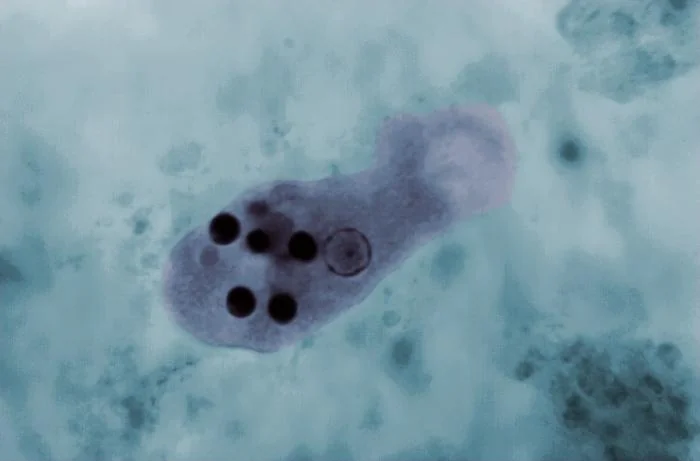
Causes amoebic dysentery - bloody diarrhoea with abdominal pain, which can mimic ulcerative colitis clinically and endoscopically. Its most important complication is an amoebic liver abscess, presenting with fever and right upper quadrant pain, often without concurrent diarrhoea, weeks to months after the original exposure. Diagnosis is by stool microscopy or antigen testing, and serology or aspirate analysis for suspected liver abscess; treatment is metronidazole followed by a luminal agent (such as paromomycin) to clear intestinal cysts and prevent relapse.
Cryptosporidium
Acquired from contaminated water, including swimming pools, and from contact with farm animals. Causes watery diarrhoea that is usually self-limiting in an immunocompetent host but can be severe, prolonged and life-threatening in advanced HIV or other significant immunosuppression - a recognised AIDS-defining illness when chronic. Diagnosed with a modified Ziehl-Neelsen stain or antigen testing on stool.
Travellers' diarrhoea
Affects a substantial proportion of travellers to resource-limited settings, most often within the first 2 weeks of a trip. Enterotoxigenic E. coli (ETEC) is the single commonest cause worldwide, with Campylobacter, Salmonella, Shigella and norovirus all contributing, and Giardia or amoebiasis worth considering if symptoms persist beyond 2 weeks.
- Prevention - safe food and water precautions ("boil it, cook it, peel it, or forget it"), though adherence in practice is poor and prevention is only partially effective
- Self-treatment - oral rehydration is the mainstay; loperamide can be used for watery, non-bloody diarrhoea without fever to control symptoms, but should be avoided if there is blood, mucus or fever, where it risks worsening an invasive infection
- Standby antibiotics - a short course, typically azithromycin, may be advised for travellers to high-risk areas or with certain medical conditions, to self-treat moderate-to-severe diarrhoea; fluoroquinolones are used less now given rising resistance, particularly in Campylobacter acquired in South and Southeast Asia
Investigations
- Stool culture (and PCR panel where available) - for anyone with bloody diarrhoea, systemic illness, recent hospitalisation or antibiotic use, or occupational risk (food handlers, healthcare workers)
- Stool microscopy for ova, cysts and parasites - for persistent diarrhoea or a relevant travel or exposure history, ideally three samples
- Clostridioides difficile toxin testing - for diarrhoea developing after recent antibiotic use or in hospital, covered in its own article
- Blood cultures - if there are features of bacteraemia or sepsis, particularly relevant to invasive Salmonella
- U&Es and FBC - to assess dehydration and, in suspected STEC infection, to monitor for the platelet fall and rising creatinine of evolving haemolytic uraemic syndrome
- Group and travel-specific tests - thick and thin films for malaria, and blood cultures for enteric fever, in anyone unwell after travel to an endemic area, since these can present with diarrhoea and must not be missed
When antibiotics actually help
Most bacterial gastroenteritis is self-limiting and antibiotics make no difference to its course, so the default is supportive care alone. There are, however, specific situations where antibiotics change the outcome, and knowing them - rather than treating every positive stool culture - is the point being tested.
| Situation | Typical choice |
|---|---|
| Severe or prolonged Campylobacter (within the first few days of illness) | Clarithromycin |
| Shigella, in severe disease or an outbreak/vulnerable setting | Ciprofloxacin or azithromycin, per sensitivities |
| Enteric fever (typhoid/paratyphoid) | Ceftriaxone or azithromycin, guided by sensitivity given rising resistance |
| Giardiasis and amoebiasis | Metronidazole |
| Cholera, in moderate-severe disease | Doxycycline (single dose) alongside aggressive rehydration |
| Travellers' diarrhoea, moderate-severe, in a traveller with access to standby treatment | Azithromycin, given rising fluoroquinolone resistance in Campylobacter |
| Invasive/bacteraemic non-typhoidal Salmonella, or infection in the immunosuppressed, infants or the elderly | Directed by sensitivities |
Public health and infection control
Infective diarrhoea is not only a clinical problem: several duties follow a diagnosis, and forgetting them is a common way to lose marks in an otherwise sound clinical answer.
- Notification - clinically suspected food poisoning and infectious bloody diarrhoea are notifiable to UKHSA by the diagnosing clinician, independent of any laboratory confirmation, using the statutory notification of infectious disease process
- Exclusion from work or school - symptomatic food handlers, healthcare workers and children should stay away until 48 hours after symptoms have fully resolved; E. coli O157 and typhoid/paratyphoid require longer exclusion and microbiological clearance, agreed with the local health protection team
- Infection control on wards - patients with suspected infective diarrhoea are isolated in a side room, and staff use soap and water rather than alcohol gel for hand hygiene, since alcohol does not reliably kill norovirus or C. difficile spores
- Outbreak recognition - two or more linked cases should prompt early involvement of the local health protection team, particularly where a shared food source, water supply or institutional setting (a care home, school or cruise ship) is suspected
Complications
- Haemolytic uraemic syndrome - thrombocytopenia, microangiopathic haemolytic anaemia and acute kidney injury, mainly after Shiga toxin-producing E. coli or Shigella infection in young children
- Guillain-Barré syndrome - can follow Campylobacter jejuni infection by 1-3 weeks, one of the best-recognised infectious triggers of this condition
- Reactive arthritis - after Salmonella, Shigella, Campylobacter or Yersinia, classically with the triad of arthritis, conjunctivitis and urethritis
- Post-infectious irritable bowel syndrome - can follow any significant episode of infective diarrhoea
- Amoebic liver abscess and, rarely, other extra-intestinal amoebiasis
- Bacteraemia and metastatic infection - particularly non-typhoidal Salmonella seeding bone, joints or a diseased aorta
Red flags
Prognosis
Most infective diarrhoea resolves within a week with supportive care alone. Outcomes are driven less by the organism itself than by how well dehydration is managed and how promptly complications - haemolytic uraemic syndrome, bacteraemia, an amoebic liver abscess - are recognised when they do occur. Persistent symptoms beyond 2-4 weeks warrant a fresh look for a parasitic cause, post-infectious IBS, or an alternative, non-infective diagnosis.
References
- NICE Clinical Knowledge Summaries. Gastroenteritis. Available here
- UK Health Security Agency. Notifiable diseases and causative organisms: how to report. Available here
- Public Health England / UKHSA. Guidelines for the public health management of gastrointestinal infections. Available here
- NICE NG13. Diarrhoea and vomiting caused by gastroenteritis in under 5s: diagnosis and management. Available here
- National Travel Health Network and Centre (TravelHealthPro). Travellers' diarrhoea factsheet. Available here
- World Health Organization. Cholera fact sheet. Available here
This article is written for revision and education. It is not clinical guidance and must not be used to make decisions about the care of a patient. Always check current NICE guidance and local protocols.