
Psoriasis
Key points
- Psoriasis: a chronic, immune-mediated papulosquamous skin disease causing well-demarcated, erythematous plaques with silvery scale, driven by keratinocyte hyperproliferation and a Th17-predominant immune response.
- Chronic plaque psoriasis: the commonest subtype (80-90% of cases), typically affecting the extensor surfaces (elbows, knees), scalp and lower back.
- Koebner phenomenon: new psoriatic plaques appearing at sites of skin trauma - scratches, scars, sunburn - roughly 10-14 days later.
- Nail involvement: pitting, onycholysis and the oil-drop sign are common, and nail disease is strongly associated with psoriatic arthritis.
- Psoriatic arthritis: develops in up to 30% of patients with skin psoriasis, can precede skin disease, and should be screened for at every review.
- Diagnosis: clinical, based on morphology and distribution; biopsy is reserved for atypical or diagnostically uncertain cases.
- Management ladder: emollients throughout, then topical vitamin D analogues and corticosteroids first-line, phototherapy second-line, and systemic or biologic therapy for severe or refractory disease.
- Red flag: generalised pustular psoriasis and erythrodermic psoriasis are dermatological emergencies with systemic complications and require urgent admission.
Introduction
Psoriasis is a chronic, immune-mediated inflammatory disease of the skin, affecting around 2% of the UK population. It runs a relapsing and remitting course over decades, most commonly starting in early adulthood, with a smaller peak of onset later in life.1
It is far more than a cosmetic skin condition. Psoriasis is associated with an inflammatory arthritis in a substantial minority of patients, with an increased risk of cardiovascular disease and metabolic syndrome, and with a considerable psychological burden that is often disproportionate to the visible extent of the skin disease. Recognising and treating psoriasis therefore means looking well beyond the plaques themselves.
Several distinct clinical patterns exist, and correctly naming the subtype matters because triggers, associations and treatment differ between them.
Pathophysiology
Psoriasis arises from a combination of genetic susceptibility and immune dysregulation, usually set off by an environmental trigger in a predisposed individual.
Genetics
Around a third of patients have an affected first-degree relative. The strongest single genetic association is with HLA-Cw6 at the PSORS1 locus, and genome-wide association studies have also implicated genes in the IL-23/Th17 signalling pathway, directly explaining why drugs targeting this pathway are so effective.4
Immune-mediated inflammation
In genetically susceptible skin, a triggering event activates dendritic cells, which produce IL-23. IL-23 drives differentiation and expansion of Th17 cells, which release IL-17 and IL-22. These cytokines act on keratinocytes to accelerate their proliferation and shorten the normal skin turnover time from around 28 days to as little as 3-5 days. Keratinocytes cannot mature properly at this pace, retaining their nuclei in the stratum corneum (parakeratosis) and producing the thickened, scaly plaque seen clinically.5
This IL-23/Th17 axis is now the central target of modern biologic therapy: drugs blocking IL-17, IL-23 or their shared subunit IL-12/23p40 produce some of the highest response rates seen in any inflammatory skin disease.
Triggers and precipitants
- Streptococcal throat infection - classically precipitates guttate psoriasis in children and young adults
- Skin trauma - the Koebner phenomenon, producing new plaques at the site of injury
- Drugs - beta-blockers, lithium, antimalarials (chloroquine, hydroxychloroquine), and NSAIDs can all induce or worsen psoriasis
- Withdrawal of systemic corticosteroids - can precipitate a severe flare or pustular psoriasis
- Alcohol excess and smoking
- Psychological stress
- HIV infection - associated with unusually severe or treatment-resistant psoriasis
Clinical features
Several clinically distinct patterns of psoriasis exist, and recognising which one you are looking at changes both the differential diagnosis and the management plan.
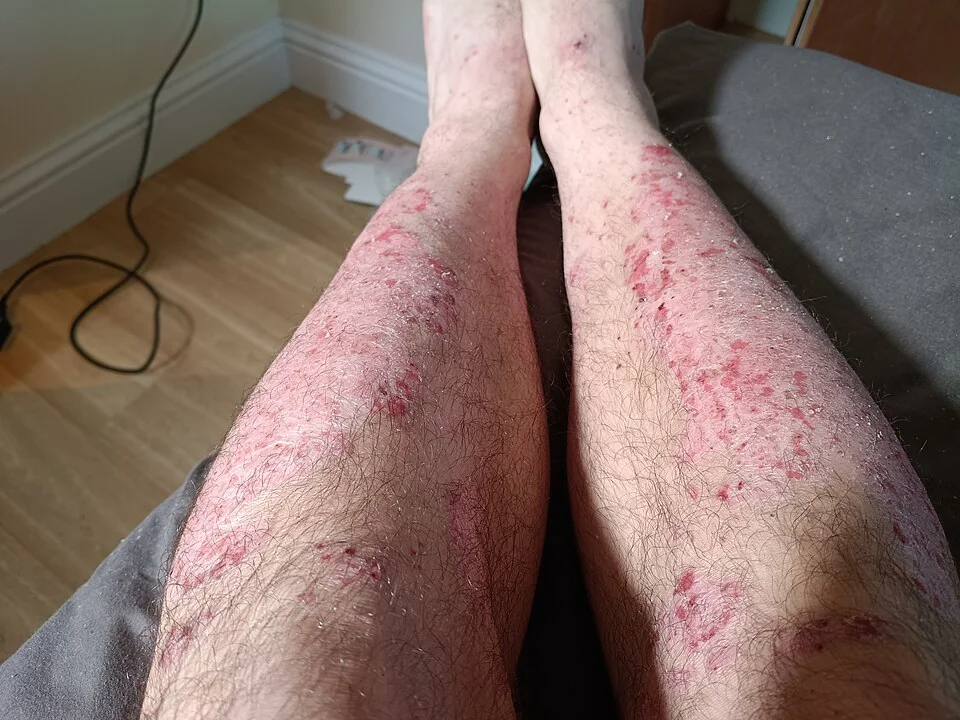
| Subtype | Features |
|---|---|
| Chronic plaque (80-90%) | Well-demarcated, raised, erythematous plaques with silvery scale on extensor surfaces (elbows, knees), scalp and lower back |
| Guttate | Numerous small (0.5-1.5 cm), 'raindrop'-shaped papules over the trunk and proximal limbs, typically 2-4 weeks after streptococcal pharyngitis, mainly in children and young adults |
| Flexural (inverse) | Smooth, well-demarcated erythema in the axillae, groin and submammary folds, with little or no scale because of moisture in these sites |
| Pustular (localised) | Sterile pustules on an erythematous base, classically palmoplantar |
| Pustular (generalised - von Zumbusch) | Widespread sterile pustules with fever and systemic upset - a dermatological emergency |
| Erythrodermic | Widespread erythema affecting over 90% of the body surface, with fine scale and loss of normal skin function - a dermatological emergency |
Nail changes
Nail involvement occurs in up to half of patients with skin psoriasis and is even more prevalent in those with psoriatic arthritis, making the nails worth examining at every review.
- Pitting - small depressions in the nail plate from disordered keratinisation of the proximal nail matrix
- Onycholysis - separation of the nail plate from the nail bed, often with a distal yellow-brown border
- Oil-drop (salmon-patch) sign - a yellow-brown discolouration under the nail plate from psoriasis of the nail bed
- Subungual hyperkeratosis - thickened, crumbly material beneath the nail
- Nail plate crumbling - in severe disease, the whole nail can become friable and disrupted
Other features
- Auspitz sign - pinpoint bleeding when scale is gently removed, reflecting the thinned suprapapillary epidermis over dilated dermal capillaries
- Scalp involvement - well-demarcated, scaly plaques, often extending just beyond the hairline, distinguishing it from seborrhoeic dermatitis
- Itch and soreness - psoriasis is often assumed to be asymptomatic, but itch is reported by the majority of patients and can be severe
Clinical examination
Examine the whole skin, not just the area the patient mentions, plus the scalp, nails and joints.
- Extent and distribution - percentage of body surface area affected, using the patient's palm (roughly 1% of body surface area) as a rough guide
- Morphology - plaque thickness, scale, and whether pustules or erythroderma are present
- Nails - pitting, onycholysis, oil-drop sign, subungual hyperkeratosis
- Joints - swelling, tenderness, dactylitis ('sausage digit'), enthesitis (particularly at the Achilles tendon or plantar fascia), and reduced spinal movement, screening for psoriatic arthritis
- Impact on quality of life - ask directly about mood, sleep and social or occupational impact, since these are often underestimated on examination alone
Differential diagnosis
- Seborrhoeic dermatitis - greasy scale in the scalp, eyebrows and nasolabial folds, less well demarcated than psoriasis
- Eczema (discoid or chronic) - more itchy, less sharply demarcated, and usually with a personal or family history of atopy
- Tinea corporis - an expanding annular lesion with an active scaly edge, usually a single or few lesions rather than symmetrical plaques
- Lichen planus - violaceous, flat-topped, itchy papules, often with fine white surface streaks (Wickham striae) rather than silvery scale
- Pityriasis rosea - an initial herald patch followed by smaller oval lesions in a 'Christmas tree' distribution on the trunk, generally self-limiting
- Cutaneous T cell lymphoma (mycosis fungoides) - can mimic chronic plaque psoriasis but tends to be more resistant to standard treatment and requires biopsy if suspected
Investigations
Psoriasis is diagnosed clinically from its characteristic morphology and distribution; investigations are used to support management decisions rather than to make the diagnosis.
- Skin biopsy - reserved for atypical presentations or where cutaneous T cell lymphoma is a concern
- Throat swab and antistreptolysin O titre - if guttate psoriasis suggests a preceding streptococcal infection
- Baseline bloods before systemic therapy - FBC, U&Es, LFTs, and a lipid profile and HbA1c given the association with metabolic syndrome
- Screening for latent tuberculosis and hepatitis B/C - before starting biologic therapy
- Severity scoring - the Psoriasis Area and Severity Index (PASI) and body surface area are used in secondary care to grade severity and to determine eligibility for systemic and biologic therapy under NICE criteria
Management
Treatment follows a stepwise ladder, moving up when the previous step fails to control the disease adequately, and always continuing emollients throughout.2
Topical therapy - first line
- Emollients for all patients, to soften scale and reduce irritation
- Vitamin D analogues (calcipotriol) - first-line anti-proliferative treatment, often combined with a potent topical corticosteroid in a single preparation for once-daily use7
- Topical corticosteroids - potent preparations for the trunk and limbs, milder preparations for the face and flexures; used for a maximum of around 4-8 weeks continuously to reduce the risk of tachyphylaxis and skin atrophy
- Coal tar and dithranol preparations - older but still useful, especially for thick, chronic plaques, though messy and less well tolerated
- Topical treatment for the scalp - tar-based or corticosteroid shampoos and scalp preparations for scalp plaques
Phototherapy - second line
Narrowband UVB is used for widespread plaque or guttate psoriasis not controlled by topical treatment. PUVA (psoralen plus UVA) is more effective but carries a higher long-term skin cancer risk and is reserved for resistant disease.
Systemic and biologic therapy - severe or refractory disease
- Methotrexate - first-line systemic agent for most patients, also useful where psoriatic arthritis coexists; requires monitoring of FBC and LFTs and folic acid co-prescription
- Ciclosporin - rapid-acting, useful for severe flares, but nephrotoxic and hypertensive with long-term use, so generally used for shorter courses
- Acitretin - an oral retinoid, useful particularly in pustular psoriasis, but teratogenic and requires reliable contraception for a prolonged period afterwards
- Biologic therapy - TNF-alpha inhibitors (adalimumab, etanercept), IL-17 inhibitors (secukinumab, ixekizumab) and IL-23 inhibitors (guselkumab, risankizumab) for moderate-to-severe disease meeting NICE severity and treatment-failure criteria, chosen partly on the basis of coexisting psoriatic arthritis3
Complications
- Psoriatic arthritis - an inflammatory arthritis affecting up to 30% of patients with skin psoriasis; it can precede, coincide with, or follow skin disease, and the CASPAR criteria are used to support diagnosis6
- Cardiovascular disease and metabolic syndrome - psoriasis is an independent risk factor for myocardial infarction, obesity, type 2 diabetes and hypertension, thought to reflect shared inflammatory pathways
- Psychological impact - depression, anxiety and reduced quality of life are common and correlate poorly with the objective extent of skin disease; psoriasis has been shown to impair quality of life to a similar degree as other major chronic illnesses8
- Secondary bacterial infection of fissured or excoriated plaques
- Treatment-related complications - skin atrophy from prolonged potent topical steroid use, and the specific toxicities of each systemic agent (hepatotoxicity with methotrexate, nephrotoxicity with ciclosporin, teratogenicity with acitretin)
Red flags
Prognosis
Psoriasis is a lifelong, relapsing condition for most patients, though its severity fluctuates considerably over time and with treatment. Guttate psoriasis following a streptococcal infection often resolves completely within weeks to months, though around a third of patients go on to develop chronic plaque disease later in life.
With the current topical, phototherapy and systemic ladder - and particularly since the introduction of IL-17 and IL-23 inhibitors - the great majority of patients with even severe disease can now achieve near-clear or clear skin, a marked change from the outlook a generation ago. The main determinants of long-term outcome are the timely recognition of psoriatic arthritis, since delayed treatment allows irreversible joint damage, and attention to cardiovascular risk factors, which meaningfully affects mortality in this population.
References
- NICE Clinical Knowledge Summaries. Psoriasis. Available here
- NICE CG153. Psoriasis: assessment and management. 2012, updated 2017. Available here
- British Association of Dermatologists. Guidelines for biologic therapy for psoriasis. 2020. Available here
- Nair RP, Duffin KC, Helms C et al. Genome-wide scan reveals association of psoriasis with IL-23 and NF-kB pathways. Nature Genetics. 2009. Available here
- Griffiths CE, Barker JN. Pathogenesis and clinical features of psoriasis. The Lancet. 2007. Available here
- Taylor W, Gladman D, Helliwell P et al. Classification criteria for psoriatic arthritis: development of new criteria from a large international study (CASPAR). Arthritis & Rheumatism. 2006. Available here
- BNF. Psoriasis - treatment summary. Available here
- Rapp SR, Feldman SR, Exum ML et al. Psoriasis causes as much disability as other major medical diseases. Journal of the American Academy of Dermatology. 1999. Available here
This article is written for revision and education. It is not clinical guidance and must not be used to make decisions about the care of a patient. Always check current NICE guidance and local protocols.