
Contact Dermatitis
Key points
- Contact dermatitis: an inflammatory skin reaction caused by direct contact with an external substance, split into irritant and allergic subtypes with different mechanisms and management.
- Irritant contact dermatitis: the commoner type (around 80% of cases), caused by direct chemical or physical damage to the skin barrier. It is dose-dependent and needs no prior sensitisation - anyone exposed for long enough can develop it.
- Allergic contact dermatitis: a type IV, T cell-mediated delayed hypersensitivity reaction to a specific hapten, requiring prior sensitisation. Onset is typically 24-72 hours after re-exposure.
- The key clue: distribution. A rash confined to the hands, earlobes, wrist, or under a ring or watch strap points straight at what has touched that site.
- Diagnosis: clinical history and examination, with patch testing to confirm and identify the specific allergen in suspected allergic contact dermatitis.
- Common allergens: nickel, chromate (cement), rubber accelerators, fragrances, preservatives, and para-phenylenediamine (PPD) in hair dye and henna tattoos.
- Management: identify and avoid the trigger, emollients and a soap substitute, and a topical corticosteroid matched to severity for the acute reaction.
- Occupational disease: hand dermatitis is a leading cause of time off work in hairdressing, healthcare, catering and construction, and is reportable under RIDDOR and eligible for Industrial Injuries Disablement Benefit.
Introduction
Contact dermatitis is inflammation of the skin caused by direct contact with a substance in the environment. It is one of the commonest reasons for a dermatology referral and the leading cause of occupational skin disease in the UK, with hairdressers, healthcare workers, cleaners and construction workers particularly affected.1
The term covers two mechanistically distinct conditions that can look identical on the skin: irritant contact dermatitis, a direct toxic effect on the skin barrier, and allergic contact dermatitis, a delayed (type IV) hypersensitivity reaction to a specific substance. Distinguishing them matters because irritant disease is managed by protecting the skin from a broadly damaging exposure, while allergic disease requires identifying and permanently avoiding one specific culprit, usually found through patch testing.
Both are common, both can coexist in the same patient, and both are frequently mistaken for - or complicate - atopic dermatitis, so a careful history of what has actually touched the affected skin is the single most useful diagnostic step.
Pathophysiology
Irritant contact dermatitis
Irritant contact dermatitis is a direct, non-immunological toxic effect on keratinocytes and the skin barrier. Repeated exposure to detergents, solvents, water, friction or acids strips lipids from the stratum corneum, increases transepidermal water loss and provokes a local inflammatory response. No prior sensitisation is needed, the reaction is broadly dose- and duration-dependent, and it can affect anyone given sufficient exposure - it is the pattern seen in a healthcare worker who washes and gloves their hands dozens of times a shift.
Allergic contact dermatitis
Allergic contact dermatitis is a type IV, delayed-type hypersensitivity reaction, mediated by allergen-specific T cells rather than antibodies. A small molecule (hapten) penetrates the skin and binds to a carrier protein; Langerhans cells process and present this hapten-protein complex to naive T cells in the regional lymph nodes, generating a population of memory T cells over one to three weeks (the sensitisation phase). On subsequent contact with the same allergen, these memory T cells are recruited into the skin and release cytokines that produce the visible eczematous reaction within 24-72 hours (the elicitation phase).8
Because sensitisation must occur first, allergic contact dermatitis typically follows months or years of uneventful exposure to a product before it suddenly develops - a detail that surprises patients who are certain a familiar product 'has never caused a problem before'.
| Irritant | Allergic | |
|---|---|---|
| Mechanism | Direct toxic damage to the skin barrier | Type IV, T cell-mediated hypersensitivity |
| Sensitisation required | No | Yes, over weeks to years |
| Onset after exposure | Minutes to hours; graded with dose | 24-72 hours after re-exposure in a sensitised person |
| Typical distribution | Confined to the exposed area, sharply marginated | May extend beyond the contact site; can be more diffuse |
| Confirmatory test | None - clinical diagnosis | Patch testing |
Common causes and occupations
Certain substances and occupations recur so often in both practice and exams that they are worth learning as pairs.
Irritants
- Water, soap and detergents - the commonest cause, seen with frequent hand washing
- Solvents and degreasing agents
- Acids and alkalis
- Friction and occlusion, for example from gloves worn for long periods
- Wet work generally, which is why hand dermatitis is so strongly linked to healthcare, catering and cleaning
Allergens
- Nickel - jewellery, belt buckles, buttons; the commonest contact allergen tested for in Europe and the classic cause of a rash under a watch strap, earrings or a jean stud
- Chromate - cement, leather tanning; a classic cause of hand and lower leg dermatitis in builders
- Rubber accelerators (thiurams, carbamates) - gloves and footwear
- Fragrances and preservatives - cosmetics, moisturisers and wet wipes; an important and frequently overlooked cause when a patient's 'sensitive skin' product is itself the trigger
- Para-phenylenediamine (PPD) - permanent hair dye and 'black henna' temporary tattoos, a well-recognised cause of severe facial and scalp reactions
- Topical medicaments - neomycin, lanolin and topical corticosteroid vehicles themselves, which is why a dermatitis that worsens despite treatment should prompt suspicion of the treatment5
Clinical features
Distribution is the single most useful diagnostic feature and should be mapped against a careful occupational, cosmetic and hobby history.
| Site | Suggests |
|---|---|
| Hands, especially the finger webs and dorsa | Wet work, gloves, occupational irritants or rubber accelerators |
| Earlobes, wrist, umbilicus, or under a belt buckle | Nickel |
| Eyelids | Transferred allergen from the hands, or an airborne allergen |
| Scalp margin and ears | Hair dye (PPD), shampoo |
| Feet, especially the dorsum | Footwear - rubber, leather tanning agents or adhesives |
| Anywhere under an adhesive dressing or transdermal patch | Adhesive or the medication itself |
In an acute reaction, expect erythema, oedema, and papulovesicles that can weep or blister in severe cases, with sharp margins in irritant disease corresponding closely to the area of contact. Chronic contact dermatitis instead shows dryness, scaling, fissuring and lichenification from repeated low-grade exposure and scratching - the pattern typically seen in long-standing occupational hand dermatitis.
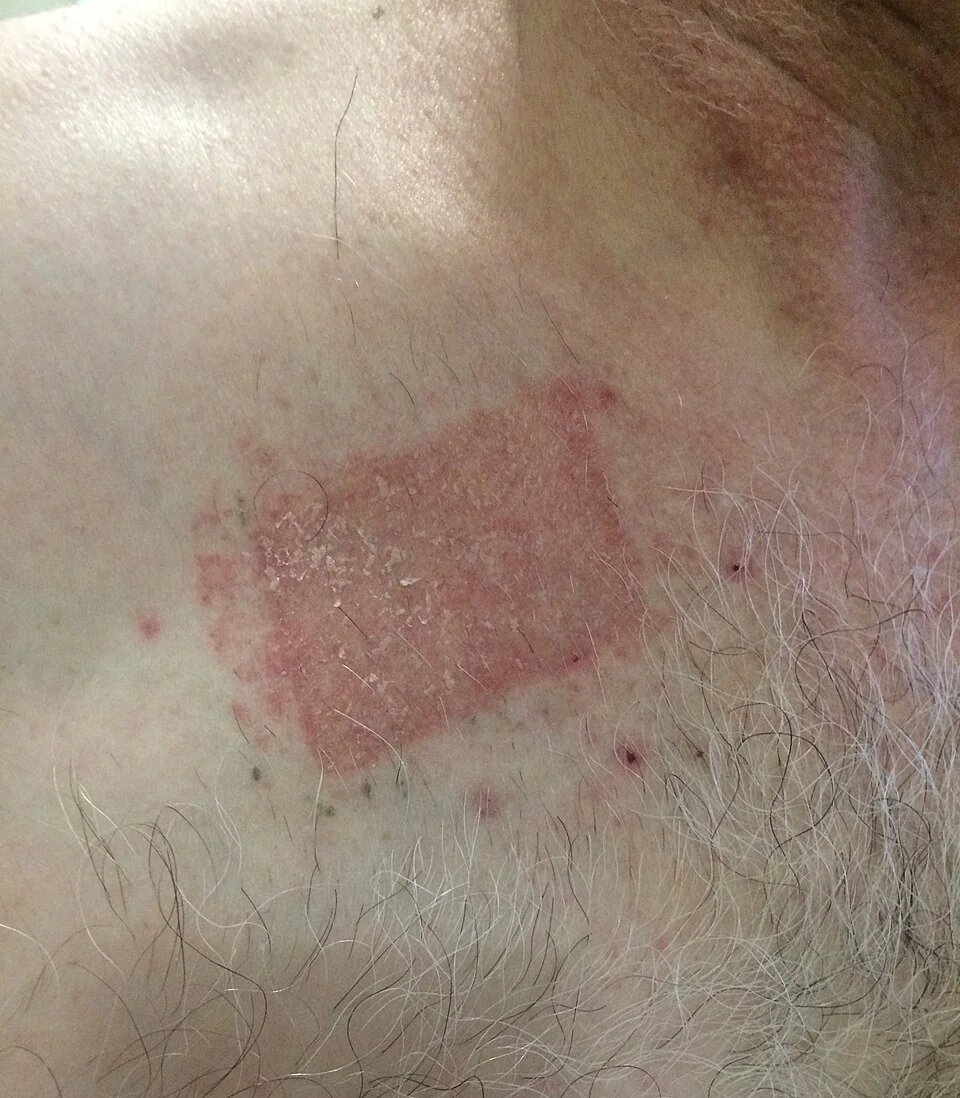
Itch is prominent in allergic contact dermatitis; irritant reactions can be itchy but are often described as sore, burning or stinging rather than itchy, particularly with a caustic or solvent exposure.
Clinical examination
Examine the full distribution of the rash, not just the area the patient points to, and specifically look at the hands, since occupational and allergic contact dermatitis so often starts or is worst there.
- Distribution and margination - sharply demarcated and confined to an exposed area favours a contact cause
- Morphology - acute weeping/vesicular versus chronic dry/fissured/lichenified change
- Signs of secondary bacterial infection - increased weeping, crusting, or spreading erythema
- Jewellery, watches and clothing fastenings currently worn, checked against the distribution
- Occupation and hobbies - ask directly what the hands touch during a typical working day
Differential diagnosis
- Atopic dermatitis - a personal or family history of atopy, and a distribution favouring the flexures rather than an area of specific external contact
- Seborrhoeic dermatitis - scalp, eyebrows and nasolabial folds, with greasy scale
- Psoriasis - well-demarcated plaques with silvery scale, classically on extensor surfaces and the scalp
- Tinea (dermatophyte infection) - an expanding, annular lesion with an active scaly edge, especially on the feet or groin
- Scabies - widespread itch, burrows in the finger webs, and a household contact history
- Dyshidrotic eczema (pompholyx) - intensely itchy vesicles on the palms, soles and finger sides, which can be triggered or worsened by irritants but is a distinct pattern
- Cellulitis - unilateral warmth, spreading erythema and systemic upset, rather than the bilateral, symmetrical pattern typical of contact dermatitis
Investigations
Irritant contact dermatitis is a clinical diagnosis based on history and distribution; there is no confirmatory test. Where allergic contact dermatitis is suspected, or where a dermatitis fails to settle despite avoiding the obvious suspects, patch testing is the investigation of choice.2,3
Patch testing
Small quantities of standardised allergens, at concentrations chosen to elicit a reaction only in someone already sensitised, are applied to the back in adhesive chambers and left in place for 48 hours. The skin is then read for a reaction at removal and again at 72-96 hours, since a positive reaction can appear or evolve after the patches come off.
- A baseline series (the European baseline series in the UK) screens for the commonest allergens - nickel, fragrance mix, rubber chemicals, preservatives and others
- Extended or bespoke series are added when the history suggests a specific occupational or cosmetic exposure - for example a hairdressing or a corticosteroid series
- A positive patch test must be interpreted in the context of current or past relevance - a positive reaction to an allergen the patient has never encountered is of academic rather than practical interest
- Patients should stop topical corticosteroids and oral immunosuppressants before testing, as these can suppress the reaction and produce a false negative
Management
Management follows the same broad principles regardless of subtype, with allergen avoidance added where a specific allergic trigger has been identified.
- Identify and avoid the trigger - the single most important step in allergic contact dermatitis, and the reason patch testing is worth pursuing even when it delays a prescription
- Emollients used liberally as a leave-on treatment and soap substitute, to restore the barrier and reduce further irritant exposure from washing itself
- Topical corticosteroids, potency matched to site and severity as in atopic dermatitis, for the acute inflammatory reaction
- Protective measures at work - cotton glove liners under rubber or vinyl gloves, glove changes during long shifts, and barrier creams before wet work
- Short course of oral corticosteroids for severe, widespread acute reactions, for example extensive allergic contact dermatitis to a plant or a hair dye
- Treat secondary bacterial infection if present, usually with a course of flucloxacillin
Occupational referral
Occupational hand dermatitis that persists despite treatment, or that clearly relates to a specific job, should prompt referral to occupational health. Employers have a duty under UK health and safety law to assess and reduce skin exposure risks, and cases meeting the criteria are reportable under RIDDOR (Reporting of Injuries, Diseases and Dangerous Occurrences Regulations) and may be eligible for Industrial Injuries Disablement Benefit.4,6 Persistent occupational contact dermatitis is a common cause of job loss or change of role if not addressed early, which makes early recognition and workplace modification as important as the topical treatment itself.
Complications
- Secondary bacterial infection, usually staphylococcal, presenting as increased weeping, crusting or pain
- Chronic lichenified hand dermatitis from ongoing low-grade exposure, which can be difficult to reverse once established
- Id reaction (autosensitisation) - a widespread, symmetrical eczematous eruption at sites distant from the original contact area, thought to reflect a systemic immune response to a localised allergic reaction
- Occupational disability and job loss where hand dermatitis is not recognised and modified early
- Post-inflammatory hyper- or hypopigmentation, which can be prominent and persistent in darker skin tones
Red flags
Prognosis
Irritant contact dermatitis generally resolves once the offending exposure is reduced or protected against, though chronic hand dermatitis in someone who cannot avoid wet work at all can become a long-term, relapsing problem. Allergic contact dermatitis resolves reliably once the specific allergen is identified and avoided, but symptoms recur promptly on re-exposure, sometimes for life, since sensitisation is generally permanent.7
The practical outlook therefore depends less on the skin itself and more on how completely the trigger can be removed from daily life - a straightforward matter for a nickel-allergic patient avoiding cheap jewellery, and a much harder one for a hairdresser sensitised to a chemical central to their trade, where a change of occupation is sometimes the only durable solution.
References
- NICE Clinical Knowledge Summaries. Dermatitis - contact. Available here
- British Association of Dermatologists. Patch testing patient information leaflet. Available here
- British Society for Cutaneous Allergy. Patch test guidelines. Available here
- Health and Safety Executive. Occupational dermatitis. Available here
- DermNet NZ. Allergic contact dermatitis. Available here
- GOV.UK. Industrial Injuries Disablement Benefit. Available here
- Diepgen TL, Coenraads PJ. The epidemiology of occupational contact dermatitis. International Archives of Occupational and Environmental Health. 1999. Available here
- BNF. Corticosteroids - topical. Available here
This article is written for revision and education. It is not clinical guidance and must not be used to make decisions about the care of a patient. Always check current NICE guidance and local protocols.