
Hypoparathyroidism: Recognising and Treating Symptomatic Hypocalcaemia
Key points
- Hypoparathyroidism: insufficient or absent PTH secretion, causing hypocalcaemia with a raised phosphate - the opposite biochemical pattern to primary hyperparathyroidism.
- Commonest cause: post-surgical, following thyroidectomy or parathyroidectomy, either from inadvertent removal or devascularisation of the parathyroid glands.
- Other causes: autoimmune disease (sometimes as part of autoimmune polyendocrine syndrome type 1), DiGeorge syndrome (22q11 deletion), severe hypomagnesaemia, and neck irradiation.
- Pseudohypoparathyroidism: a distinct condition of end-organ PTH resistance - PTH is high but calcium is low, often with the skeletal features of Albright hereditary osteodystrophy.
- Clinical features: neuromuscular excitability - paraesthesiae, cramps, tetany, Chvostek's and Trousseau's signs - and in severe cases seizures, laryngospasm and a prolonged QT interval.
- Acute severe management: IV calcium gluconate with cardiac monitoring.
- Chronic management: oral calcium plus an active vitamin D analogue (alfacalcidol or calcitriol) - plain vitamin D is ineffective because activation normally depends on PTH-stimulated renal 1-alpha-hydroxylase.
- Correct magnesium first: hypocalcaemia will not resolve until hypomagnesaemia is corrected, because magnesium is required for PTH secretion and action.
Introduction
Hypoparathyroidism is a state of insufficient or absent parathyroid hormone (PTH), leading to hypocalcaemia with a raised serum phosphate - the mirror image of primary hyperparathyroidism, where PTH excess lowers phosphate and raises calcium.
Causes
| Cause | Notes |
|---|---|
| Post-surgical | By far the commonest cause. Follows total thyroidectomy or parathyroidectomy, from inadvertent removal or devascularisation of one or more parathyroid glands. May be transient (from bruising or oedema of the glands) or permanent. |
| Autoimmune | Isolated, or as part of autoimmune polyendocrine syndrome type 1 (APS-1 / APECED) alongside chronic mucocutaneous candidiasis and Addison's disease; caused by mutations in the AIRE gene |
| DiGeorge syndrome (22q11.2 deletion) | Congenital failure of development of the third and fourth pharyngeal pouches, causing parathyroid agenesis or hypoplasia, alongside thymic aplasia (T-cell immunodeficiency), congenital cardiac defects and characteristic facies |
| Severe hypomagnesaemia | Magnesium is required both for PTH secretion and for PTH action at its receptor; severe deficiency causes functional hypoparathyroidism that will not resolve until magnesium is replaced |
| Radiation-induced | Following neck irradiation, e.g. for head and neck malignancy |
| Infiltrative disease | Haemochromatosis, Wilson's disease, or metastatic infiltration of the glands - rare |
| Genetic (non-DiGeorge) | Activating mutations of the calcium-sensing receptor (autosomal dominant hypocalcaemia), and other rare congenital forms |
Pseudohypoparathyroidism - resistance rather than deficiency
Pseudohypoparathyroidism is a distinct, important differential. Here the parathyroid glands secrete PTH normally, or in excess, but the target tissues (bone and kidney) are resistant to its action, usually because of a defect in the receptor's downstream signalling (a GNAS gene mutation).
Clinical features
The clinical picture is that of hypocalcaemia, driven by increased neuromuscular excitability as membrane threshold potential falls.
- Perioral and peripheral paraesthesiae - tingling around the mouth, fingers and toes, often an early symptom
- Muscle cramps
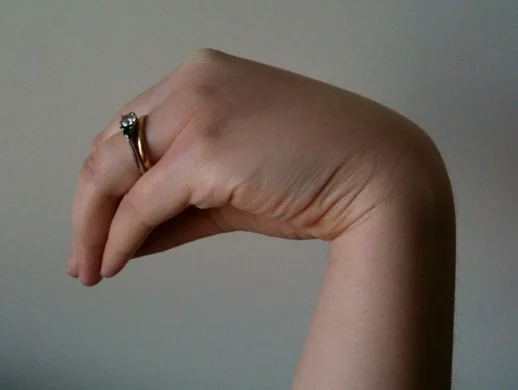
- Tetany - sustained, involuntary muscle contraction; in the hand this produces the classic "main d'accoucheur" (obstetrician's hand) posture of wrist and MCP flexion with DIP/PIP extension and thumb adduction
- Chvostek's sign - tapping over the facial nerve just anterior to the ear (over the parotid) produces twitching of the ipsilateral facial muscles; present in a minority of normal individuals so not fully specific on its own
- Trousseau's sign - inflating a blood pressure cuff above systolic pressure for 2 to 3 minutes induces carpal spasm (the same obstetrician's hand posture); more specific than Chvostek's sign
- Fatigue, anxiety and irritability
- Dry, coarse skin, brittle nails and, in longstanding disease, cataracts and basal ganglia calcification
- Chronic disease in children can cause dental abnormalities and, if hypoparathyroidism is congenital, developmental delay
Investigations
- Corrected (albumin-adjusted) serum calcium - low
- Serum phosphate - characteristically high, because PTH is not present to promote its renal excretion (the opposite of primary hyperparathyroidism)
- PTH - low or inappropriately "normal" in true hypoparathyroidism given the hypocalcaemia; high in pseudohypoparathyroidism
- Magnesium - essential to check in every case; severe hypomagnesaemia both causes and perpetuates hypocalcaemia and must be corrected before calcium will normalise
- Vitamin D (25-hydroxyvitamin D) - to exclude coexisting deficiency as a contributor
- Renal function - CKD is an important differential/contributor to hypocalcaemia and hyperphosphataemia
- ECG - looking for QT prolongation, especially in acute or severe hypocalcaemia
- Genetic testing - considered where a hereditary cause (DiGeorge, autoimmune polyendocrine syndrome, pseudohypoparathyroidism) is suspected, particularly in children or where there is a suggestive family history or syndromic phenotype
Management
Acute, severe or symptomatic hypocalcaemia
- IV calcium gluconate, given slowly with continuous cardiac monitoring because of the risk of arrhythmia, followed by an infusion if hypocalcaemia is severe or symptoms recur
- Check and correct magnesium at the same time - calcium will not correct sustainably while magnesium remains low
- Secure the airway if laryngospasm or stridor develops
- Treat seizures in the standard way while correcting the underlying calcium
Chronic management
- Oral calcium supplementation
- Active vitamin D analogues - alfacalcidol (1-alpha-hydroxycholecalciferol) or calcitriol (1,25-dihydroxycholecalciferol) are used rather than plain (native) vitamin D
- Aim for a low-normal serum calcium - just enough to control symptoms - rather than a fully normal level, since replacing calcium without PTH's renal calcium-conserving effect increases urinary calcium excretion and the risk of nephrocalcinosis and renal impairment
- Recombinant human PTH (e.g. rhPTH(1-84)) - available for selected patients with chronic hypoparathyroidism poorly controlled on calcium and active vitamin D alone; replaces the missing hormone directly
- Monitor renal ultrasound periodically for nephrocalcinosis, alongside regular calcium, phosphate, magnesium and renal function checks
Managing the underlying cause
- Post-surgical hypoparathyroidism - often transient in the first days to weeks after neck surgery; calcium and active vitamin D are weaned once autonomous parathyroid function recovers, if it does
- Hypomagnesaemia - treat the underlying cause (e.g. diuretics, alcohol excess, malabsorption, proton pump inhibitors) alongside replacement
- Autoimmune polyendocrine syndrome type 1 - screen for and manage associated Addison's disease and candidiasis
Complications
- Nephrocalcinosis and chronic kidney disease - from hypercalciuria during calcium/vitamin D replacement without PTH's renal calcium-conserving effect
- Basal ganglia calcification - can cause movement disorders in longstanding disease
- Cataracts
- Cardiac arrhythmia from QT prolongation, including torsades de pointes
- Laryngospasm - airway-threatening in acute severe hypocalcaemia
- Seizures
- Dental abnormalities if hypoparathyroidism develops in childhood
- Reduced quality of life from chronic symptoms and the burden of lifelong monitoring and treatment
Red flags
Prognosis
Transient post-surgical hypoparathyroidism is common in the days after thyroid or parathyroid surgery and often resolves within days to weeks as the remaining gland tissue recovers. Permanent hypoparathyroidism develops in a minority and requires lifelong calcium and active vitamin D replacement.
With appropriate treatment, symptoms of hypocalcaemia are generally well controlled, but the balance is delicate: under-treatment risks tetany and seizures, while over-treatment risks hypercalciuria, nephrocalcinosis and renal impairment. This is why lifelong monitoring of calcium, renal function and, periodically, renal imaging is required rather than a one-off correction.
Recombinant PTH therapy, where available, has improved control and quality of life for patients with chronic hypoparathyroidism refractory to conventional treatment, by replacing the missing hormone rather than simply supplementing its downstream effects.
References
- NICE Clinical Knowledge Summaries. Hypocalcaemia. Available here
- Bollerslev J, Rejnmark L, Marcocci C et al. European Society of Endocrinology clinical guideline: treatment of chronic hypoparathyroidism in adults. Eur J Endocrinol. 2015. Available here
- Brandi ML, Bilezikian JP, Shoback D et al. Management of hypoparathyroidism: summary statement and guidelines. J Clin Endocrinol Metab. 2016. Available here
- Society for Endocrinology. Clinical guidance on calcium and parathyroid disorders. Available here
- BNF. Calcium gluconate, alfacalcidol and calcitriol. Available here
- Huckfinne, public domain, via Wikimedia Commons. Available here
This article is written for revision and education. It is not clinical guidance and must not be used to make decisions about the care of a patient. Always check current NICE guidance and local protocols.