
Long QT Syndrome and Torsades de Pointes
Key points
- QT interval: measured from the start of the QRS to the end of the T wave, and corrected for heart rate as the QTc. Normal is under 440 ms in men and 460 ms in women.
- The danger threshold: a QTc above 500 ms carries a substantially increased risk of torsades de pointes, and above 500 ms the risk rises steeply with each further 10 ms.
- Torsades de pointes: polymorphic ventricular tachycardia with a twisting QRS axis, occurring only in the context of a prolonged QT interval.
- Acquired causes: far commoner than congenital. Hypokalaemia, hypomagnesaemia, hypocalcaemia, bradycardia, and a long list of drugs - antiarrhythmics, macrolides, quinolones, antipsychotics, antiemetics and methadone.
- Congenital syndromes: LQT1 triggered by exercise and especially swimming, LQT2 by emotion and sudden noise, LQT3 by sleep and rest.
- Acute treatment: magnesium sulfate 2 g IV over 10 minutes, stop all QT-prolonging drugs, correct potassium and magnesium, and defibrillate if pulseless.
- Refractory torsades: increase the heart rate to shorten the QT - overdrive pacing at 90-110 per minute, or an isoprenaline infusion if acquired.
- Long term: beta-blockers for congenital long QT (propranolol or nadolol), avoidance of QT-prolonging drugs and of triggers, and an ICD for the highest-risk patients.
Introduction
The QT interval represents the total time taken for ventricular depolarisation and repolarisation. When repolarisation is prolonged, the myocardium spends longer in a vulnerable state in which early afterdepolarisations can trigger a new action potential. If one arrives during the vulnerable period, the result is torsades de pointes - a polymorphic ventricular tachycardia that may terminate spontaneously, recur repeatedly, or degenerate into ventricular fibrillation.
This matters far beyond cardiology. QT prolongation is one of the commonest reasons a drug is withdrawn from the market, and the combination of a QT-prolonging antibiotic, an antiemetic, an antipsychotic and a diuretic-induced hypokalaemia is an entirely realistic prescription in an unwell inpatient. Recognising that combination is a routine part of safe prescribing.
Torsades de pointes translates as "twisting of the points", describing the way the QRS complexes appear to rotate around the isoelectric baseline, alternating between predominantly positive and predominantly negative.
Measuring the QT interval
The QT interval is measured from the beginning of the QRS complex to the end of the T wave, where the T wave returns to the isoelectric baseline. Measure it in the lead where the T wave ends latest and is clearest - usually lead II or V5.
- Measure three consecutive beats and take the average
- Where the T wave merges into a U wave, draw a tangent down the steepest part of the T wave descent and take its intersection with the baseline
- Automated machine measurements are unreliable in the presence of U waves, atrial fibrillation, bundle branch block and pacing - measure it yourself if the value matters
Correcting for heart rate
The QT interval shortens as heart rate increases, so it must be corrected. Bazett's formula (QTc = QT divided by the square root of the R-R interval in seconds) is the most widely used, although it over-corrects at fast rates and under-corrects at slow ones. Fridericia's formula is more accurate at extremes of rate.
| QTc | Men | Women | Significance |
|---|---|---|---|
| Normal | Under 440 ms | Under 460 ms | No action needed |
| Borderline | 440-470 ms | 460-480 ms | Review drugs and electrolytes; repeat the ECG |
| Prolonged | Above 470 ms | Above 480 ms | Identify and remove the cause; monitor |
| High risk | Above 500 ms | Above 500 ms | Substantially increased risk of torsades; stop culprit drugs and correct electrolytes urgently |
| Very high risk | Above 550-600 ms | Above 550-600 ms | Cardiac monitoring; consider prophylactic measures |
Acquired long QT syndrome
Acquired causes are far more common than congenital ones and are the form students will meet on the wards. The great majority are avoidable, and most cases involve more than one contributing factor acting together.
Electrolyte disturbance
- Hypokalaemia - the commonest single contributor, frequently from diuretics, vomiting or diarrhoea
- Hypomagnesaemia - often coexists with hypokalaemia, and potassium cannot be corrected until magnesium is
- Hypocalcaemia - prolongs the ST segment specifically
Drugs
The list is long and constantly updated. The classes below account for most clinically important cases, and the risk multiplies when two or more are combined or when renal or hepatic impairment raises drug levels.
| Class | Examples |
|---|---|
| Antiarrhythmics | Amiodarone, sotalol, flecainide, quinidine, procainamide, dronedarone |
| Antibiotics | Macrolides (clarithromycin, erythromycin, azithromycin), quinolones (ciprofloxacin, levofloxacin, moxifloxacin) |
| Antifungals | Fluconazole, itraconazole, ketoconazole |
| Antipsychotics | Haloperidol, quetiapine, olanzapine, risperidone, and notably intravenous haloperidol |
| Antidepressants | Citalopram and escitalopram (dose-dependent), tricyclic antidepressants |
| Antiemetics | Ondansetron, domperidone, metoclopramide |
| Antimalarials | Chloroquine, hydroxychloroquine, quinine |
| Others | Methadone, terfenadine, arsenic trioxide, several tyrosine kinase inhibitors |
Other causes
- Bradycardia and complete heart block - a slow rate lengthens the QT and provides the long pause that initiates torsades
- Hypothyroidism
- Hypothermia
- Myocardial ischaemia and infarction
- Raised intracranial pressure, particularly subarachnoid haemorrhage
- Anorexia nervosa and starvation - through both direct effects and electrolyte disturbance
- Liver disease and renal impairment - largely through impaired drug clearance
- HIV and its treatment
Congenital long QT syndrome
Congenital long QT syndrome affects around 1 in 2000 people and results from mutations in genes encoding cardiac ion channels. More than 15 subtypes are described, but three account for the great majority, and their triggers differ in a way that is both clinically useful and heavily examined.
| Type | Gene and channel | Proportion | Classic trigger | T wave appearance |
|---|---|---|---|---|
| LQT1 | KCNQ1 - slow delayed rectifier potassium current | ~40-45% | Exertion, especially swimming and diving; emotional stress | Broad-based T waves |
| LQT2 | KCNH2 (hERG) - rapid delayed rectifier potassium current | ~35-40% | Sudden loud noise (alarm clock, telephone), emotion, the postpartum period | Low-amplitude, notched or bifid T waves |
| LQT3 | SCN5A - cardiac sodium channel | ~5-10% | Rest and sleep, bradycardia | Long isoelectric ST segment with a late-appearing T wave |
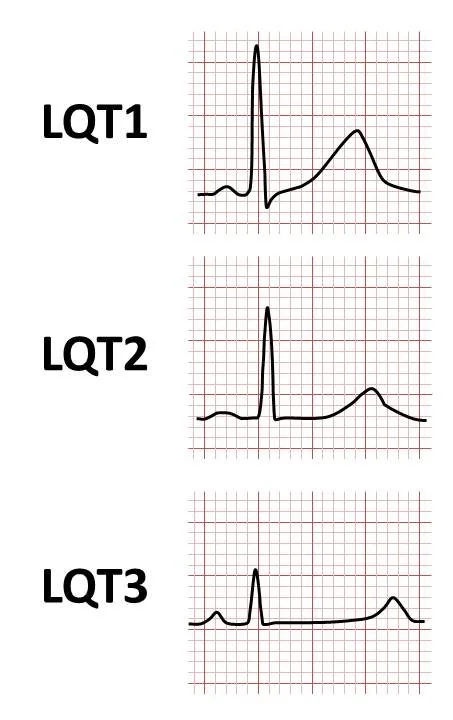
The hERG potassium channel affected in LQT2 is also the channel blocked by most QT-prolonging drugs, which is why patients with subclinical LQT2 are unusually susceptible to drug-induced torsades.
Named syndromes
- Romano-Ward syndrome - autosomal dominant, long QT alone. The commonest form.
- Jervell and Lange-Nielsen syndrome - autosomal recessive, long QT with congenital sensorineural deafness. Rarer, but more severe, with a markedly prolonged QT and a high event rate in childhood.
- Andersen-Tawil syndrome (LQT7) - long QT with periodic paralysis and dysmorphic features
- Timothy syndrome (LQT8) - long QT with syndactyly and neurodevelopmental problems
Torsades de pointes
Recognising it
- Polymorphic ventricular tachycardia, typically at 160-250/min
- A continuously changing QRS axis, so the complexes appear to twist around the isoelectric line in a spindle pattern, with amplitude waxing and waning
- A prolonged QT interval in the preceding sinus beats - this is what defines torsades, as opposed to other polymorphic VT
- A characteristic initiating sequence - a short-long-short pattern: an ectopic beat, a compensatory pause, then a further ectopic beat landing on the prolonged T wave (R-on-T)

Most episodes are brief and self-terminating, causing palpitations, dizziness or syncope. The danger is that episodes recur in rapid succession or degenerate into ventricular fibrillation.
Acute management
Note also what not to give: most conventional antiarrhythmic drugs, including amiodarone and sotalol, prolong the QT further and are contraindicated in torsades. This is the one polymorphic VT where amiodarone is the wrong answer.
Investigations
- 12-lead ECG with the QT measured manually and corrected. Repeat serially while a culprit drug is being withdrawn.
- U&Es, magnesium and calcium - the essential investigations
- Thyroid function tests
- Full drug chart review, including over-the-counter and recreational drugs, and check for interactions that raise drug levels
- Ambulatory ECG monitoring - to capture episodes, assess QT variability across the day and detect non-sustained polymorphic VT
- Exercise tolerance test - in congenital long QT the QT fails to shorten normally with exercise, and paradoxical prolongation in recovery is characteristic of LQT1
- Echocardiogram - to exclude structural heart disease
- Genetic testing - identifies a mutation in around 75% of clinically definite congenital cases, and guides both treatment and family screening
- Family screening with ECGs for all first-degree relatives where a congenital cause is confirmed or suspected
The Schwartz score combines ECG findings, clinical history and family history to estimate the probability of congenital long QT syndrome, and is used to decide who warrants genetic testing.
Long-term management
Acquired long QT
- Withdraw the culprit drug permanently and document it clearly as an adverse reaction in the notes and on the drug chart
- Correct and maintain electrolytes, and review the diuretic regimen
- Treat the underlying condition - hypothyroidism, bradycardia, malnutrition
- Check the ECG before and after starting any new QT-prolonging drug in a susceptible patient
- Consider whether the long QT is really acquired - a substantial minority of patients with drug-induced torsades carry a subclinical congenital mutation, so consider referral if the QT does not normalise
Congenital long QT
- Beta-blockers - the mainstay of treatment, reducing cardiac events by around 70%. Propranolol and nadolol are preferred over cardioselective agents, and treatment is continued lifelong. They are most effective in LQT1 and LQT2 and less so in LQT3.
- Avoid all QT-prolonging drugs - patients should carry a list, and the CredibleMeds database is a widely used reference
- Avoid trigger activities - competitive sport and swimming unsupervised in LQT1; sudden loud noises such as alarm clocks and telephones in the bedroom in LQT2
- Maintain potassium and magnesium, and take particular care during any illness causing vomiting or diarrhoea
- Left cardiac sympathetic denervation - for patients with recurrent events despite beta-blockade, or who cannot tolerate it
- Implantable cardioverter defibrillator - for survivors of cardiac arrest, for recurrent syncope despite beta-blockade, and for selected very high-risk patients such as those with a QTc above 550 ms or Jervell and Lange-Nielsen syndrome
- Mexiletine - a sodium channel blocker with specific benefit in LQT3
- Family screening and genetic counselling - first-degree relatives should have an ECG and, where a mutation is identified, cascade genetic testing
- Driving and occupation - DVLA restrictions apply after syncope or arrhythmia; check current guidance2
Differential diagnosis
| Condition | Distinguishing features |
|---|---|
| Epilepsy | Torsades causing syncope with brief jerking is very commonly misdiagnosed as seizure. A normal EEG and MRI with drug-resistant 'seizures' should prompt an ECG. |
| Vasovagal syncope | Prodrome of nausea, sweating and visual greying, with a clear postural or emotional trigger. Syncope in long QT is typically abrupt and without warning. |
| Brugada syndrome | Coved ST elevation in V1-V2 with a normal QT; events at rest or with fever |
| Catecholaminergic polymorphic VT | Exercise-induced bidirectional or polymorphic VT with a normal resting QT |
| Hypertrophic cardiomyopathy | Exertional syncope with LVH on the ECG and an abnormal echocardiogram |
| Short QT syndrome | QTc under 340 ms with tall peaked T waves and a risk of AF and VF |
| Polymorphic VT with a normal QT | Usually acute myocardial ischaemia - treat with urgent revascularisation, not magnesium |
Red flags
Prognosis
Acquired long QT has an excellent prognosis once the cause is removed. The QT normalises over hours to days as the drug is cleared and electrolytes are corrected, and recurrence is preventable through accurate documentation of the culprit agent.
Congenital long QT syndrome, untreated, carries a mortality of around 20% within a year of a first syncopal episode and approximately 50% at ten years. With beta-blockade the risk falls dramatically - to around 1-2% over five years in most patients - making it one of the more effective preventive treatments in cardiology, and a strong argument for detecting the condition before the first serious event.
Prognosis within congenital long QT varies by subtype and by QTc. LQT3 has fewer events but a higher proportion are fatal, since they occur during sleep and are unwitnessed. A QTc above 500 ms, previous cardiac arrest, syncope despite treatment, female sex after adolescence, and Jervell and Lange-Nielsen syndrome all mark higher risk.
Family screening is critical, and is the intervention with the greatest population-level benefit. Identifying an asymptomatic gene carrier and starting a beta-blocker converts a potentially fatal condition into a manageable one, and the index case is often diagnosed only after a relative has died suddenly.
References
- Resuscitation Council UK. Adult advanced life support guidelines. Available here
- DVLA. Assessing fitness to drive: a guide for medical professionals. Available here
- Zeppenfeld K, Tfelt-Hansen J, de Riva M et al. 2022 ESC Guidelines for the management of patients with ventricular arrhythmias and the prevention of sudden cardiac death. European Heart Journal. 2022. Available here
- Schwartz PJ, Ackerman MJ. The long QT syndrome: a transatlantic clinical approach to diagnosis and therapy. European Heart Journal. 2013. Available here
- CredibleMeds. QT drug lists. Available here
- BNF. Magnesium sulfate - indications and dosing. Available here
- MHRA Drug Safety Update. Citalopram and escitalopram: QT interval prolongation. Available here
- NICE CG109. Transient loss of consciousness (blackouts) in over 16s. 2010, updated 2023. Available here
This article is written for revision and education. It is not clinical guidance and must not be used to make decisions about the care of a patient. Always check current NICE guidance and local protocols.