
Asthma-COPD Overlap: Recognising Both Diseases in One Patient
Key points
- Asthma-COPD overlap: persistent airflow limitation with several features usually associated with asthma. It is a description of a patient, not a separate disease with its own pathology.
- Two routes in: a long-standing asthmatic who develops fixed obstruction through airway remodelling or smoking, and a smoker with COPD who has eosinophilic, steroid-responsive inflammation.
- UK terminology: NICE does not use the term. NG115 instead asks whether the patient has asthmatic features or features suggesting steroid responsiveness, and lets that decide the inhaler.
- The four NICE features: a previous secure diagnosis of asthma or of atopy, a higher blood eosinophil count, FEV1 variation of at least 400 ml over time, or diurnal peak flow variation of at least 20%.
- Diagnosis: post-bronchodilator FEV1/FVC below 0.7 confirming fixed obstruction, plus objective evidence of variability, reversibility, eosinophilia or a raised FeNO.
- Management principle: treat the asthma component first. Never manage these patients on a LABA plus LAMA alone - an inhaled corticosteroid is mandatory, because withholding it in asthma risks a fatal attack.
- Usual regimen: ICS/LABA, escalating to triple therapy with a LAMA, alongside every COPD intervention: smoking cessation, vaccination and pulmonary rehabilitation.
- Prognosis: worse than either condition alone - more frequent exacerbations, faster decline in lung function, poorer quality of life and greater healthcare use.
Introduction
Asthma and COPD are taught as opposites: one variable and reversible, the other fixed and progressive. In practice a substantial minority of patients with chronic airflow obstruction have features of both, and these patients are systematically disadvantaged because they are excluded from almost every clinical trial of either disease.
Asthma-COPD overlap (ACO) describes persistent airflow limitation together with several features usually associated with asthma. It is estimated to affect 15 to 25% of patients with obstructive airway disease, rising with age.3 The essential point is that this is a descriptive label, not a distinct disease with its own pathology or its own guideline - and both GINA and GOLD have deliberately moved away from calling it a syndrome for exactly that reason.4,5
The reason any of this matters is a safety one. Asthma and COPD sit at opposite ends of the risk-benefit calculation for inhaled corticosteroids: in asthma, withholding an ICS risks a fatal attack, whereas in COPD an ICS increases the risk of pneumonia and is reserved for selected patients. Getting the label wrong therefore carries a real and asymmetric cost, and the error that kills is treating an asthmatic as though they had pure COPD.
How overlap arises
Two quite different clinical stories converge on the same picture, and it is worth being able to tell them apart because they carry different implications.
Route 1: asthma that becomes fixed
A patient with long-standing asthma develops incompletely reversible obstruction through airway remodelling - subepithelial fibrosis, smooth muscle hypertrophy and basement membrane thickening accumulated over years of inflammation. The process is accelerated enormously by smoking, which also blunts the response to corticosteroids.
- Symptoms began in childhood or early adult life
- A history of atopy - eczema, allergic rhinitis, nasal polyps, food allergy
- Documented variability or reversibility at some point in the past, even if not now
- Often, though not always, a smoking history superimposed on the asthma
Route 2: COPD with an eosinophilic phenotype
A smoker with established COPD is found to have eosinophilic, corticosteroid-responsive inflammation - a raised blood eosinophil count or FeNO, and a better than expected response to an ICS. The inflammation of typical COPD is neutrophilic and steroid-resistant, so this group behaves differently from the rest.
- Symptoms began after the age of 40 in a smoker
- Raised blood eosinophils or FeNO
- Frequent exacerbations that respond well to oral corticosteroids
- Some day-to-day symptom variability and night waking, which is unusual in pure COPD
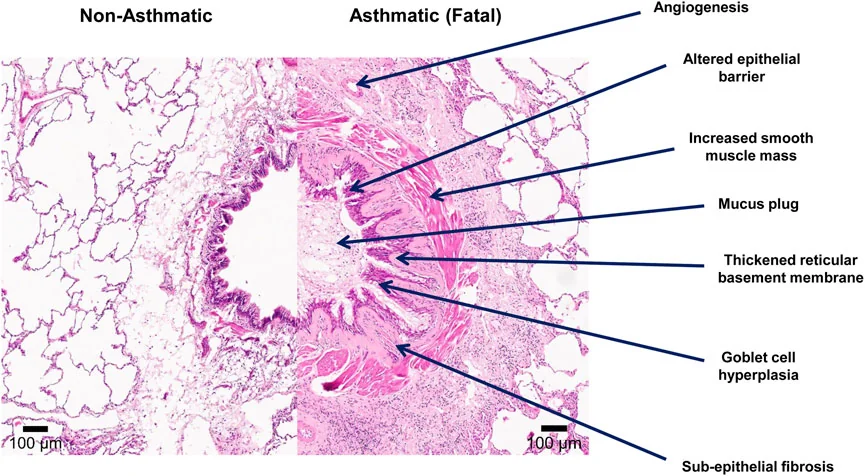
Clinical features
The hallmark is a patient who does not read like a textbook case of either disease. Look for persistent, exertional breathlessness with a chronic productive cough - the COPD picture - overlaid with episodic symptom variability, night waking and clear trigger sensitivity - the asthma picture.
| Feature | Favours asthma | Favours COPD |
|---|---|---|
| Age at onset | Childhood or under 40 | Over 40 |
| Smoking | Not required | Almost always present |
| Symptom pattern | Episodic, with symptom-free intervals | Persistent and slowly progressive |
| Night waking with wheeze | Common | Uncommon |
| Atopy and family history | Frequent | No more than background |
| Sputum | Scanty, often none when stable | Chronic and mucoid |
| Bronchodilator reversibility | Marked | Absent or minimal |
| Airflow obstruction between attacks | Resolves | Persists |
| Transfer factor (TLCO) | Normal or raised | Reduced in emphysema |
| Predominant inflammatory cell | Eosinophils, CD4 lymphocytes | Neutrophils, macrophages, CD8 lymphocytes |
| Corticosteroid response | Excellent | Limited |
Examination
Examination findings are those of chronic airflow obstruction and cannot distinguish the two: hyperinflation, a prolonged expiratory phase, polyphonic expiratory wheeze and quiet breath sounds. Additional pointers worth seeking are signs of atopy (eczema, nasal polyps, allergic rhinitis) favouring an asthma component, and tar staining, cachexia or cor pulmonale favouring COPD.
Investigations
There is no single diagnostic test and no internationally agreed criteria. The diagnosis rests on demonstrating fixed obstruction plus objective evidence of an asthma component.
Establishing fixed obstruction
- Post-bronchodilator spirometry with an FEV1/FVC ratio below 0.7 that does not normalise - this is the requirement, and it is what excludes pure asthma
- Persistence should be confirmed on more than one occasion, ideally including after a trial of adequate anti-inflammatory treatment
Establishing the asthma component
- Marked bronchodilator reversibility - an FEV1 increase of 12% or more and 200 ml or more, and particularly an increase of 400 ml or more, which NICE specifically identifies as an asthmatic feature
- Peak flow diary showing diurnal variability of 20% or more
- Blood eosinophil count - a raised count both supports the diagnosis and predicts ICS benefit
- FeNO - elevation indicates type 2 airway inflammation, though it is suppressed by corticosteroids and by smoking
- Total and specific IgE, or skin prick testing - to document atopy
- Documented historical evidence - old spirometry, previous peak flow records, or a clear response to steroids in the notes. This is often the most valuable single piece of information and is frequently sitting unread in the record.
Excluding the alternatives
- Chest X-ray, and CT thorax where the picture is atypical - to exclude bronchiectasis, fibrosis and malignancy
- Transfer factor (TLCO) - reduced in emphysema, preserved in asthma, and one of the more useful discriminators
- Echocardiogram and BNP - heart failure is a common and easily missed cause of breathlessness and wheeze in this age group
- Alpha-1 antitrypsin - in early-onset disease or a light smoking history
- Aspergillus serology and total IgE - allergic bronchopulmonary aspergillosis produces exactly this picture of asthma with fixed obstruction, and is treatable
Management
Inhaled therapy
- Start with an ICS/LABA combination, at a dose appropriate to the severity of the asthma component. A long-acting beta-2 agonist must never be given without an ICS in a patient with any asthma component.
- Add a LAMA to make triple therapy (ICS + LABA + LAMA) if breathlessness or exacerbations persist. Triple therapy is particularly effective in patients with a raised eosinophil count and frequent exacerbations.
- Provide a short-acting reliever, and review reliever use at every appointment as a marker of control.
- Review the ICS dose regularly. Aim for the lowest dose that maintains control, since the pneumonia risk in patients with a COPD component is dose-related.
- Escalate to specialist assessment if control remains poor - options include a leukotriene receptor antagonist, theophylline, roflumilast, macrolide prophylaxis, or a biologic where a severe eosinophilic or allergic phenotype is confirmed.
Everything else, from both diseases
Because these patients have both conditions, they need the non-pharmacological management of both. This part of the plan does more for outcome than any adjustment of the inhaler.
- Smoking cessation - the highest-value intervention available. Smoking accelerates the decline in FEV1, promotes remodelling and induces relative corticosteroid resistance, so it damages both components at once.
- Pulmonary rehabilitation - for anyone with MRC grade 3 or above, or after an exacerbation requiring admission
- Vaccination - annual influenza, plus pneumococcal and COVID-19
- A written personalised action plan covering both what to do when asthma symptoms escalate and when to start a rescue pack for an exacerbation
- Inhaler technique and adherence checks at every review - the most common reason for apparent treatment failure in either disease
- Trigger and allergen management, and treatment of coexisting allergic rhinitis
- Comorbidity management - obesity, reflux, obstructive sleep apnoea, anxiety, depression, cardiovascular disease and osteoporosis
- Long-term oxygen therapy assessment if there is chronic hypoxaemia, using the same criteria as in COPD
| Diagnosis | Preferred inhaled regimen | Rationale |
|---|---|---|
| Asthma | ICS-containing therapy from diagnosis, as AIR or MART | Inflammation is eosinophilic and steroid-responsive; a reliever alone is unsafe |
| COPD without steroid-responsive features | LABA + LAMA; ICS added only for continuing exacerbations | Inflammation is neutrophilic and steroid-resistant, and ICS carries a pneumonia risk |
| Overlap | ICS + LABA, escalating to ICS + LABA + LAMA | The asthma component must be treated, and the COPD component benefits from dual bronchodilation |
Exacerbations
Exacerbations in overlap are more frequent and more severe than in either condition alone, and each one accelerates the decline in lung function. Acute management follows the pathway for whichever picture predominates, but a few points deserve emphasis.
- Oxygen targets depend on the risk of hypercapnia, not on the label. If there is fixed obstruction and any history of CO2 retention, target 88-92% and check a blood gas. Otherwise target 94-98%.
- Oral corticosteroids are effective and should not be withheld. Prednisolone 30-40 mg for 5 days covers both pictures.
- Antibiotics only for purulent sputum or radiological consolidation - most exacerbations in either disease are viral
- Consider the mimics - pneumothorax, pulmonary embolism, heart failure and pneumonia all present as an exacerbation and all are commoner in this population
- Review the maintenance regimen before discharge, since a patient who exacerbates repeatedly is usually under-treated, non-adherent, or using their device incorrectly
Complications
- Accelerated decline in FEV1 - faster than in either condition alone
- Frequent exacerbations and hospital admission, with higher healthcare utilisation than either disease separately
- Chronic respiratory failure and cor pulmonale in advanced disease
- Pneumonia - the risk from inhaled corticosteroids applies to the COPD component of the disease
- Systemic corticosteroid toxicity - osteoporosis, diabetes, cataracts, adrenal suppression - from repeated rescue courses
- Reduced quality of life, exercise limitation and higher rates of anxiety and depression than in either condition alone
- Lung cancer and cardiovascular disease - both raised by the shared smoking exposure
Red flags
Prognosis
Patients with overlap consistently do worse than those with either condition alone. They report more symptoms and poorer quality of life, exacerbate more often, decline faster, and consume substantially more healthcare. Some studies also show higher mortality, although this is confounded by age, smoking exposure and comorbidity.
The prognosis is nevertheless meaningfully modifiable, and by unglamorous means. Smoking cessation, an appropriately dosed inhaled corticosteroid, correct inhaler technique, pulmonary rehabilitation and vaccination together deliver most of the achievable benefit. The reversible component of the obstruction is often larger than anyone expects until it is properly treated - which is the strongest practical argument for identifying the asthma component in the first place, and for treating it as asthma.
References
- NICE NG115. Chronic obstructive pulmonary disease in over 16s: diagnosis and management. 2018, updated 2019. Available here
- NICE NG245. Asthma: diagnosis, monitoring and chronic asthma management (BTS, NICE, SIGN). 2024. Available here
- Postma DS, Rabe KF. The asthma-COPD overlap syndrome. NEJM. 2015. Available here
- Global Initiative for Asthma (GINA). Global strategy for asthma management and prevention. Available here
- Global Initiative for Chronic Obstructive Lung Disease (GOLD). Global strategy for the diagnosis, management and prevention of COPD. Available here
- NICE Clinical Knowledge Summaries. Chronic obstructive pulmonary disease. Available here
- BNF. Inhaled corticosteroid and long-acting bronchodilator combinations. Available here
- Hsieh A, Assadinia N, Hackett T, CC BY 4.0, via Wikimedia Commons. Available here
This article is written for revision and education. It is not clinical guidance and must not be used to make decisions about the care of a patient. Always check current NICE guidance and local protocols.