
Asthma: Diagnosis, Chronic Management and the Acute Attack
Key points
- Asthma: a chronic inflammatory airway disease causing variable, reversible airflow obstruction with bronchial hyperresponsiveness.
- Symptoms: wheeze, cough, breathlessness and chest tightness that are episodic, diurnally variable (worse at night and early morning), and triggered by cold air, exercise, allergens and infection.
- Diagnosis: never on symptoms alone. UK practice starts with FeNO and blood eosinophils, then spirometry with bronchodilator reversibility, then peak flow variability.
- The key numbers: FeNO 50 ppb or more (adults) or 35 ppb or more (children) is diagnostic; bronchodilator reversibility is an FEV1 rise of 12% or more and 200 ml or more; peak flow variability of 20% or more is positive.
- Chronic management: every adult and young person aged 12 and over should be on an inhaled corticosteroid. A salbutamol-only reliever is no longer acceptable treatment.
- AIR and MART: low-dose ICS/formoterol is used as an as-needed anti-inflammatory reliever (AIR), and as both regular and reliever treatment (MART) when control is inadequate.
- Acute severity: acute severe means PEF 33-50%, respiratory rate 25 or more, heart rate 110 or more, or an inability to complete sentences. Life-threatening means PEF under 33%, silent chest, cyanosis, exhaustion or an altered conscious level.
- A normal PaCO2 in an acute attack is not reassuring: it means the patient is tiring and no longer hyperventilating. A rising PaCO2 is near-fatal asthma and requires critical care.
Introduction
Asthma is a chronic inflammatory disease of the airways characterised by variable and reversible airflow obstruction, bronchial hyperresponsiveness and airway inflammation. Around 5.4 million people in the UK receive treatment for asthma, making it one of the commonest long-term conditions encountered in every clinical setting.1
The word that defines asthma is variability. Airway calibre changes over hours, days and seasons, and it is this fluctuation - rather than any single abnormal measurement - that separates asthma from the fixed obstruction of COPD. A patient with entirely normal spirometry in clinic may still have asthma, which is why a single normal test never excludes the diagnosis.
Despite effective treatment being available, asthma still causes around 1,200 deaths a year in the UK. The National Review of Asthma Deaths found that the majority of these deaths were associated with avoidable factors: excessive reliever use, inadequate preventer use, no personalised asthma action plan, and a failure to recognise or act on deteriorating control.6 Almost every one of these is something a clinician can address at a routine review.
Pathophysiology
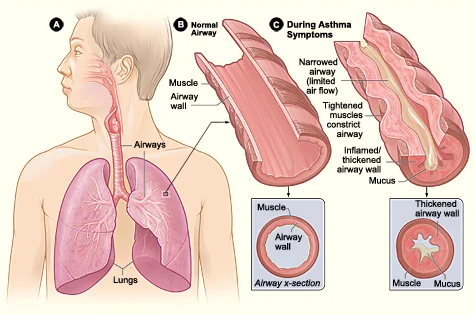
Airway narrowing in asthma results from three processes acting together. Understanding which process a drug targets explains the entire treatment ladder.
- Bronchoconstriction - contraction of airway smooth muscle. This is rapid, reversible, and the component relieved within minutes by a beta-2 agonist.
- Airway inflammation and mucosal oedema - infiltration by eosinophils, mast cells, T-helper 2 lymphocytes and their cytokines, with mucosal swelling and mucus hypersecretion. This is the component suppressed by inhaled corticosteroids, and it is why a reliever alone treats the symptom but not the disease.
- Airway remodelling - with chronic uncontrolled inflammation, the basement membrane thickens, smooth muscle hypertrophies and subepithelial fibrosis develops. This produces a component of fixed, irreversible obstruction and is the strongest argument for treating inflammation early.
Type 2 inflammation
Most asthma is driven by so-called type 2 (T2) inflammation, in which the cytokines IL-4, IL-5 and IL-13 recruit eosinophils, drive IgE class switching and stimulate mucus production. This matters clinically for three reasons:
- It produces the biomarkers used to diagnose asthma - IL-13 upregulates nitric oxide synthase in bronchial epithelium, which is what a raised FeNO measures, and IL-5 drives the blood eosinophilia
- T2 inflammation is corticosteroid-responsive, so a raised FeNO or eosinophil count predicts benefit from inhaled corticosteroids
- It is the target of the biologic therapies used in severe asthma
A minority of patients have non-T2 (neutrophilic or paucigranulocytic) asthma, which is typically later onset, associated with obesity or smoking, has a normal FeNO and responds poorly to corticosteroids.
The atopic march
Asthma frequently coexists with atopic dermatitis and allergic rhinitis, the three together forming the atopic triad. Childhood eczema often precedes the development of allergic rhinitis and then asthma - the so-called atopic march - and a personal or family history of atopy substantially raises the probability of asthma in a patient with compatible symptoms.
Risk factors and triggers
Risk factors for developing asthma
- Personal or family history of atopy - eczema, allergic rhinitis, food allergy
- Maternal smoking in pregnancy and childhood exposure to tobacco smoke
- Low birth weight and prematurity
- Obesity - independently associated, and worsens control
- Occupational sensitiser exposure - see occupational asthma below
- Air pollution, particularly traffic-related particulates
- Bronchiolitis or severe viral wheeze in infancy
Triggers of symptoms and exacerbations
- Viral upper respiratory tract infection - the commonest precipitant of an exacerbation by a wide margin, especially rhinovirus
- Allergens - house dust mite, pollen, animal dander, moulds
- Cold air and exercise, particularly in cold dry conditions
- Emotion, laughter and stress
- Smoking, including passive exposure, and vaping
- Drugs - beta-blockers (including topical eye drops), NSAIDs and aspirin, and adenosine
- Occupational exposures - isocyanates, flour, latex, colophony, wood dusts
- Gastro-oesophageal reflux and, in some women, the perimenstrual period
Clinical features
Symptoms
The four cardinal symptoms are wheeze, cough, breathlessness and chest tightness. None is specific on its own; what makes them suggest asthma is the pattern in which they occur.
- Episodic - symptom-free intervals between attacks, rather than continuous breathlessness
- Diurnal variation - characteristically worse at night and in the early hours of the morning, and a history of waking at night with cough or wheeze is one of the most useful discriminators
- Trigger-related - reproducibly provoked by exercise, cold air, allergens, laughter or infection
- Responsive to bronchodilators - a clear history of relief with a reliever inhaler
- Seasonal or environmental variability - better on holiday, worse at work, worse in a particular room or house
Cough may be the sole symptom - cough-variant asthma - typically a dry nocturnal cough in an atopic patient, and a common cause of chronic cough referred to secondary care.
Points to cover in the history
- Atopy - eczema, hay fever, food allergy, and a family history of the same
- Occupation - and specifically whether symptoms improve away from work and at weekends
- Smoking and vaping, and exposure to smoke at home
- Current inhaler use, including how many reliever canisters are being used - this is a direct measure of control
- Previous exacerbations, oral steroid courses, hospital admissions and any ICU admission or intubation - the single best predictor of a future life-threatening attack
- Adherence and inhaler technique - ask what the patient actually does, not what they have been told to do
- Pets, damp, mould and bedding at home
Examination
Between attacks the chest is often entirely normal, and a normal examination does not exclude asthma. When symptomatic, look for:
- Widespread polyphonic expiratory wheeze - polyphonic because many airways of differing calibre are narrowed. A fixed monophonic wheeze suggests a single obstructed airway, for example a tumour or inhaled foreign body.
- Prolonged expiratory phase
- Tachypnoea and use of accessory muscles in an acute attack
- Hyperinflated chest in longstanding poorly controlled disease
- Signs of atopy - eczema in the flexures, nasal polyps, allergic shiners, a transverse nasal crease
- Harrison sulci in children with chronic disease - grooves at the costal insertion of the diaphragm
Differential diagnosis
| Condition | Discriminating features |
|---|---|
| COPD | Age over 35, significant smoking history, persistent rather than variable symptoms, minimal diurnal variation, largely irreversible obstruction, chronic sputum production |
| Bronchiectasis | Chronic daily production of large volumes of purulent sputum, coarse crackles, recurrent infections, finger clubbing |
| Heart failure | Orthopnoea and paroxysmal nocturnal dyspnoea, bibasal crackles, raised JVP, peripheral oedema, cardiomegaly. Cardiac wheeze is genuinely difficult to distinguish and BNP helps. |
| Inducible laryngeal obstruction (vocal cord dysfunction) | Inspiratory stridor rather than expiratory wheeze, throat tightness, poor response to bronchodilators, symptoms not relieved by steroids, often young women. Truncated inspiratory limb on flow-volume loop. |
| Pulmonary embolism | Sudden onset breathlessness, pleuritic chest pain, hypoxia disproportionate to examination findings, risk factors for venous thromboembolism |
| Inhaled foreign body | Sudden onset in a child, fixed monophonic wheeze, unilateral signs, hyperinflation of one lung on expiratory film |
| Bronchiolitis | Infant under 1 year, coryzal prodrome, fine inspiratory crackles and high-pitched wheeze, RSV season |
| Gastro-oesophageal reflux | Cough worse when supine and after meals, dyspepsia, acid taste |
| ACE inhibitor cough | Dry cough starting weeks to months after the drug was begun, no wheeze or variability |
Investigations and making the diagnosis
UK guidance requires objective confirmation in every patient - a clinical impression is not enough to label someone as asthmatic for life.2 The tests are performed in a defined order, and testing stops as soon as one is positive.
Adults and young people aged 17 and over
- Fractional exhaled nitric oxide (FeNO) - diagnose asthma if the level is 50 ppb or more in a patient with compatible symptoms.
- Blood eosinophil count - if FeNO is unavailable or below 50 ppb, measure the eosinophil count. Diagnose asthma if it is above the laboratory reference range.
- Spirometry with bronchodilator reversibility - if both of the above are normal. Diagnose asthma if FEV1 increases by 12% or more and 200 ml or more after a bronchodilator (an increase of 10% or more of the predicted FEV1 is also diagnostic).
- Peak expiratory flow variability - if reversibility testing is unavailable or negative. Twice-daily readings for two weeks, diagnosing asthma if variability is 20% or more.
- Bronchial challenge testing - if the diagnosis is still in doubt, refer for histamine or methacholine challenge. Diagnose asthma if PC20 is 8 mg/ml or less.
Children aged 5 to 16
- FeNO - diagnose asthma if 35 ppb or more.
- Spirometry with bronchodilator reversibility - diagnose asthma if FEV1 improves by 12% or more (or by 10% or more of the predicted value).
- Peak flow variability of 20% or more over two weeks.
- If tests remain negative but suspicion persists, refer to a specialist, and consider skin prick testing to house dust mite or specific IgE as supportive evidence of atopy.
Children under 5
Objective testing is not reliably possible. Treat on the basis of clinical judgement and observation, review regularly, and perform objective tests once the child is able to cooperate, usually at around 5 years.
Other investigations
- Chest X-ray - not required to diagnose asthma. Request it if there are atypical features, focal signs, or a suspicion of pneumothorax, pneumonia or an inhaled foreign body.
- Full blood count - eosinophilia supports the diagnosis; a very high count raises the possibility of ABPA or eosinophilic granulomatosis with polyangiitis.
- Total and specific IgE, and Aspergillus precipitins - if ABPA is suspected.
- Serial peak flow at and away from work - the investigation of choice for suspected occupational asthma.
- Nasal endoscopy - if polyps or chronic rhinosinusitis are suspected as a contributor.
Chronic management
UK asthma management changed fundamentally with the 2024 BTS, NICE and SIGN joint guideline.2 The single most important principle is that asthma is an inflammatory disease and every patient aged 12 and over should receive an inhaled corticosteroid. Treating with a short-acting beta-2 agonist alone relieves symptoms while leaving the inflammation - and therefore the risk of a fatal attack - untreated, and is no longer acceptable practice.
Adults and young people aged 12 and over
| Step | Treatment |
|---|---|
| 1 | Low-dose ICS/formoterol as needed (AIR therapy) for newly diagnosed asthma with infrequent symptoms |
| 2 | Low-dose MART - if symptoms occur three or more times a week, there is night waking, or the patient presents with highly symptomatic or severe disease at diagnosis |
| 3 | Moderate-dose MART |
| 4 | Check FeNO and blood eosinophils. If either is raised, refer to a specialist. If neither is raised, add a leukotriene receptor antagonist (montelukast) or a long-acting muscarinic antagonist (tiotropium) to moderate-dose MART and review after 8 to 12 weeks |
| 5 | Refer to a specialist asthma service for consideration of high-dose therapy, biologics or other add-on treatment |
Children aged 5 to 11
- Twice-daily paediatric low-dose ICS with an as-needed SABA
- If control is inadequate, paediatric low-dose MART, or twice-daily paediatric low-dose ICS plus a leukotriene receptor antagonist with an as-needed SABA
- Paediatric moderate-dose MART
- Refer to a specialist
Non-pharmacological management and review
- A personalised asthma action plan for every patient, in writing - this alone reduces hospital admissions and was absent in most patients who died in the National Review of Asthma Deaths
- Smoking cessation, and removing exposure to second-hand smoke
- Annual asthma review, and review within 48 hours of any exacerbation or hospital discharge
- Annual influenza vaccination, and pneumococcal vaccination for those on oral corticosteroids or with severe disease
- Weight loss where the patient is obese, which measurably improves control
- Allergen avoidance where a specific and practicable trigger is identified, and treatment of coexisting allergic rhinitis with an intranasal corticosteroid
- Breathing exercise programmes as an adjunct for symptom control
Severe asthma and biologics
Patients requiring high-dose therapy or frequent oral corticosteroids should be managed in a specialist service, where a monoclonal antibody may be offered based on phenotype:
- Omalizumab - anti-IgE, for severe allergic asthma
- Mepolizumab, reslizumab and benralizumab - targeting the IL-5 pathway, for severe eosinophilic asthma
- Dupilumab - anti-IL-4 receptor alpha, blocking both IL-4 and IL-13
- Tezepelumab - anti-TSLP, acting further upstream and effective across eosinophilic and non-eosinophilic phenotypes
Acute asthma
Assessment of an acute attack is a grading exercise, and the grade determines the management and the disposal. Assess with a peak flow, oxygen saturations, respiratory rate, heart rate and the ability to speak.3
| Grade | Features |
|---|---|
| Moderate | PEF 50-75%, no features of acute severe asthma, and speech is normal |
| Acute severe | Any one of: PEF 33-50%, respiratory rate 25 or more, heart rate 110 or more, or an inability to complete sentences in one breath |
| Life-threatening | Any one of: PEF under 33%, SpO2 under 92%, PaO2 under 8 kPa, a normal PaCO2 (4.6-6.0 kPa), silent chest, cyanosis, poor respiratory effort, exhaustion, altered conscious level, arrhythmia or hypotension |
| Near-fatal | Raised PaCO2, or the need for mechanical ventilation with raised inflation pressures |
Immediate treatment
- Oxygen - titrate to target saturations of 94-98% using a reservoir mask if needed
- Salbutamol - 5 mg nebulised, driven by oxygen, repeated at 15-30 minute intervals or given back-to-back in severe attacks. In a moderate attack, 4 to 10 puffs of an MDI through a spacer is equally effective.
- Corticosteroids - prednisolone 40-50 mg orally, or hydrocortisone 100 mg IV if the patient cannot swallow. Give to every patient with an acute attack, and continue for at least 5 days.
- Ipratropium bromide - 0.5 mg nebulised, added in acute severe or life-threatening asthma, or where the response to salbutamol is poor
- Magnesium sulfate - 1.2 to 2 g IV over 20 minutes, a single dose, in acute severe or life-threatening asthma not responding to initial treatment. Discuss with a senior first.
- Aminophylline - IV, on senior advice only, in life-threatening or near-fatal asthma. Its role is limited and toxicity is significant.
- Escalate - involve critical care early if there is a poor response, exhaustion, a rising PaCO2 or a falling conscious level
Antibiotics are not routinely indicated. Most exacerbations are triggered by viruses, and antibiotics should be given only where there is objective evidence of bacterial infection such as consolidation on a chest X-ray.
Monitoring and discharge
- Repeat PEF 15-30 minutes after starting treatment and regularly thereafter, and monitor oxygen saturations continuously
- Check potassium - both salbutamol and corticosteroids cause hypokalaemia, and it can be marked after repeated nebulisers
- Consider a chest X-ray if there is suspicion of pneumothorax or consolidation, if the patient requires ventilation, or if the response to treatment is poor
- Discharge when PEF is above 75% of best or predicted, the patient has been stable on discharge medication for 12-24 hours, and inhaler technique has been checked
- Provide a written personalised action plan, arrange GP follow-up within 2 working days, and respiratory clinic follow-up within 4 weeks after an admission
Specific asthma syndromes
Occupational asthma
Around one in ten cases of adult-onset asthma is caused by a workplace sensitiser, and it is important because early removal from exposure can cure it, whereas continued exposure produces permanent disease.7 The clue is symptoms that improve at weekends and on holiday and return on going back to work. Common sensitisers include isocyanates (spray painting), flour and grain dust (baking), latex, colophony (soldering flux), wood dusts and laboratory animals. The investigation of choice is serial peak flow measurement at and away from work, and every suspected case should be referred to an occupational lung disease specialist.
Aspirin-exacerbated respiratory disease
Also known as Samter's triad: asthma, nasal polyposis and sensitivity to aspirin and NSAIDs. It arises from a shift of arachidonic acid metabolism towards leukotriene production when cyclo-oxygenase is inhibited. Patients typically have severe, adult-onset, eosinophilic asthma with anosmia from polyps. Avoid all NSAIDs; leukotriene receptor antagonists are particularly effective, and aspirin desensitisation is an option in specialist hands.
Allergic bronchopulmonary aspergillosis
A hypersensitivity reaction to Aspergillus fumigatus colonising the airways. Suspect it in an asthmatic with poor control, recurrent fleeting pulmonary infiltrates, expectoration of brown mucus plugs, and eventual proximal bronchiectasis. Investigations show a raised total IgE, positive Aspergillus-specific IgE and precipitins, and marked peripheral eosinophilia. Treatment is with oral corticosteroids, with itraconazole as a steroid-sparing agent.
Exercise-induced bronchoconstriction
Symptoms typically begin a few minutes after exercise stops and peak at 5 to 10 minutes, provoked by cooling and drying of the airway. It usually indicates inadequately controlled underlying asthma, so the first response is to optimise preventer treatment rather than simply to add a pre-exercise reliever. A warm-up period and a scarf over the mouth in cold weather both help.
Asthma in pregnancy
Control improves in about a third of women, worsens in a third and is unchanged in a third. The essential message is that asthma treatment should be continued unchanged throughout pregnancy, including inhaled and oral corticosteroids. The risk to mother and fetus from an uncontrolled attack far exceeds any risk from the medication, and treatment being stopped in pregnancy is a recognised contributor to maternal asthma deaths.
Complications
- Exacerbations requiring oral corticosteroids, hospital admission or ventilation
- Fixed airflow obstruction from airway remodelling in chronically uncontrolled disease
- Pneumothorax and pneumomediastinum - from high intrathoracic pressures in a severe attack
- Respiratory failure and death
- Corticosteroid side effects - inhaled: oral candidiasis, dysphonia and, at high dose, adrenal suppression and reduced growth velocity in children; systemic: osteoporosis, diabetes, hypertension, weight gain, cataracts and adrenal suppression
- Hypokalaemia from beta-2 agonist and corticosteroid treatment
- Impaired quality of life - school and work absence, exercise limitation, sleep disturbance, anxiety and depression
Red flags
Prognosis
For the majority of patients, asthma controlled with an inhaled corticosteroid carries an excellent prognosis and a normal life expectancy with no restriction on activity. Many children with mild disease become symptom-free by adolescence, although airway hyperresponsiveness often persists and symptoms may return in adult life.
Poorer outcomes are associated with adult-onset disease, smoking, obesity, fixed airflow obstruction on spirometry, frequent exacerbations and chronic oral corticosteroid dependence. Around 5 to 10% of patients have severe asthma that remains uncontrolled despite high-dose treatment, and it is this group that accounts for a disproportionate share of the morbidity, healthcare cost and mortality - and for whom biologic therapy has been genuinely transformative.
Asthma deaths remain a matter of considerable clinical concern precisely because they are so often preventable. The final common path is almost always the same: escalating reliever use, an unfilled preventer prescription, no action plan, and a delay in seeking help. Recognising that pattern at a routine review is one of the highest-value things a clinician can do.
References
- Asthma + Lung UK. Asthma statistics and facts. Available here
- NICE NG245. Asthma: diagnosis, monitoring and chronic asthma management (BTS, NICE, SIGN). 2024. Available here
- British Thoracic Society / SIGN. British guideline on the management of asthma - acute asthma. Available here
- NICE Clinical Knowledge Summaries. Asthma. Available here
- Global Initiative for Asthma (GINA). Global strategy for asthma management and prevention. Available here
- Royal College of Physicians. Why asthma still kills: the National Review of Asthma Deaths (NRAD). 2014. Available here
- British Thoracic Society. Standards of care for occupational asthma. Available here
- BNF. Salbutamol, beclometasone and formoterol - indications and dosing. Available here
- MHRA Drug Safety Update. Montelukast: reminder of the risk of neuropsychiatric reactions. 2019. Available here
- National Heart, Lung and Blood Institute (NIH), public domain, via Wikimedia Commons. Available here
- Tradimus, CC BY-SA 3.0, via Wikimedia Commons. Available here
This article is written for revision and education. It is not clinical guidance and must not be used to make decisions about the care of a patient. Always check current NICE guidance and local protocols.