
End Stage Renal Disease and Renal Replacement Therapy
Key points
- End stage renal disease (ESRD): CKD stage G5 - an eGFR below 15 - at which renal function is inadequate to sustain life without renal replacement therapy or a decision for conservative management.
- Four options: haemodialysis, peritoneal dialysis, kidney transplantation and conservative kidney management. All four are legitimate, and the choice depends on the patient's physiology, priorities and social circumstances.
- When to start dialysis: guided by symptoms and complications rather than a threshold eGFR - uraemic symptoms, refractory fluid overload, hyperkalaemia or acidosis. Typically eGFR 5 to 10, but earlier if symptomatic.
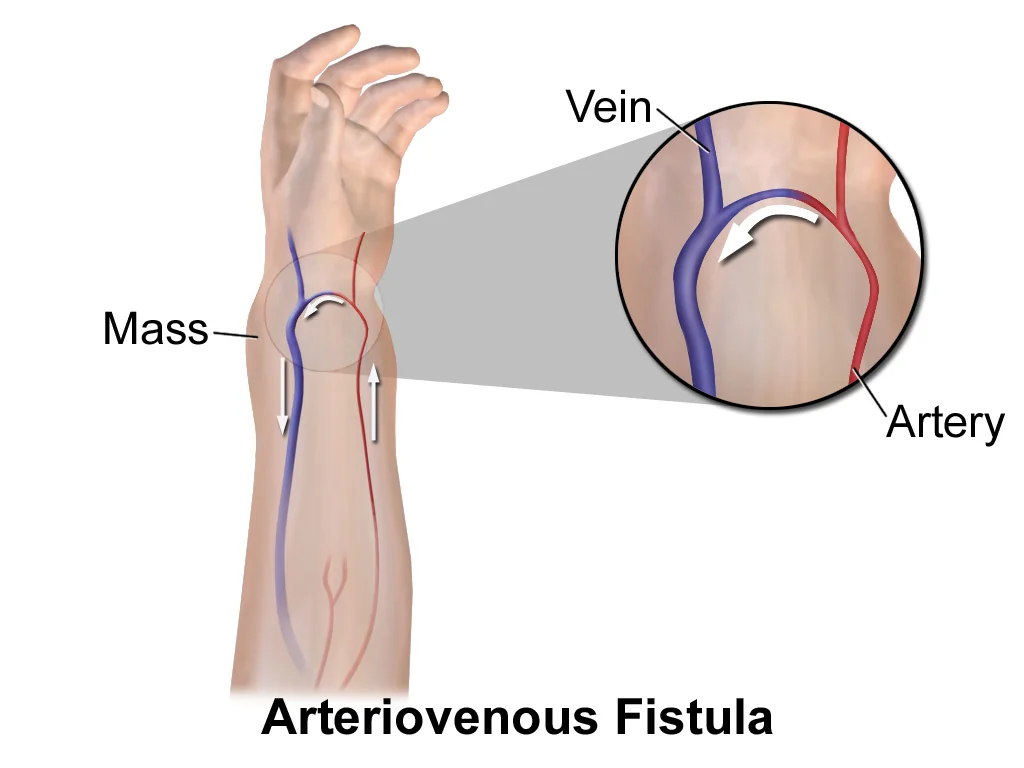
- Haemodialysis access: an arteriovenous fistula is the gold standard, needing 6 to 8 weeks to mature. Tunnelled central venous catheters carry a much higher risk of infection and are second best.
- Typical haemodialysis regimen: 4 hours, three times a week, usually in a satellite unit. Complications include intradialytic hypotension, disequilibrium syndrome, access problems and amyloidosis.
- Peritoneal dialysis: uses the peritoneum as the semipermeable membrane via a Tenckhoff catheter, performed at home daily. Peritonitis is the major complication - a cloudy bag with abdominal pain.
- Transplantation is the best option: for suitable patients it offers superior survival and quality of life compared with dialysis, and is more cost-effective. A live donor graft outlasts a deceased donor graft.
- Conservative management: an active treatment choice, not a failure of care - appropriate for frail elderly patients with multiple comorbidities in whom dialysis may not prolong meaningful life.
Introduction
End stage renal disease describes CKD stage G5 - an eGFR below 15 mL/min/1.73 m2 - at which the kidneys can no longer maintain fluid, electrolyte and waste homeostasis sufficiently to sustain life indefinitely.1 Around 70,000 people in the UK are living with treated ESRD, and the number continues to rise with the ageing population and the prevalence of diabetes.
The label matters less than the decision it prompts. Reaching G5 requires a considered choice between four management pathways, made with the patient well in advance of the crisis point. Emergency dialysis started through a temporary neck line in an unprepared patient carries worse outcomes than planned initiation, which is why NICE recommends that these conversations begin at least a year before RRT is expected to be needed.2
| Option | Where | Key advantage | Key disadvantage |
|---|---|---|---|
| Haemodialysis | Hospital or satellite unit (or home in selected patients) | Efficient clearance; unit staff manage the treatment | Rigid schedule and travel; large fluid and dietary restrictions; haemodynamic swings |
| Peritoneal dialysis | At home, daily | Independence, no needles, gentler on the circulation, preserves residual renal function longer | Daily commitment; risk of peritonitis; membrane fails over years |
| Transplantation | Surgical, then outpatient follow-up | Best survival and quality of life; freedom from dialysis | Requires major surgery, lifelong immunosuppression, and organ availability |
| Conservative kidney management | Community and outpatient | Avoids the burden of dialysis; symptom-focused care | Does not extend life; requires careful advance planning |
When to start renal replacement therapy
The decision is driven by clinical need rather than a number. Trials of very early initiation have not shown benefit, so dialysis is usually started when symptoms or biochemical complications appear - typically at an eGFR between 5 and 10, though a symptomatic patient may need to start earlier and a well patient may safely wait.
- Uraemic symptoms - nausea and vomiting, anorexia and weight loss, intractable pruritus, restless legs, fatigue and impaired cognition
- Uraemic complications - encephalopathy, asterixis, seizures, or uraemic pericarditis (all urgent)
- Refractory fluid overload - pulmonary oedema not controlled by diuretics and fluid restriction
- Refractory hyperkalaemia despite dietary measures, drug review and potassium binders
- Refractory metabolic acidosis
- Failure to thrive or malnutrition attributable to uraemia
Haemodialysis
Blood is pumped through an extracorporeal circuit and across a semipermeable membrane in the dialyser, against a countercurrent flow of dialysate. Solutes move by diffusion down their concentration gradients, and excess fluid is removed by ultrafiltration driven by a transmembrane pressure gradient. Anticoagulation, usually with heparin, prevents the circuit from clotting.
The standard UK regimen is 4 hours, three times weekly, in a hospital or satellite unit.4 Home haemodialysis and more frequent or nocturnal schedules give better clearance and fewer symptoms, and suit motivated patients.
Vascular access
| Access | Detail | Problems |
|---|---|---|
| Arteriovenous fistula | The gold standard. A surgical anastomosis between an artery and a vein (radiocephalic at the wrist, or brachiocephalic at the elbow), which arterialises the vein so it can take large-bore needles. Needs 6 to 8 weeks or more to mature before first use. | Stenosis and thrombosis, infection (less common than with lines), aneurysm, steal syndrome (distal ischaemia of the hand), and high-output cardiac failure with very high flow fistulas |
| Arteriovenous graft | A synthetic (usually PTFE) conduit between artery and vein, used when the native veins are inadequate. Can be used sooner than a fistula. | Higher rates of thrombosis and infection than a fistula |
| Tunnelled central venous catheter | A cuffed catheter tunnelled subcutaneously, usually into the internal jugular vein. Can be used immediately, so is used when access is needed before a fistula matures. | Much higher risk of infection and bacteraemia, central venous stenosis and thrombosis, and lower blood flows giving less efficient dialysis |
| Temporary (non-tunnelled) catheter | For immediate, short-term use in acute situations | Highest infection risk; should be replaced with definitive access promptly |
Complications of haemodialysis
| Type | Complications |
|---|---|
| Intradialytic (during a session) | Hypotension (the commonest - from rapid ultrafiltration, often with cramps and nausea), cramps, nausea and vomiting, headache, arrhythmia, chest pain, anaphylactoid reaction to the membrane, air embolism (rare), and haemolysis |
| Dialysis disequilibrium syndrome | Occurs when a very uraemic patient is dialysed too rapidly for the first time. Urea is cleared from blood faster than from the brain, drawing water into the brain by osmosis and causing cerebral oedema - headache, nausea, confusion, seizures and, rarely, death. Prevented by short, gentle initial sessions. |
| Access-related | Thrombosis, stenosis, infection and bacteraemia (especially Staphylococcus aureus), aneurysm, steal syndrome, high-output cardiac failure |
| Long-term | Accelerated cardiovascular disease (the leading cause of death), dialysis-related amyloidosis from beta-2 microglobulin deposition causing carpal tunnel syndrome and arthropathy, renal bone disease, acquired cystic kidney disease with a small risk of renal cell carcinoma, malnutrition, and depression |
| Infective | Line-related sepsis and infective endocarditis - dialysis patients with fever and a line need blood cultures and a low threshold for echocardiography; also blood-borne virus transmission risk, hence hepatitis B vaccination and surveillance |
Dialysis patients require substantial dietary and fluid restriction - typically limiting fluid to around 1 litre daily plus urine output, and restricting potassium, phosphate and sodium - supported by a specialist renal dietitian. Drug dosing must account for both renal impairment and dialysability, and many drugs are given after dialysis to avoid being removed.
Peritoneal dialysis
Peritoneal dialysis uses the patient's own peritoneal membrane as the dialysing surface. Dialysate is instilled into the peritoneal cavity through a Tenckhoff catheter; solutes diffuse across the peritoneum into the fluid, and water is drawn in by the osmotic gradient created by glucose (or icodextrin) in the dialysate. The fluid is then drained and replaced.
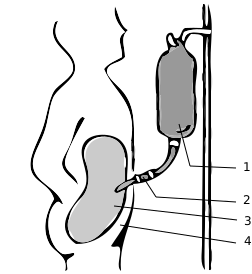
- Continuous ambulatory peritoneal dialysis (CAPD) - the patient performs around four manual exchanges daily, each taking 30 to 40 minutes, with fluid dwelling in the abdomen between exchanges
- Automated peritoneal dialysis (APD) - a machine performs exchanges overnight while the patient sleeps, leaving the day free; often preferred for those working or in education
Advantages and disadvantages
| Advantages | Disadvantages |
|---|---|
| Performed at home, giving independence and avoiding thrice-weekly travel | Daily commitment, with no days off; requires manual dexterity, adequate vision, and space to store fluids |
| No needles and no extracorporeal circuit | Risk of peritonitis and exit-site infection |
| Gentler haemodynamically - continuous fluid removal, so better tolerated in cardiac disease | Membrane failure over years, from fibrosis and loss of ultrafiltration capacity; most patients eventually transfer to haemodialysis |
| Preserves residual renal function longer | Protein loss in the dialysate, and glucose absorption causing weight gain and worsening glycaemic control in diabetes |
| Fewer dietary and fluid restrictions | Risk of hernia, and mechanical problems from raised intra-abdominal pressure |
Transplantation
Kidney transplantation is the treatment of choice for suitable patients with ESRD, offering better survival, better quality of life and lower long-term cost than dialysis. It is covered in detail in the transplantation and immunosuppression article; the essentials in the context of choosing a modality are summarised here.
- Live donor transplantation gives the best outcomes, can be planned electively, and may allow pre-emptive transplantation before dialysis is ever needed
- Deceased donor transplantation involves waiting on the national list, with a median wait of two to three years in the UK; donors may be after brain death (DBD) or circulatory death (DCD)
- Not everyone is a candidate - active malignancy, active infection, severe cardiorespiratory disease and inability to comply with immunosuppression are the main barriers; age alone is not a contraindication
- Lifelong immunosuppression is required, with its attendant risks of infection, malignancy and drug toxicity
- Grafts do not last forever - patients may return to dialysis and be re-listed
Conservative kidney management
Also called conservative or supportive care, this is an active and legitimate treatment pathway - not a withdrawal of care - in which the decision is made not to pursue dialysis, and management focuses on preserving remaining function, controlling symptoms and planning for the end of life.5
- Most appropriate for frail elderly patients with significant comorbidity, in whom the survival advantage of dialysis is small or absent, and where dialysis may reduce quality of life, accelerate functional decline and involve substantial time in hospital
- Includes active medical management - blood pressure and fluid control, correction of anaemia and acidosis, phosphate control, and treatment of pruritus, nausea, restless legs and breathlessness
- Involves early advance care planning - discussing preferred place of care and death, resuscitation decisions and ceilings of treatment while the patient can participate
- Requires honest prognostic discussion, with palliative care involvement as appropriate
- Is reversible - patients may change their mind, and the decision should be revisited
Complications of end stage renal disease
- Cardiovascular disease - the leading cause of death; risk is many times that of the general population, from accelerated atherosclerosis, left ventricular hypertrophy, vascular calcification and arrhythmia
- Anaemia from erythropoietin deficiency
- CKD-mineral and bone disorder and renal osteodystrophy, with fracture and vascular calcification
- Hyperkalaemia and metabolic acidosis
- Fluid overload and hypertension
- Malnutrition and protein-energy wasting, worsened by dialysate protein losses
- Infection - access-related sepsis, PD peritonitis, and generally impaired immunity
- Dialysis-related amyloidosis with carpal tunnel syndrome
- Acquired cystic kidney disease with a small increased risk of renal cell carcinoma
- Uraemic pericarditis, neuropathy and encephalopathy
- Sexual dysfunction and infertility
- Depression, anxiety and reduced quality of life - highly prevalent and frequently untreated
- Calciphylaxis - painful ischaemic skin necrosis from vascular calcification, with high mortality
Red flags
Prognosis
Survival on dialysis is considerably worse than most people expect, and comparable to that of many malignancies: overall five-year survival on dialysis is around 50%, and substantially lower in older patients and those with diabetes or established cardiovascular disease.3 Cardiovascular disease accounts for the majority of deaths, followed by infection and withdrawal of treatment.
Transplantation transforms the outlook. A successful transplant roughly doubles life expectancy compared with remaining on dialysis, and markedly improves quality of life, employment and fertility. Graft survival continues to improve, with most live donor grafts functioning at 10 years, and pre-emptive transplantation before dialysis gives the best results of all.
Outcomes with haemodialysis and peritoneal dialysis are broadly similar overall. Peritoneal dialysis often gives better early outcomes and preserves residual function, while haemodialysis becomes preferable once the peritoneal membrane fails - so most patients on PD eventually transfer. Modality choice is therefore better framed as a sequence over a patient's lifetime than a single irreversible decision.
For frail elderly patients with multiple comorbidities, the survival advantage of dialysis over conservative management is small and may be negligible once functional status is taken into account, and dialysis involves considerably more hospital time. Presenting conservative care as a genuine option, with realistic figures, is an essential part of informed consent rather than a counsel of despair.
References
- KDIGO 2024 Clinical Practice Guideline for the Evaluation and Management of Chronic Kidney Disease. Available here
- NICE NG107. Renal replacement therapy and conservative management. 2018. Available here
- UK Renal Registry. Annual report on adult renal replacement therapy in the UK. Available here
- UK Kidney Association. Clinical practice guidelines - haemodialysis and peritoneal dialysis. Available here
- NICE Clinical Knowledge Summaries. Chronic kidney disease. Available here
- BruceBlaus, CC BY 3.0, via Wikimedia Commons. Available here
- Nanoxyde, CC BY-SA 3.0, via Wikimedia Commons. Available here
This article is written for revision and education. It is not clinical guidance and must not be used to make decisions about the care of a patient. Always check current NICE guidance and local protocols.