
Klinefelter Syndrome: 47,XXY
Key points
- Klinefelter syndrome: one or more extra X chromosomes in a phenotypic male, classically 47,XXY, affecting around 1 in 600 male births.
- Mechanism: meiotic non-disjunction in either parent, with a modest maternal age association; not inherited from an affected parent in the usual sense.
- Cardinal features: small, firm testes and infertility from primary (hypergonadotrophic) hypogonadism; tall stature; gynaecomastia.
- Presentation: often subtle or absent in childhood; commonly identified in adulthood during investigation of infertility, or not at all.
- Testosterone replacement: started at puberty or diagnosis, improves virilisation, bone density, mood and libido, but does not restore fertility.
- Fertility: azoospermia in the great majority; surgical sperm retrieval (micro-TESE) with ICSI offers a chance of biological parenthood for some.
- Associated risks: increased risk of breast cancer, osteoporosis, venous thromboembolism, type 2 diabetes and metabolic syndrome.
- Cognition: usually normal intelligence, but increased rates of specific language, literacy and executive function difficulties, and of anxiety and depression.
Introduction
Klinefelter syndrome is the presence of one or more extra X chromosomes in a phenotypic male, classically 47,XXY. It is the commonest sex chromosome disorder and the commonest genetic cause of male infertility and primary hypogonadism, with an estimated prevalence of around 1 in 600 live male births.1
It is also one of the most under-diagnosed genetic conditions in medicine: many affected men are never formally diagnosed, and among those who are, the diagnosis is frequently made incidentally in adulthood during investigation of infertility, low libido, or gynaecomastia, rather than from childhood recognition. This gap between prevalence and diagnosis rate is itself a common exam point.
Two features explain the gap. First, the phenotype in childhood is often unremarkable, so there is rarely a clear trigger for testing before puberty. Second, once puberty has passed, the principal consequence - reduced fertility - only becomes clinically relevant when a man actively tries to conceive, which for many is a decade or more after the physical changes of hypogonadism first appear. Contrast this with Down syndrome or Turner syndrome, where a recognisable phenotype or a screening pathway usually brings the diagnosis forward into childhood.
Aetiology
The extra X chromosome arises from meiotic non-disjunction, with roughly equal contribution from maternal and paternal meiosis (unlike Turner syndrome, where the loss is predominantly paternal in origin). There is a modest association with advanced maternal age, though far weaker than in trisomy 21.
| Karyotype | Proportion / note |
|---|---|
| 47,XXY | ~80-90% - the classic and by far commonest pattern |
| 46,XY/47,XXY mosaicism | A minority; phenotype often milder, and spontaneous fertility is more likely |
| 48,XXXY, 48,XXYY, 49,XXXXY | Rare variants with an additional sex chromosome; generally more severe phenotype including a higher likelihood of learning disability, the more extra sex chromosome material is present |
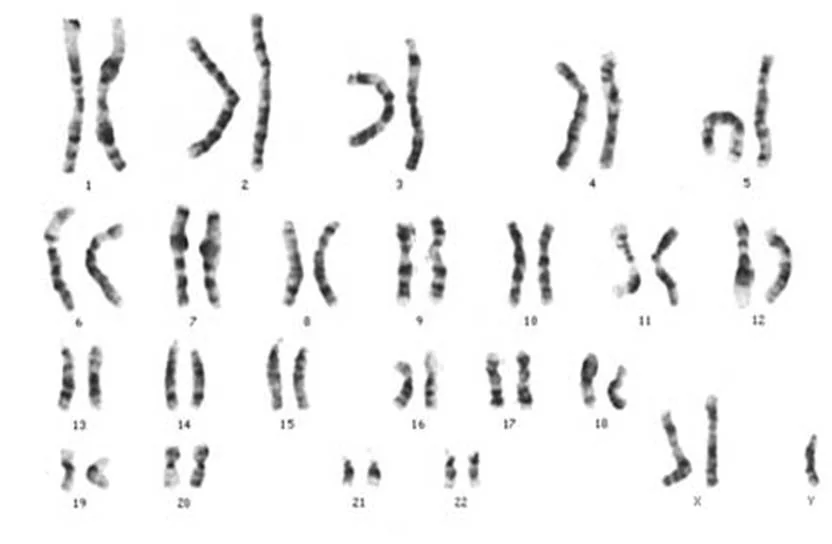
The extra X chromosome causes testicular dysfunction from puberty onwards - progressive hyalinisation and fibrosis of the seminiferous tubules - leading to primary testicular failure. Leydig cell function is relatively better preserved than seminiferous tubule function early on, but testosterone production still declines over time, producing a mixed picture of low-to-borderline testosterone with impaired spermatogenesis.3
Clinical features
Features are often subtle in childhood and become more apparent from puberty onwards, which is why the diagnosis is so often delayed.
Childhood
- Often unremarkable; may have mild speech and language delay
- Slightly longer limbs relative to trunk length, and relatively small testes even before puberty
- Cryptorchidism is somewhat more common than in the general population
Puberty and adulthood
- Small, firm testes - the single most consistent physical sign, present from puberty onwards, and often the clue that prompts karyotype testing
- Tall stature with disproportionately long legs, from delayed epiphyseal fusion secondary to low testosterone
- Gynaecomastia, often prominent, related to a relatively increased oestrogen-to-testosterone ratio, and associated with an increased risk of male breast cancer
- Reduced facial and body hair, and a tendency to a female pattern of fat distribution
- Infertility - the presenting complaint in a large proportion of adult diagnoses, from azoospermia or severe oligospermia
- Reduced libido and erectile dysfunction, related to hypogonadism
- Learning and behavioural features - typically normal general intelligence, but increased rates of specific difficulties with expressive language, reading and executive function, and increased rates of anxiety, depression and social difficulties, often related in part to the practical and psychological impact of the physical features themselves
Examination
Examination should be systematic rather than relying on any single sign, since the phenotype can be subtle, especially before puberty or once testosterone replacement has begun.
- Height and body proportions - tall stature with a disproportionately long leg length relative to trunk (a reduced upper-to-lower segment ratio)
- Genitalia - testicular volume, which is characteristically small (often under 6 mL, well below the normal adult range) and firm, with a normal or near-normal phallus
- Breast tissue - gynaecomastia, sometimes asymmetric, and worth palpating specifically for a discrete lump given the increased breast cancer risk
- Body hair distribution - reduced facial, axillary and pubic hair for age
- General build - a tendency to a relatively female pattern of fat distribution and reduced muscle bulk if hypogonadism is untreated
Differential diagnosis
- Kallmann syndrome and other causes of hypogonadotrophic hypogonadism - low testosterone with low or inappropriately normal gonadotrophins, distinguished from Klinefelter syndrome's primary (hypergonadotrophic) pattern by the LH/FSH result, and by anosmia in Kallmann syndrome specifically
- Constitutional delay of puberty - normal karyotype, and puberty eventually progresses spontaneously with normal testicular volume
- Androgen insensitivity syndrome - a 46,XY karyotype with a female or ambiguous phenotype due to end-organ androgen resistance, distinguished by karyotype and by the phenotype itself
- Simple gynaecomastia (pubertal, or secondary to drugs, liver disease or a hormone-secreting tumour) - distinguished by normal testicular volume and a normal karyotype
Investigations
Karyotype from a peripheral blood sample gives the definitive diagnosis. Hormone profiling supports and often precedes it, particularly when the diagnosis is first considered in an infertility clinic.
- LH and FSH - elevated, reflecting primary (hypergonadotrophic) hypogonadism, as the pituitary drives testes that cannot respond adequately
- Testosterone - low or low-normal, and typically declines further with age
- Semen analysis - azoospermia in the great majority, though sperm can occasionally still be found on testicular biopsy even when the ejaculate sample shows none
- Testicular ultrasound - small testicular volume, and to exclude a coexisting testicular mass
- Bone density (DXA) - baseline, given the increased osteoporosis risk from long-standing hypogonadism
- Karyotype - confirms 47,XXY or a variant, and is the test that should be sent whenever the clinical picture is suggestive, since hormone results alone cannot distinguish Klinefelter syndrome from other causes of primary hypogonadism
Management
Care is multidisciplinary - endocrinology, urology/andrology, fertility services, and psychological or educational support as needed - with the two main pillars being hormone replacement and fertility planning, which are addressed separately because testosterone replacement does not restore fertility and can in fact further suppress residual spermatogenesis.
Testosterone replacement
Testosterone replacement therapy, usually starting around the time of expected puberty or at diagnosis in an adult, addresses virilisation, bone density, muscle mass, mood and libido. It is generally continued lifelong, with monitoring of testosterone levels, haematocrit (testosterone can cause polycythaemia), lipid profile and prostate-specific antigen in line with standard testosterone replacement monitoring in any hypogonadal man.4
Fertility
The great majority of men with classic 47,XXY Klinefelter syndrome are azoospermic and infertile through natural conception. Microdissection testicular sperm extraction (micro-TESE) can retrieve viable sperm from a meaningful proportion of men, even with a completely azoospermic ejaculate, for use with intracytoplasmic sperm injection (ICSI) as part of IVF. This should be discussed proactively as part of routine care, ideally before or around puberty when preservation options can be considered, and reproductive counselling should make clear that infertility, while common, is not universal, particularly in mosaic Klinefelter syndrome.
Other management
- Gynaecomastia - can be treated surgically if it causes significant psychological distress or discomfort; testosterone replacement alone does not reliably reverse established gynaecomastia
- Breast cancer surveillance - men with Klinefelter syndrome have a risk of male breast cancer intermediate between the general male and female population, and should be advised on breast awareness and prompt review of any new lump
- Metabolic and cardiovascular risk - increased rates of type 2 diabetes, metabolic syndrome and venous thromboembolism warrant proactive lifestyle advice and periodic screening
- Speech and language, and educational support - assessment and input from early childhood where language delay is identified, rather than waiting for school-age difficulties to become apparent
- Psychological support - for the wider impact of the diagnosis on body image, fertility and identity, which can be considerable and is easily overlooked in a clinic focused on hormone levels
Complications
Long-standing untreated hypogonadism, and the extra X chromosome itself, carry consequences beyond fertility that shape long-term follow-up.
- Osteoporosis - from chronic low testosterone, with an increased fracture risk if replacement is inadequate or started late
- Male breast cancer - risk roughly 20-50 times that of the general male population, though the absolute risk remains low; still enough to warrant breast awareness advice
- Metabolic syndrome and type 2 diabetes - increased prevalence, related to both the hormonal profile and a tendency to central adiposity
- Venous thromboembolism - baseline risk is increased, and testosterone replacement itself (particularly at supraphysiological levels) can add to this, which is one reason for routine monitoring on treatment
- Autoimmune disease - modestly increased rates of conditions such as systemic lupus erythematosus, thought to relate to the extra X chromosome's effect on immune regulation2
- Psychosocial impact - the cumulative effect of infertility, gynaecomastia and, for some, subtle learning or language difficulties, on self-esteem and relationships, which deserves explicit attention rather than being assumed to resolve once hormone levels are corrected
Genetic counselling
Klinefelter syndrome usually arises from a sporadic non-disjunction event, and the recurrence risk in a future pregnancy is only marginally above the general population baseline, similar in principle to the reassurance given in Turner syndrome. It is not a condition an affected man passes on to children in the conventional sense of a Mendelian trait, though sperm retrieved via micro-TESE for ICSI can occasionally carry an unbalanced sex chromosome complement, so pre-implantation or prenatal testing may be discussed with couples pursuing this route.
Transition and long-term follow-up
Where the diagnosis is made in childhood or adolescence, transition from paediatric endocrinology to adult services needs the same deliberate planning as in Turner syndrome, because the reasons for follow-up change over time. In adolescence the focus is pubertal induction, growth, and early discussion of fertility preservation; in adulthood it shifts to maintaining adequate testosterone replacement, monitoring bone density and metabolic risk, and supporting fertility treatment if the patient wishes to conceive.
- Testosterone level and symptom review - at least annually once replacement is established, adjusting dose and preparation to the patient's response rather than to a target number alone
- Haematocrit - checked before starting and periodically on treatment, since testosterone-induced polycythaemia may require dose reduction or venesection
- Bone density - baseline DXA and repeat scanning at intervals, particularly where replacement started late or has been inconsistent
- Metabolic screen - blood pressure, HbA1c and lipids, given the increased prevalence of type 2 diabetes and metabolic syndrome
- Fertility discussion revisited - a man's reproductive intentions change over years, and options should be raised again rather than considered settled by a single adolescent conversation
- Mood and psychological wellbeing - explicitly asked about, since anxiety and depression are commoner and are often attributed solely to hypogonadism when they may need treatment in their own right
A recurring practical point is that many men diagnosed in adulthood have already lived for decades with untreated hypogonadism, so the initial assessment is as much about identifying accumulated consequences - low bone density, metabolic risk, psychological impact - as it is about starting replacement. Framing the diagnosis positively matters: it explains symptoms the patient may have found inexplicable for years, and most of its consequences are treatable.
Prognosis
With testosterone replacement and routine monitoring for the associated metabolic, bone and cardiovascular risks, most men with Klinefelter syndrome have a normal life expectancy and lead full lives, working, forming relationships and, via assisted reproduction, sometimes achieving biological parenthood. Because many affected men remain undiagnosed throughout life without ever developing complications requiring specific attention, the overall population impact of the diagnosis is best thought of as a spectrum, from men who are never identified to those with more marked hypogonadism and its downstream consequences from adolescence onwards.
References
- Groth KA, Skakkebaek A, Host C et al. Klinefelter syndrome - a clinical update. Journal of Clinical Endocrinology & Metabolism. 2013. Available here
- Gravholt CH, Chang S, Wallentin M et al. Klinefelter syndrome: integrating genetics, neuropsychology, and endocrinology. Endocrine Reviews. 2018. Available here
- GeneReviews. Klinefelter Syndrome. NCBI Bookshelf. Available here
- British Society for Sexual Medicine / European Association of Urology. Guidelines on male hypogonadism. Available here
This article is written for revision and education. It is not clinical guidance and must not be used to make decisions about the care of a patient. Always check current NICE guidance and local protocols.