
Penile Cancer
Key points
- Penile cancer: rare in the UK (around 700 cases a year), and over 95% are squamous cell carcinomas, typically arising on the glans or inner prepuce.
- Main risk factors: HPV infection (types 16 and 18), phimosis, lichen sclerosus (BXO), chronic inflammation, smoking and immunosuppression including HIV.
- Circumcision: neonatal circumcision is protective, largely by preventing phimosis and chronic inflammation - which is why the disease is rare in populations where it is routine.
- Presentation: a painless ulcer, lump, plaque or fungating mass on the glans or prepuce. It is often concealed beneath a phimotic foreskin, causing substantial delay.
- Premalignant lesions: penile intraepithelial neoplasia (PeIN) - including Bowen disease and erythroplasia of Queyrat (a red velvety plaque on the glans).
- Spread: predictably via lymphatics to the INGUINAL nodes first, then to pelvic nodes. Distant metastasis is late.
- The prognostic factor that matters: inguinal lymph node status. Node-negative disease has ~85-90% 5-year survival; pelvic nodal involvement falls below 20%.
- Management: organ-preserving surgery wherever possible (topical therapy, laser, glansectomy), with inguinal lymph node staging in anything above low-risk disease.
Introduction
Penile cancer is uncommon in the UK, with around 700 new cases annually - roughly 1% of male cancers - but its incidence varies enormously worldwide, reaching several times UK rates in parts of South America, Africa and Asia. It is predominantly a disease of older men, with most cases diagnosed over 60, though HPV-driven disease can occur considerably earlier.1
Over 95% are squamous cell carcinomas, arising most often on the glans (around half) or the inner surface of the prepuce. Rarer types include melanoma, basal cell carcinoma, sarcoma and, importantly, secondary deposits from bladder, prostate or rectal primaries.
Two features dominate the clinical picture. First, the disease is often hidden beneath a phimotic foreskin, so patients frequently present late with advanced local disease - the median delay from noticing a lesion to seeking help is measured in many months. Second, its spread is highly predictable, moving stepwise through the inguinal then pelvic lymph nodes, which makes accurate nodal staging both feasible and decisive for survival.
Risk factors
- Human papillomavirus (HPV) infection - particularly types 16 and 18, detectable in around half of penile cancers. The same oncogenic types responsible for cervical and oropharyngeal cancer, and the reason HPV vaccination of boys (introduced in the UK in 2019) is expected to reduce incidence
- Phimosis - a strong association, probably mediated through retained smegma, chronic inflammation and the inability to inspect or clean the glans
- Lichen sclerosus (balanitis xerotica obliterans) - a recognised premalignant condition requiring long-term follow-up
- Chronic inflammation - recurrent balanitis and poor genital hygiene
- Smoking - a clear dose-dependent association, and one of the few modifiable factors
- Immunosuppression - notably HIV, which increases risk several-fold, and transplant immunosuppression
- Increasing age - most cases occur over 60
- Lack of neonatal circumcision - neonatal circumcision is protective, largely by preventing phimosis and chronic inflammation. Note the nuance: circumcision performed in adulthood does not confer the same protection
- PUVA (psoralen and ultraviolet A) therapy - for psoriasis, a recognised iatrogenic risk
- Multiple sexual partners and early age of first intercourse - through HPV acquisition
- Previous or current genital warts (condylomata)
Clinical features
The primary lesion
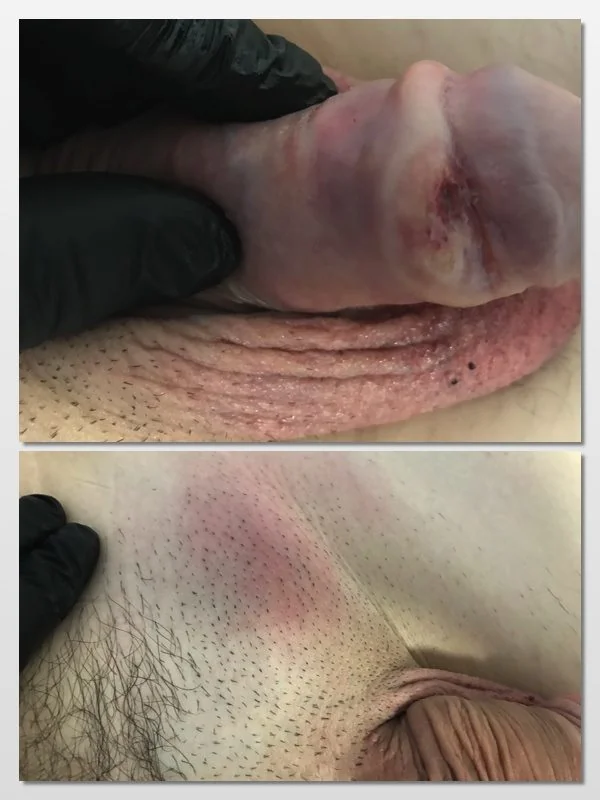
- A painless lump, ulcer, plaque or wart-like growth on the glans, coronal sulcus or inner prepuce - painlessness is characteristic and contributes to delayed presentation
- A fungating or exophytic mass in more advanced disease
- Bleeding or foul-smelling discharge from beneath the foreskin - often the symptom that finally prompts presentation
- Persistent ulceration that fails to heal despite treatment for presumed infection
- Colour change - red, white or pigmented areas
- Phimosis that is new, worsening, or preventing inspection of the glans
- Difficulty retracting the foreskin, or a palpable mass felt through it
Regional and metastatic disease
- Palpable inguinal lymphadenopathy - present in around half at diagnosis, though a proportion of these are reactive from infected or inflamed tumours rather than metastatic
- Fixed or ulcerated inguinal nodes - advanced nodal disease, which may erode into the femoral vessels causing catastrophic haemorrhage
- Lower limb lymphoedema from lymphatic obstruction
- Weight loss, fatigue and anorexia
- Bone pain, cough or abdominal symptoms with distant metastases - although distant spread is typically a late event
- Hypercalcaemia - a recognised paraneoplastic feature, often with bulky disease
Differential diagnosis
| Condition | Distinguishing features |
|---|---|
| Penile squamous cell carcinoma | Persistent painless ulcer, plaque or mass, often with bleeding or discharge; does not resolve with treatment |
| Balanitis / balanoposthitis | Diffuse erythema and soreness of glans and prepuce; resolves with antifungal or antibiotic treatment. Recurrent candidal balanitis suggests diabetes |
| Genital warts (condylomata acuminata) | Multiple soft papillomatous lesions, HPV 6 and 11 (low risk); usually clearly benign |
| Primary syphilis (chancre) | Painless, indurated, clean-based ulcer with regional lymphadenopathy; heals spontaneously. Serology and dark-field microscopy |
| Genital herpes | Painful grouped vesicles and shallow ulcers, recurrent, often with systemic symptoms at first episode |
| Lichen sclerosus (BXO) | White, atrophic, scarred prepuce and glans; premalignant, so biopsy if atypical or non-resolving |
| Lichen planus / psoriasis | Violaceous flat-topped papules, or well-demarcated scaly plaques with lesions elsewhere |
| Chancroid / lymphogranuloma venereum | Painful ragged ulcer with tender suppurative nodes; travel and sexual history |
| Zoon balanitis | Benign plasma cell balanitis - shiny orange-red patch in older uncircumcised men; biopsy distinguishes it |
| Peyronie disease | Fibrous plaque of the tunica albuginea causing curvature and pain on erection, not an ulcer |
| Metastasis from another primary | Rare; bladder, prostate or rectal primary; consider if there is a known cancer |
The practical rule is straightforward: any penile lesion that persists beyond about four weeks despite appropriate treatment requires biopsy, and a sexual health screen should be performed in parallel where an infective cause is plausible.
Investigations
Diagnosis of the primary
- Full examination of the penis with the foreskin retracted - if phimosis prevents this, arrange examination under anaesthesia with dorsal slit or circumcision
- Biopsy of the lesion - essential for diagnosis, giving histological type, grade and depth of invasion, plus HPV status
- Examination of both groins for lymphadenopathy, documenting size, number, laterality and whether nodes are mobile or fixed
- MRI of the penis (sometimes with an artificial erection) - to assess corporal invasion, which determines whether organ-preserving surgery is feasible
- Ultrasound of the penis - an alternative for assessing local depth
- HIV test and sexual health screen - given the association with HPV and immunosuppression
Staging the nodes - the decisive step
- Ultrasound of the groins with fine needle aspiration of any suspicious node
- Dynamic sentinel lymph node biopsy (DSNB) - the standard approach for staging clinically node-negative patients with intermediate or high-risk primaries. It identifies occult metastasis while sparing the majority the considerable morbidity of a full lymphadenectomy
- CT chest, abdomen and pelvis - for pelvic nodal and distant staging in node-positive or high-risk disease
- PET-CT - to assess pelvic and distant disease where inguinal nodes are positive
- Bloods - FBC, U&Es, LFTs and calcium (hypercalcaemia can occur as a paraneoplastic phenomenon or with bulky disease)
Staging
| Stage | Description |
|---|---|
| Tis | Carcinoma in situ (penile intraepithelial neoplasia) |
| Ta | Non-invasive verrucous carcinoma |
| T1 | Invades subepithelial connective tissue (T1a without, T1b with lymphovascular invasion or high grade) |
| T2 | Invades corpus spongiosum |
| T3 | Invades corpus cavernosum or urethra |
| T4 | Invades adjacent structures - scrotum, prostate, pubic bone |
| N1-N3 | N1 one or two unilateral inguinal nodes; N2 three or more unilateral or bilateral; N3 pelvic nodes or extranodal extension |
| M1 | Distant metastasis |
Management
Management is delivered through specialist supraregional penile cancer centres in the UK, because the disease is rare and outcomes are better with concentrated expertise. The guiding principle is organ preservation wherever oncologically safe, since function and body image matter enormously and most patients can now avoid total penectomy.2
The primary tumour
| Stage | Options |
|---|---|
| PeIN / Tis | Topical 5-fluorouracil or imiquimod, laser ablation, or glans resurfacing. Circumcision alone may suffice if disease is confined to the prepuce |
| Ta / T1 | Wide local excision, laser therapy, glans resurfacing or circumcision, aiming to preserve the organ |
| T2 (glans confined) | Glansectomy with reconstruction, or partial penectomy; radiotherapy or brachytherapy as an organ-preserving alternative in selected patients |
| T3 / T4 | Partial or total penectomy, with perineal urethrostomy if total penectomy is required. Neoadjuvant chemotherapy may be used to downstage bulky disease |
| Metastatic | Platinum-based chemotherapy (e.g. TIP - paclitaxel, ifosfamide, cisplatin); palliative radiotherapy and supportive care |
The lymph nodes
- Low-risk, node-negative disease (Tis, Ta, T1a) - surveillance of the groins is appropriate
- Intermediate/high-risk with impalpable nodes - dynamic sentinel lymph node biopsy; proceed to lymphadenectomy if positive
- Palpable nodes - fine needle aspiration or biopsy; if malignant, inguinal lymphadenectomy. Note that palpable nodes may be reactive to infection, so a short course of antibiotics before reassessment is sometimes used
- Confirmed inguinal metastases - radical inguinal lymphadenectomy, with pelvic lymphadenectomy if there are multiple or extranodal-extension-positive inguinal nodes
- Adjuvant chemotherapy for extensive nodal disease; neoadjuvant chemotherapy for bulky or fixed nodes
- Lymphadenectomy carries significant morbidity - lymphoedema of the legs and scrotum, wound infection and breakdown, seroma and lymphocele - which is precisely why sentinel node biopsy is preferred where it is applicable
Supportive care
- Clinical nurse specialist support and access to psychosexual counselling - these are not optional extras in a cancer affecting body image, sexual function and urinary function so profoundly
- Smoking cessation support
- Reconstructive and prosthetic options, including phalloplasty in selected cases
- Lymphoedema management after lymphadenectomy
- Long-term follow-up - most recurrences occur within the first 2 years, and self-examination should be taught
Complications
- Local invasion - into corpora, urethra, scrotum and pubic bone, causing urinary obstruction and fistulae
- Inguinal nodal metastasis - the principal determinant of survival
- Erosion of the femoral vessels by fixed inguinal nodes, with the risk of catastrophic haemorrhage
- Lower limb and genital lymphoedema - from nodal disease and, commonly, from lymphadenectomy
- Distant metastasis - lung, liver, bone; usually a late event
- Hypercalcaemia as a paraneoplastic phenomenon
- Urinary complications - obstruction, spraying, and the need for perineal urethrostomy after total penectomy
- Sexual dysfunction and infertility - after partial or total penectomy
- Psychological morbidity - profound effects on body image, masculinity, relationships and mood; depression is common and frequently under-recognised
- Surgical complications - wound breakdown, infection, meatal stenosis, seroma and lymphocele
- Chemotherapy and radiotherapy toxicity
Red flags
Prognosis
Lymph node status is by far the most important prognostic factor, and it dominates everything else. Patients with node-negative disease have 5-year survival of around 85-90%, whereas those with inguinal nodal involvement fall to roughly 40-50%, and pelvic nodal disease or extranodal extension carries a 5-year survival below 20%. Distant metastatic disease remains largely incurable, with median survival of under a year.
Stage, grade and lymphovascular invasion of the primary all influence outcome principally through their effect on the likelihood of nodal spread - which is the rationale for sentinel lymph node biopsy in clinically node-negative intermediate and high-risk disease. Identifying and clearing occult nodal metastases early gives materially better survival than waiting for nodes to become clinically apparent, and this is one of the clearest examples in urology of staging directly changing outcome rather than merely describing it.
Two further points deserve emphasis. First, delayed presentation is the main modifiable determinant of stage at diagnosis: embarrassment, and the concealment of lesions beneath a phimotic foreskin, mean many men present with locally advanced disease that could have been treated with simple organ-preserving surgery months earlier. Second, survivorship needs are substantial and easily neglected - even successfully treated men face lasting effects on sexual function, urinary function, body image and mental health, and lymphoedema after lymphadenectomy can be lifelong. Looking forward, the HPV vaccination programme extended to boys in the UK in 2019 is expected to reduce the incidence of HPV-driven penile cancer over the coming decades, in the same way that it is already reducing cervical disease.
References
- Cancer Research UK. Penile cancer statistics. Available here
- European Association of Urology / ASCO. Guidelines on Penile Cancer. Available here
- NICE NG12. Suspected cancer: recognition and referral. 2015, updated 2023. Available here
- NICE. Improving outcomes in urological cancers (supraregional penile cancer centres). Available here
- British Association of Urological Surgeons (BAUS). Penile cancer - patient information. Available here
- UK Health Security Agency. HPV vaccination programme (extended to boys, 2019). Available here
- DickGrayson07, CC BY-SA 4.0, via Wikimedia Commons. Available here
This article is written for revision and education. It is not clinical guidance and must not be used to make decisions about the care of a patient. Always check current NICE guidance and local protocols.