
Epididymitis and Orchitis
Key points
- Epididymo-orchitis: inflammation of the epididymis and, by contiguous spread, the testis. Usually infective and typically unilateral, with a gradual onset over days.
- The rule that overrides everything: exclude testicular torsion first. Torsion is sudden and severe; epididymo-orchitis is gradual. If there is any doubt - especially under 25 - explore surgically.
- Organism depends on age and sexual history: under 35 or sexually active: Chlamydia trachomatis and Neisseria gonorrhoeae. Over 35 or with urinary tract abnormality: enteric organisms, chiefly E. coli.
- Classic signs: tender, swollen epididymis (felt behind and above the testis), scrotal erythema and warmth, and a positive Prehn's sign - elevating the testis relieves the pain.
- Cremasteric reflex: preserved in epididymo-orchitis, whereas it is characteristically absent in torsion.
- Treatment - STI likely: ceftriaxone IM (single dose) plus doxycycline 100 mg twice daily for 10-14 days, with partner notification and full sexual health screening.1
- Treatment - enteric likely: a quinolone (ofloxacin or ciprofloxacin) or doxycycline for 10-14 days, guided by urine culture.
- Isolated orchitis: usually viral, and classically mumps - typically 4-8 days after parotitis, in an unimmunised patient. Treatment is supportive.
Introduction
Epididymitis is inflammation of the epididymis, the coiled tube along the posterolateral aspect of the testis that stores and transports sperm. Because infection readily spreads to the adjacent testis, the combined picture of epididymo-orchitis is the usual clinical presentation. Isolated orchitis - inflammation of the testis alone - is much less common and is typically viral in origin.2
Infection normally reaches the epididymis by retrograde ascent along the vas deferens from the urethra, prostate or bladder. This explains the two distinct clinical groups: younger, sexually active men in whom the organism ascends from a urethritis, and older men in whom it ascends from the urinary tract, often in the context of outflow obstruction, catheterisation or instrumentation.
Aetiology
The likely organism is predicted by age, sexual history and the presence of urinary tract abnormality, and this is what determines empirical antibiotic choice.
| Group | Likely organisms | Clinical pointers |
|---|---|---|
| Sexually active men, typically under 35 | Chlamydia trachomatis (commonest), Neisseria gonorrhoeae, Mycoplasma genitalium | Urethral discharge, dysuria, new or multiple partners, previous STI |
| Men over 35, or with urinary tract abnormality | Enteric organisms - E. coli, Klebsiella, Proteus, Enterococcus, Pseudomonas | Lower urinary tract symptoms, BPH, catheter, recent instrumentation, known UTI |
| Men who have insertive anal intercourse | Enteric organisms as well as STI pathogens | Take a full and non-judgemental sexual history |
| Isolated orchitis (viral) | Mumps (paramyxovirus); also coxsackie, EBV, echovirus, varicella | Parotitis 4-8 days earlier, unimmunised, bilateral in ~15-30% |
| Immunosuppressed / endemic exposure | Mycobacterium tuberculosis, Brucella, fungal | 'Beaded' vas deferens, chronic course, TB risk factors, travel history |
Non-infective causes
- Amiodarone - a well-recognised, dose-related, non-infective epididymitis that resolves on dose reduction or withdrawal. Worth remembering, as it avoids futile antibiotics
- Trauma and post-vasectomy congestive epididymitis
- Behçet disease and other vasculitides
- Idiopathic
- Urine reflux along the vas after strenuous exertion or heavy lifting
Risk factors
- Unprotected sexual intercourse, new or multiple partners, and previous sexually transmitted infection
- Bladder outlet obstruction and incomplete emptying - benign prostatic hyperplasia, stricture
- Urinary catheterisation, cystoscopy or recent urological instrumentation
- Recent urinary tract infection or prostatitis
- Structural urinary tract abnormality - important in children, where epididymitis should prompt assessment for underlying anomalies
- Immunosuppression and diabetes
- Anal intercourse, and lack of mumps immunisation for viral orchitis
Clinical features
Symptoms
- Gradual onset of unilateral scrotal pain and swelling, developing over hours to days rather than minutes
- Pain often radiates to the groin, lower abdomen or flank, following the course of the vas
- Dysuria, urinary frequency and urgency - suggesting a urinary source
- Urethral discharge - suggesting a sexually transmitted cause; it may be scant and only present on examination
- Fever, rigors and malaise - more prominent than in torsion
- Nausea and vomiting are uncommon - their presence should raise concern for torsion instead
- Symptoms of mumps - fever, headache and parotid swelling preceding orchitis by 4-8 days
Signs
- Tender, swollen, indurated epididymis - palpable posterior and superior to the testis; early on the epididymis alone is tender, but as inflammation spreads the whole hemiscrotum becomes involved and the two become indistinguishable
- Erythematous, warm, oedematous scrotal skin
- Positive Prehn's sign - elevation of the testis relieves the pain (in torsion it does not)
- Cremasteric reflex present - preserved, unlike in torsion
- Normal testicular lie - vertical, not high-riding or horizontal
- Reactive hydrocoele may develop
- Fever and tachycardia in more significant infection
- Examine the abdomen, and perform a gentle DRE where prostatitis is suspected; check for urethral discharge
Investigations
- Urine dipstick and midstream urine for culture - looking for an enteric organism; useful in the over-35 group
- First-void urine NAAT for Chlamydia trachomatis and Neisseria gonorrhoeae - in any sexually active man; a full sexual health screen (including HIV and syphilis serology) should be offered
- Urethral swab and Gram stain - if discharge is present; Gram-negative intracellular diplococci indicate gonorrhoea and change the antibiotic choice
- FBC and CRP - raised in significant infection
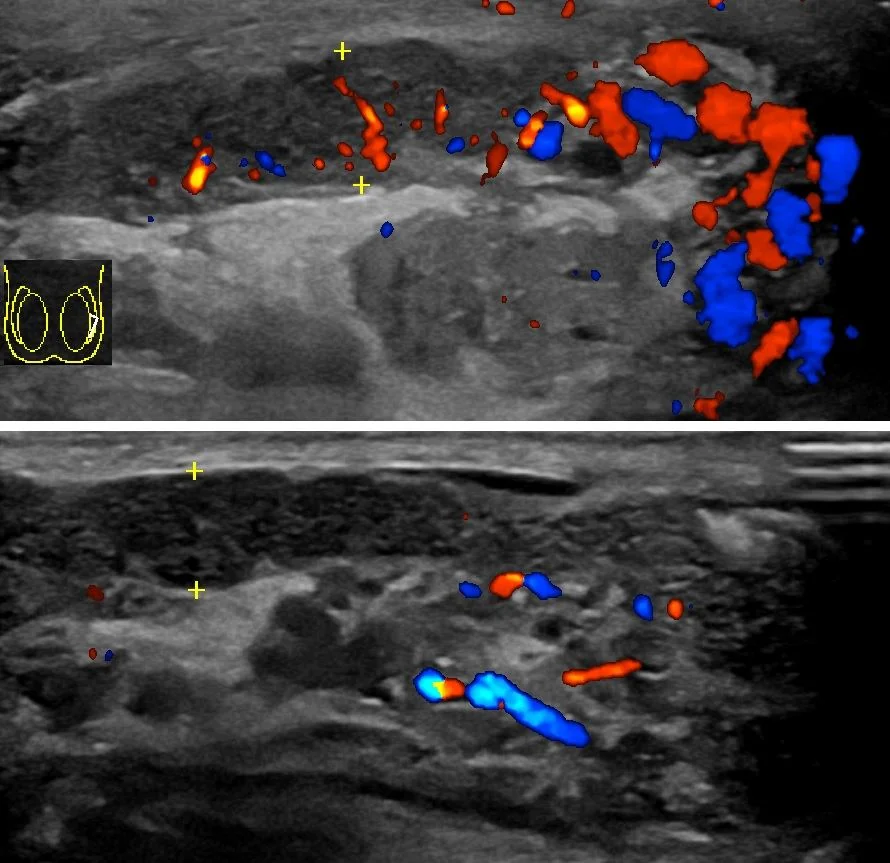
- Scrotal ultrasound with colour Doppler - shows an enlarged, hyperaemic epididymis with increased blood flow, in contrast to the reduced flow of torsion. It is also used to look for abscess and, importantly, to exclude an underlying tumour where the swelling does not settle
- Blood cultures - if systemically unwell or septic
- Mumps serology or salivary PCR - where viral orchitis is suspected, particularly with parotitis and no urinary or sexual risk factors
- Post-void residual and renal tract imaging - in older men, in recurrent episodes and in children, to identify underlying urinary tract obstruction or structural abnormality
- Early morning urine for acid-fast bacilli - if tuberculous epididymitis is suspected
Management
Empirical antibiotic treatment
Antibiotics are chosen by the most likely organism, based on age, sexual history and urinary features, and adjusted once cultures and NAAT results are available. Courses are 10-14 days, longer than for simple UTI.1
| Likely cause | Regimen |
|---|---|
| STI likely, gonorrhoea possible (young, sexually active, discharge) | Ceftriaxone 1 g IM single dose PLUS doxycycline 100 mg twice daily for 10-14 days |
| STI likely, chlamydia or M. genitalium (gonorrhoea unlikely) | Doxycycline 100 mg twice daily for 10-14 days (or ofloxacin) |
| Enteric organism likely (over 35, LUTS, recent instrumentation) | Ofloxacin 200 mg twice daily for 14 days, or ciprofloxacin 500 mg twice daily for 10 days; alternatives per local guidance and culture |
| Unknown / mixed risk | Cover both - e.g. ceftriaxone plus doxycycline, or a quinolone which covers both enteric organisms and chlamydia |
| Severe infection, sepsis or abscess | Admit for IV antibiotics, with urological review and drainage if required |
Supportive management
- Analgesia - paracetamol and NSAIDs
- Scrotal elevation and support - a supportive garment genuinely helps, and is the therapeutic counterpart of Prehn's sign
- Rest, adequate fluid intake and ice packs
- Abstain from sexual intercourse until the patient and partners have completed treatment
Sexual health management
- Refer to genitourinary medicine where an STI is likely
- Partner notification and treatment - essential to prevent reinfection and onward transmission, and to protect partners from pelvic inflammatory disease and tubal infertility
- Full STI screen including HIV and syphilis
- Test of cure where indicated, particularly for gonorrhoea and M. genitalium
- Safer sex advice and condom provision
Follow-up and further assessment
- Review at 3 days if symptoms are not improving - reconsider the diagnosis, the organism and the possibility of abscess or torsion
- Re-examine after treatment to confirm the swelling has resolved. A persistent mass must be imaged to exclude testicular tumour - a tumour presenting as apparent epididymo-orchitis is a classic route to delayed cancer diagnosis
- Investigate the urinary tract in older men, recurrent episodes, and in all children with epididymitis
- Consider amiodarone as a non-infective cause if the patient is taking it and cultures are negative
- Mumps orchitis is managed supportively - analgesia, scrotal support and rest; antibiotics are useless. Encourage MMR vaccination for prevention
Complications
- Scrotal abscess - suspect if fever and pain persist despite antibiotics; requires ultrasound and surgical drainage
- Pyocele - pus within the tunica vaginalis
- Testicular infarction - severe inflammation can compromise testicular blood supply
- Testicular atrophy - occurs in a proportion, particularly after mumps orchitis and severe bacterial infection
- Subfertility and infertility - from epididymal scarring and obstruction, or testicular atrophy. Bilateral mumps orchitis carries the greatest risk, though absolute infertility remains uncommon
- Chronic epididymitis and chronic scrotal pain - persistent discomfort lasting months, which can be difficult to treat
- Recurrent infection - particularly if an underlying urinary tract abnormality is not addressed
- Sepsis - especially in older, catheterised or immunosuppressed patients
- Fournier's gangrene - rare but life-threatening necrotising infection of the perineum, particularly in diabetics
- Reactive hydrocoele
- Onward transmission of untreated STI, with pelvic inflammatory disease and tubal infertility in female partners
Red flags
Prognosis
Most cases of bacterial epididymo-orchitis resolve completely with appropriate antibiotics. Pain and fever usually begin to settle within 3 days, though swelling and induration commonly take several weeks to resolve fully - patients should be warned about this, since slow resolution of a lump often causes alarm and prompts unnecessary re-attendance. Failure to improve within 3 days, however, is a genuine warning sign and should prompt reassessment rather than reassurance.
Complications are uncommon but not negligible. A small proportion develop abscess, testicular atrophy or chronic scrotal pain, and chronic epididymitis can be persistent and frustrating to treat. Where the cause is an untreated urinary tract abnormality or an untreated sexual partner, recurrence is likely - which is why addressing the underlying cause matters as much as the antibiotic course.
Mumps orchitis deserves separate comment. It affects around 20-30% of post-pubertal males with mumps, is bilateral in 15-30%, and leads to some degree of testicular atrophy in around half of affected testes. Despite this, significant infertility is relatively uncommon and largely confined to those with bilateral involvement - so patients can be given measured reassurance while acknowledging the risk. Since it is entirely preventable, this is a useful opportunity to reinforce MMR vaccination, particularly given that mumps outbreaks continue to occur in unimmunised and partially immunised young adult populations.
References
- BASHH. UK National Guideline for the Management of Epididymo-orchitis. Available here
- NICE Clinical Knowledge Summaries. Scrotal pain and swelling. Available here
- European Association of Urology. Guidelines on Urological Infections - epididymitis and orchitis. Available here
- UK Health Security Agency. Mumps: guidance, data and analysis. Available here
- MHRA Drug Safety Update. Fluoroquinolone antibiotics: restrictions and precautions for use. Available here
- BNF. Doxycycline and ofloxacin - indications and cautions. Available here
- Mikael Häggström, MD, CC0, via Wikimedia Commons. Available here
This article is written for revision and education. It is not clinical guidance and must not be used to make decisions about the care of a patient. Always check current NICE guidance and local protocols.