
Parkinson's Disease and Parkinsonism: Diagnosis and Management
Key points
- Parkinsonism: a clinical syndrome of bradykinesia plus rest tremor and/or rigidity; Parkinson's disease is its commonest cause but not the only one.
- Parkinson's disease (PD): a progressive neurodegenerative disease caused by loss of dopaminergic neurons in the substantia nigra pars compacta, with Lewy body inclusions.
- Classic triad: bradykinesia, rest tremor (typically 'pill-rolling', 4-6 Hz) and cogwheel rigidity, usually asymmetric at onset.
- Diagnosis: clinical, based on the UK Brain Bank criteria - bradykinesia plus at least one other core feature, with supportive features and no red flags for an alternative parkinsonian syndrome.2
- First-line treatment: levodopa (with a peripheral decarboxylase inhibitor) for older patients or greater functional impairment; a dopamine agonist or MAO-B inhibitor may be preferred to delay levodopa in younger patients.
- Long-term complication: motor fluctuations and dyskinesia develop in most patients after years of levodopa treatment.
- Atypical parkinsonism: progressive supranuclear palsy, multiple system atrophy and corticobasal degeneration all present with parkinsonism plus additional red flag features and respond poorly to levodopa.
- Non-motor features: constipation, anosmia and REM sleep behaviour disorder can precede motor symptoms by years; depression, dementia and autonomic dysfunction are common later.
Introduction
Parkinsonism is a clinical syndrome defined by bradykinesia together with rest tremor and/or rigidity. Parkinson's disease (PD) is by far its commonest cause, but the two terms are not interchangeable - a range of other conditions produce parkinsonism through different mechanisms and require a different approach, which is why 'parkinsonism versus PD' is one of the most consistently tested distinctions in this area of neurology.1
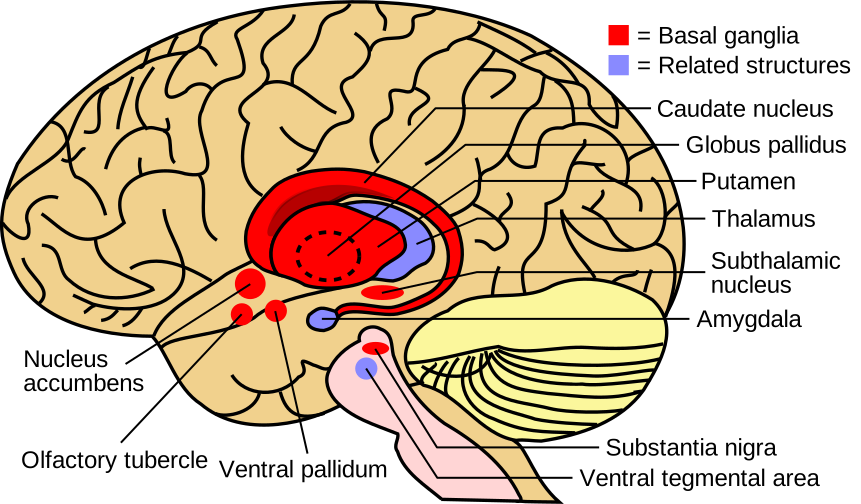
PD results from progressive loss of dopaminergic neurons in the substantia nigra pars compacta, part of the basal ganglia circuitry that normally facilitates smooth, initiated movement. Motor symptoms become apparent only once a substantial proportion (commonly cited as 50-70%) of these neurons has already been lost, which is why by the time PD is diagnosed clinically, the underlying neurodegeneration is often well advanced.
PD affects around 1 in 350 adults and its incidence rises steeply with age. It combines classic clinical sign-spotting with an increasingly nuanced medical treatment algorithm, making it a durable finals favourite.
Incidence rises steeply with age, and although PD is often thought of as a disease of older people, around 1 in 20 patients presents before the age of 40 as young-onset disease. This group tends to progress more slowly and to have a better response to levodopa, but develops motor complications such as dyskinesia considerably earlier - which is precisely why treatment strategy is influenced so strongly by age at diagnosis.
Pathophysiology
Loss of nigral dopaminergic neurons reduces dopaminergic input to the striatum, disrupting the normal balance of the direct and indirect basal ganglia pathways that regulate voluntary movement. The pathological hallmark is the Lewy body - an intracytoplasmic inclusion composed principally of misfolded alpha-synuclein - found in surviving neurons. PD is therefore classified as a synucleinopathy, a category it shares with multiple system atrophy and dementia with Lewy bodies.
Risk factors
- Increasing age - the strongest risk factor
- Male sex
- Family history and known genetic mutations (e.g. LRRK2, PARK genes) - more relevant in early-onset disease
- Exposure to certain pesticides and, historically, MPTP (a contaminant found in illicit synthetic opioids that causes an acute parkinsonian syndrome)
- Head injury
- Reduced risk is associated with smoking and caffeine intake in epidemiological studies, though neither is a recommended intervention
Clinical features
Motor features
- Bradykinesia - slowness of movement with progressive reduction in amplitude and speed on repetitive action (decrement), essential for the diagnosis; manifests as reduced arm swing, micrographia (progressively smaller handwriting), hypomimia (reduced facial expression), and a shuffling, short-stepped gait
- Rest tremor - classically 4-6 Hz, described as 'pill-rolling', present at rest and typically diminishing with voluntary movement - unlike essential tremor
- Rigidity - increased tone throughout the range of passive movement; cogwheel rigidity (a ratchety quality) results from superimposed tremor on lead-pipe rigidity
- Postural instability - typically a later feature; assessed with the pull test (retropulsion)
- Asymmetric onset - PD characteristically starts unilaterally and remains asymmetric even as it progresses3, which helps distinguish it from some atypical parkinsonian syndromes
Non-motor features
Non-motor symptoms are increasingly recognised as integral to PD, not incidental, and some precede the motor diagnosis by years.
The reason non-motor features can precede the tremor by a decade lies in where the pathology begins. Alpha-synuclein deposition is thought to start not in the substantia nigra but in the olfactory bulb and the dorsal motor nucleus of the vagus in the lower brainstem, ascending over years to reach the midbrain. This accounts neatly for the prodromal triad of anosmia, constipation and REM sleep behaviour disorder, all of which map onto those earlier-affected structures.
It also has practical consequences. REM sleep behaviour disorder in particular carries a high long-term risk of conversion to a synucleinopathy, so a patient presenting with it should be assessed carefully rather than reassured, and constipation and anosmia in an older patient with a subtle change in handwriting or arm swing deserve a considered neurological review.
Assessing a patient in the clinic gives only a snapshot, and in established disease it is important to ask how symptoms vary across the day. Patients with motor fluctuations may appear entirely well at the time of the appointment while spending several hours daily in an off state, so a symptom diary kept over a week is often far more informative about the true burden of disease than the examination performed in front of you.
- Prodromal features (can precede motor symptoms by up to a decade): anosmia, constipation, REM sleep behaviour disorder (acting out dreams, sometimes violently, during REM sleep), and depression
- Autonomic dysfunction: postural hypotension, urinary urgency, erectile dysfunction, excessive sweating
- Neuropsychiatric: depression and anxiety are very common; dementia develops in a substantial proportion with longer disease duration (Parkinson's disease dementia)
- Sleep disturbance: insomnia, excessive daytime somnolence, vivid dreams
- Sialorrhoea (drooling) from reduced spontaneous swallowing rather than excess saliva production
- Hyposmia and visual hallucinations (particularly with more advanced disease or as a medication side effect)
Clinical examination
- Observe gait: reduced arm swing, shuffling steps, festination (progressively hastening steps), difficulty initiating movement or turning
- Facial expression: hypomimia ('masked facies'), reduced blink rate
- Speech: hypophonia (quiet, monotonous voice)
- Tone: assess for cogwheel rigidity, reinforced by asking the patient to move the contralateral limb
- Tremor: observe at rest and note whether it reduces with action
- Bradykinesia: assess finger tapping and hand movements for progressive decrement in amplitude and speed
- Postural stability: the pull test, performed cautiously
- Blood pressure lying and standing, to screen for autonomic involvement
Differential diagnosis - parkinsonism beyond PD
Several conditions produce parkinsonism through mechanisms other than idiopathic PD, and recognising their distinguishing 'red flag' features matters because they respond poorly to levodopa and carry a different prognosis.
| Cause | Distinguishing features |
|---|---|
| Drug-induced parkinsonism | Typically symmetric; history of antipsychotics or metoclopramide; improves on stopping the causative drug |
| Vascular parkinsonism | Lower body predominant ('lower body parkinsonism' - gait apraxia with relatively normal arms), stepwise progression, vascular risk factors, poor response to levodopa |
| Progressive supranuclear palsy (PSP) | Early postural instability and falls, vertical gaze palsy (impaired downgaze especially), axial rigidity, symmetric onset |
| Multiple system atrophy (MSA) | Early and prominent autonomic failure (postural hypotension, urinary dysfunction) and/or cerebellar signs, poor levodopa response |
| Corticobasal degeneration | Markedly asymmetric rigidity and apraxia, 'alien limb' phenomenon, cortical sensory loss |
| Dementia with Lewy bodies | Dementia precedes or occurs within a year of parkinsonism, prominent visual hallucinations, fluctuating cognition, marked neuroleptic sensitivity |
Investigations
PD remains a clinical diagnosis, made using criteria such as the UK Parkinson's Disease Society Brain Bank criteria - bradykinesia plus at least one of rest tremor, rigidity or postural instability, with supportive features and no red flags for an alternative cause. Investigations are used mainly to exclude other causes or support diagnosis in uncertain cases, not to confirm PD itself.
- MRI brain - usually normal in early idiopathic PD; used to exclude structural causes and can show characteristic (though not universal) changes in atypical parkinsonian syndromes (e.g. the 'hummingbird sign' in PSP, 'hot cross bun sign' in MSA)
- DaTscan (dopamine transporter SPECT imaging) - can help distinguish PD/atypical parkinsonism from essential tremor or drug-induced parkinsonism when the clinical picture is unclear, by demonstrating reduced presynaptic dopaminergic uptake; it does not distinguish PD from other synucleinopathies
- Trial of levodopa - a good, sustained clinical response supports the diagnosis of PD and is itself sometimes used diagnostically in ambiguous cases
- Screen for reversible causes if drug-induced parkinsonism is suspected - full medication review
Management
Pharmacological treatment
Treatment is symptomatic - there is currently no disease-modifying therapy proven to slow neurodegeneration in PD. The choice of first agent balances symptom control against the risk of long-term motor complications.
| Class | Examples | Notes |
|---|---|---|
| Levodopa (+ decarboxylase inhibitor) | Co-careldopa, co-beneldopa | The most effective symptomatic treatment; typically first-line in older patients or those with greater functional impairment, but long-term use is associated with motor fluctuations and dyskinesia |
| Dopamine agonists | Ropinirole, pramipexole, rotigotine (patch) | Often used first in younger patients to delay levodopa-related motor complications; associated with impulse control disorders and daytime somnolence |
| MAO-B inhibitors | Selegiline, rasagiline | Mild symptomatic benefit, sometimes used early or as an adjunct; generally well tolerated |
| COMT inhibitors | Entacapone | Adjunct to levodopa to prolong its effect once motor fluctuations develop |
| Amantadine | - | Can help with levodopa-induced dyskinesia |
Advanced and surgical therapy
- Deep brain stimulation (typically of the subthalamic nucleus) - for motor fluctuations refractory to optimal medical therapy in appropriately selected patients, improving motor symptoms and allowing dose reduction
- Continuous subcutaneous apomorphine infusion or intrajejunal levodopa-carbidopa gel - for advanced disease with severe motor fluctuations not controlled by oral therapy adjustments
Multidisciplinary and non-motor management
- Physiotherapy - gait training, falls prevention
- Speech and language therapy - for hypophonia and, later, swallowing difficulty
- Occupational therapy - functional adaptation at home
- Treat non-motor symptoms actively: laxatives for constipation, domperidone or midodrine for postural hypotension, and screening for and treating depression and cognitive impairment
- Specialist Parkinson's nurse involvement throughout, coordinating care and medication timing
Complications
- Motor fluctuations and dyskinesia from long-term levodopa therapy
- Falls and fractures from postural instability and freezing of gait
- Aspiration pneumonia from progressive dysphagia in advanced disease - a leading cause of death
- Parkinson's disease dementia
- Impulse control disorders (pathological gambling, hypersexuality, compulsive shopping) associated with dopamine agonists
- Postural hypotension and falls from autonomic dysfunction
- Depression and reduced quality of life
Red flags
The commonest source of avoidable harm in Parkinson's disease occurs in hospital, and almost always involves medication timing. The points below apply to any admission, whatever the presenting problem.
Prognosis
PD is a chronic, progressive condition. With modern treatment, life expectancy is only modestly reduced and many patients maintain a good quality of life for years, though disability accumulates over time, particularly with postural instability, falls, dysphagia and later cognitive decline. Rate of progression varies considerably between individuals; tremor-dominant disease tends to progress more slowly than akinetic-rigid predominant disease. Atypical parkinsonian syndromes (PSP, MSA, corticobasal degeneration) generally progress faster and carry a worse prognosis than idiopathic PD.
An aspect of care that consistently causes avoidable harm is medication management during hospital admission. Parkinson's drugs are time-critical, and standard drug rounds are frequently too imprecise for regimens taken four or five times daily at specific intervals. Patients should generally be allowed to self-administer where they are able, doses should be prescribed at the patient's own times rather than default hospital times, and a transdermal rotigotine patch or nasogastric route should be used promptly if the patient becomes nil by mouth rather than simply omitting doses.
References
- NICE NG71. Parkinson's disease in adults. 2017, updated 2022. Available here
- Hughes AJ, Daniel SE, Kilford L, Lees AJ. Accuracy of clinical diagnosis of idiopathic Parkinson's disease: a clinico-pathological study. Journal of Neurology, Neurosurgery & Psychiatry. 1992. Available here
- Postuma RB, Berg D, Stern M et al. MDS clinical diagnostic criteria for Parkinson's disease. Movement Disorders. 2015. Available here
This article is written for revision and education. It is not clinical guidance and must not be used to make decisions about the care of a patient. Always check current NICE guidance and local protocols.