
Haemophilia and Von Willebrand Disease
Key points
- Haemophilia A and B: X-linked recessive deficiencies of factor VIII (haemophilia A, ~80% of cases) and factor IX (haemophilia B, Christmas disease). Clinically indistinguishable - only factor assays separate them.
- Von Willebrand disease (VWD): the commonest inherited bleeding disorder (up to 1% of the population), usually autosomal dominant, affecting both sexes equally - unlike haemophilia.
- Two bleeding phenotypes: haemophilia causes deep bleeding - haemarthroses and muscle haematomas. VWD causes mucocutaneous bleeding - epistaxis, menorrhagia, bruising - because von Willebrand factor mediates platelet adhesion.
- Von Willebrand factor has two jobs: it mediates platelet adhesion to damaged endothelium, and it carries and stabilises factor VIII in plasma. This is why severe VWD produces both a platelet-type and a factor-VIII-type defect.
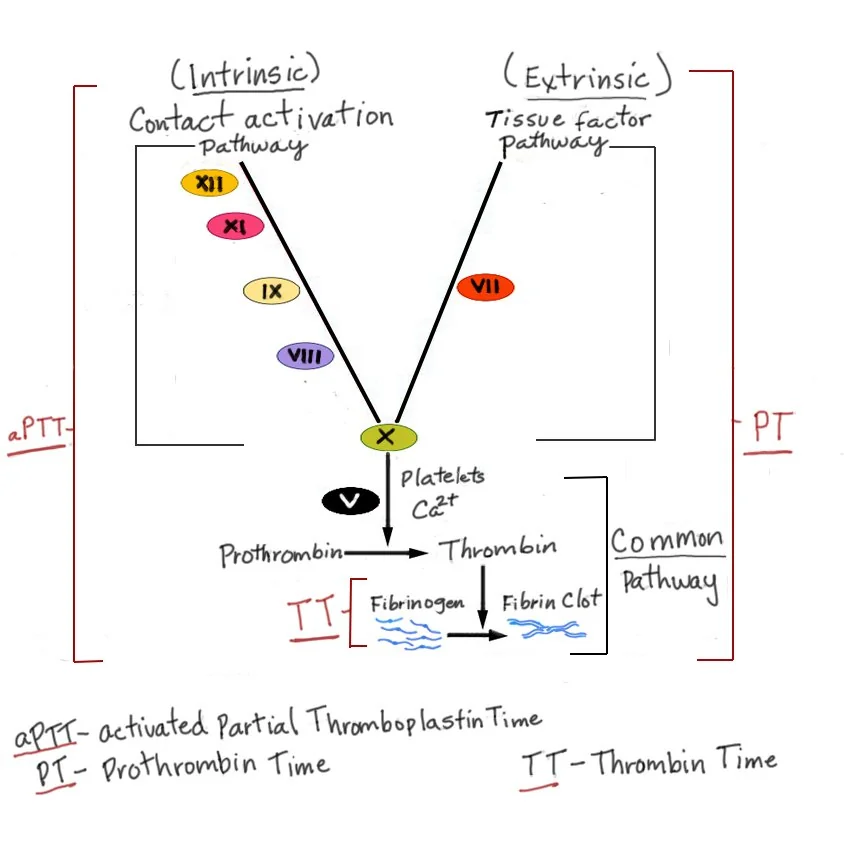
- The clotting screen: haemophilia gives a prolonged APTT with a normal PT and normal platelets. VWD gives a normal or prolonged APTT with a normal PT, and a normal platelet count in most types.
- Severity in haemophilia: graded by residual factor level: severe (<1%) causes spontaneous bleeding; moderate (1-5%) bleeds with minor trauma; mild (5-40%) usually only bleeds with surgery or significant injury.
- Management: factor replacement (recombinant factor VIII or IX), with prophylactic regimens now standard in severe haemophilia; emicizumab has transformed care in haemophilia A. Desmopressin (DDAVP) for mild haemophilia A and most type 1 VWD; tranexamic acid as an adjunct.
- Key complication: development of inhibitors - alloantibodies against infused factor - which render standard replacement ineffective and require bypassing agents or immune tolerance induction.
Introduction
Haemostasis depends on two linked processes: primary haemostasis, in which platelets adhere and aggregate to form an initial plug, and secondary haemostasis, in which the coagulation cascade generates fibrin to stabilise it. The inherited bleeding disorders in this article span both - haemophilia disrupts the cascade, while von Willebrand disease primarily disrupts platelet adhesion, and in severe forms disrupts the cascade too.1
Haemophilia
Genetics
Both haemophilia A and B are X-linked recessive. Males are affected (having only one X chromosome), while females are usually carriers, though carriers can have mildly reduced factor levels and a genuine bleeding tendency, particularly menorrhagia - a point often overlooked. Around one third of cases arise from a spontaneous new mutation, so a negative family history does not exclude the diagnosis.
| Feature | Haemophilia A | Haemophilia B (Christmas disease) |
|---|---|---|
| Deficient factor | Factor VIII | Factor IX |
| Proportion of cases | ~80-85% | ~15-20% |
| Inheritance | X-linked recessive | X-linked recessive |
| Clinical picture | Indistinguishable from B | Indistinguishable from A |
| Clotting screen | Prolonged APTT, normal PT | Prolonged APTT, normal PT |
| Diagnosis | Factor VIII assay | Factor IX assay |
| Treatment | Recombinant factor VIII; emicizumab; DDAVP in mild disease | Recombinant factor IX (DDAVP is ineffective) |
Severity
| Severity | Factor level | Bleeding pattern |
|---|---|---|
| Severe | <1% of normal | Spontaneous bleeding into joints and muscles, often from early childhood |
| Moderate | 1-5% | Bleeding after minor trauma; occasional spontaneous bleeds |
| Mild | 5-40% | Bleeding usually only after surgery, dental extraction or significant trauma - may present late, even in adulthood |
Clinical features
- Haemarthrosis - the hallmark. Bleeding into joints (knees, ankles, elbows) causing pain, swelling, warmth and reduced movement. Recurrent bleeds cause chronic haemophilic arthropathy with joint destruction, deformity and disability
- Muscle haematomas - particularly iliopsoas bleeds, which can present with hip/groin pain, a flexed hip and femoral nerve compression, and can conceal litres of blood with few external signs
- Delayed bleeding after surgery, dental extraction or circumcision - often the presenting event in mild disease
- Intracranial haemorrhage - the leading cause of bleeding-related death; may follow apparently minor head trauma
- Prolonged bleeding from the umbilical stump, or excessive bruising as an infant begins to crawl and walk, in severe disease
- Petechiae are characteristically absent - this is deep-tissue, not mucocutaneous, bleeding
Von Willebrand disease
VWD is the commonest inherited bleeding disorder, affecting up to 1% of the population, though many cases are mild and never diagnosed. Unlike haemophilia, it is usually autosomal dominant and therefore affects males and females equally - and because menorrhagia is such a prominent feature, it is disproportionately diagnosed in women.
The two functions of von Willebrand factor
- Platelet adhesion: VWF binds exposed subendothelial collagen at sites of injury and to platelet GPIb, tethering platelets to the vessel wall - the first step of primary haemostasis
- Factor VIII carriage: VWF binds and stabilises factor VIII in the circulation, protecting it from degradation. Loss of VWF therefore causes a secondary fall in factor VIII, which is why severe VWD can prolong the APTT and mimic mild haemophilia A
Types
| Type | Defect | Notes |
|---|---|---|
| Type 1 | Partial quantitative deficiency of VWF | By far the commonest (~75%); usually mild; typically autosomal dominant; usually responds to DDAVP |
| Type 2 | Qualitative defect - VWF present but dysfunctional (subtypes 2A, 2B, 2M, 2N) | Variable severity. Type 2B causes thrombocytopenia through abnormally increased platelet binding, and DDAVP is generally avoided in 2B |
| Type 3 | Complete quantitative deficiency - virtually no VWF | Rare; autosomal recessive; severe, with very low factor VIII, so it can resemble severe haemophilia with additional mucosal bleeding |
Clinical features
- Mucocutaneous bleeding - the characteristic pattern: epistaxis, easy bruising, gum bleeding, prolonged bleeding from minor cuts
- Menorrhagia - often the presenting complaint, and an important cause of iron deficiency anaemia in young women; VWD should be considered in any woman with heavy menstrual bleeding since menarche
- Post-operative and post-dental bleeding
- Gastrointestinal bleeding, sometimes from associated angiodysplasia
- Haemarthroses are uncommon except in severe type 3 disease
Acquired von Willebrand syndrome can also occur - notably in aortic stenosis (shear stress destroys large VWF multimers, causing GI bleeding from angiodysplasia, known as Heyde syndrome), and in myeloproliferative neoplasms with very high platelet counts.
Investigations
Initial clotting screen
| Condition | PT | APTT | Platelets | Bleeding time/PFA |
|---|---|---|---|---|
| Haemophilia A or B | Normal | Prolonged | Normal | Normal |
| Von Willebrand disease | Normal | Normal or prolonged | Usually normal (low in type 2B) | Prolonged |
| Vitamin K deficiency / warfarin | Prolonged | Prolonged (later) | Normal | Normal |
| DIC | Prolonged | Prolonged | Low | Prolonged |
| Liver disease | Prolonged | Prolonged | Often low | Variable |
Specific tests
- Factor VIII and factor IX assays - diagnose and grade haemophilia A and B respectively
- VWF antigen (quantity) and VWF activity/ristocetin cofactor assay (function) - the ratio between them distinguishes quantitative (type 1/3) from qualitative (type 2) defects
- VWF multimer analysis to subtype type 2 disease
- Mixing studies - if a prolonged APTT corrects on mixing with normal plasma, it indicates factor deficiency; if it fails to correct, it indicates an inhibitor (such as an acquired factor VIII antibody or a lupus anticoagulant)
- Genetic testing - to confirm the mutation, guide carrier detection and enable antenatal counselling
- Blood group - a practical caveat, since VWF levels are physiologically lower in blood group O, which can cause borderline results to be over-interpreted
- FBC and ferritin - to detect iron deficiency anaemia from chronic bleeding, particularly menorrhagia
Management
Haemophilia
- Factor replacement - recombinant factor VIII (haemophilia A) or factor IX (haemophilia B). Given either on demand for bleeding episodes, or as regular prophylaxis, which is now standard of care in severe haemophilia and dramatically reduces the joint damage that historically caused lifelong disability2
- Emicizumab - a bispecific monoclonal antibody that bridges factors IXa and X, mimicking the function of factor VIII. Given subcutaneously rather than intravenously and effective even in patients with inhibitors, it has substantially changed the management of haemophilia A
- Desmopressin (DDAVP) - releases stored factor VIII and VWF from endothelial cells, useful in mild haemophilia A only. It is ineffective in haemophilia B (factor IX is not stored in this way) and in severe disease
- Tranexamic acid - a helpful adjunct, particularly for mucosal and dental bleeding, though generally avoided in haematuria
- Gene therapy is now available for selected patients and offers the prospect of sustained endogenous factor production
- Avoid intramuscular injections, aspirin and NSAIDs; give vaccinations subcutaneously where possible
- Specialist haemophilia centre care, including physiotherapy to preserve joint function, dental care planning, and genetic counselling
Von Willebrand disease
- Desmopressin (DDAVP) - first line for most type 1 disease; generally avoided in type 2B (where it can worsen thrombocytopenia) and ineffective in type 3
- VWF-containing concentrate (or VWF/factor VIII concentrate) for type 3, severe type 2, or major bleeding and surgery
- Tranexamic acid - especially effective for menorrhagia, epistaxis and dental procedures
- Combined oral contraceptive pill or levonorgestrel intrauterine system for menorrhagia, which is often the dominant symptom in women
- Iron replacement for the iron deficiency anaemia that frequently accompanies chronic mucosal blood loss
Complications
- Inhibitor development - alloantibodies against infused factor, occurring in up to a third of patients with severe haemophilia A. Standard replacement becomes ineffective, requiring bypassing agents (e.g. recombinant factor VIIa, activated prothrombin complex concentrate), emicizumab, or immune tolerance induction
- Chronic haemophilic arthropathy - recurrent haemarthroses cause synovial hypertrophy, cartilage destruction and permanent joint damage, the leading cause of long-term morbidity
- Intracranial haemorrhage - the leading cause of bleeding-related death
- Compartment syndrome and nerve palsy from muscle haematomas (classically femoral nerve palsy from an iliopsoas bleed)
- Iron deficiency anaemia from chronic bleeding, particularly menorrhagia in VWD
- Transfusion-transmitted infection - historically catastrophic, with large numbers of people with haemophilia infected with HIV and hepatitis C through contaminated plasma-derived products in the 1970s and 1980s. Modern recombinant products have eliminated this risk, but affected patients still require ongoing care3
Red flags
Prognosis
With access to modern prophylactic factor replacement and specialist centre care, people with haemophilia in the UK now have a life expectancy approaching that of the general population, and children starting prophylaxis early can expect to avoid the severe arthropathy that defined the condition in previous generations.2 The advent of emicizumab and, more recently, gene therapy has further reduced treatment burden.
Von Willebrand disease generally carries an excellent prognosis and a normal life expectancy, with most patients having mild type 1 disease requiring treatment only around surgery, dental work or for menorrhagia. Severe type 3 disease requires ongoing specialist management comparable to severe haemophilia. The principal remaining challenges across both conditions are inhibitor development and ensuring that milder cases - particularly women with menorrhagia - are recognised rather than going undiagnosed for years.
References
- Peyvandi F, Garagiola I, Young G. The past and future of haemophilia: diagnosis, treatments, and its complications. Lancet. 2016. Available here
- Srivastava A, Santagostino E, Dougall A et al. WFH Guidelines for the Management of Hemophilia, 3rd edition. Haemophilia. 2020. Available here
- Infected Blood Inquiry. Report. 2024. Available here
- Laffan MA, Lester W, O'Donnell JS et al. The diagnosis and management of von Willebrand disease: a UKHCDO guideline. Br J Haematol. 2014. Available here
- Otocast, CC BY-SA 4.0, via Wikimedia Commons. Available here
- NICE Clinical Knowledge Summaries (CKS). Menorrhagia and bleeding disorders. Available here
This article is written for revision and education. It is not clinical guidance and must not be used to make decisions about the care of a patient. Always check current NICE guidance and local protocols.