
Syphilis
Key points
- Organism: Treponema pallidum, a spirochaete transmitted by direct contact with an infectious lesion.
- Staging: primary (chancre), secondary (systemic rash and lymphadenopathy), latent (asymptomatic), and tertiary (gummatous, cardiovascular, neurosyphilis).
- Epidemiology: diagnoses have risen sharply in the UK over the past decade, concentrated in men who have sex with men.
- Diagnosis: serology (treponemal and non-treponemal tests) is the mainstay; dark-field microscopy of chancre fluid is rarely available.
- Management: benzathine benzylpenicillin (single dose for early disease, three weekly doses for late latent).
- Jarisch-Herxheimer reaction: a self-limiting febrile reaction within hours of starting treatment, not a penicillin allergy.
- Congenital syphilis: preventable by antenatal screening; untreated maternal infection causes stillbirth, hydrops and multi-organ disease.
- Follow-up: serial non-treponemal titres (e.g. RPR) confirm treatment response - a four-fold fall is the target.
Introduction
Syphilis is a chronic systemic infection caused by Treponema pallidum, a spirochaete that classically progresses through well-defined clinical stages if untreated: primary, secondary, latent and tertiary disease.1 It is sometimes called "the great imitator" because its secondary and tertiary manifestations mimic a very wide range of other conditions.
Diagnoses in the UK have risen substantially over the last decade, with the majority occurring in men who have sex with men, though heterosexual transmission and, importantly, congenital syphilis in newborns remain significant concerns.2 Because early disease is treatable with a single injection of penicillin, and because untreated infection can cause severe long-term and congenital harm, recognising the stages is a core UKMLA skill.
Transmission and pathophysiology
T. pallidum is transmitted by direct contact with an infectious lesion during vaginal, anal or oral sex, and vertically across the placenta at any stage of pregnancy, or during birth. It cannot be cultured in vitro, which is why diagnosis relies almost entirely on serology and, where a lesion is present and facilities allow, dark-field microscopy or PCR of lesion fluid.1
Once inoculated, the organism multiplies locally, producing the primary chancre, before disseminating haematogenously to produce the systemic features of secondary syphilis. The infection can then enter a clinically silent latent phase lasting years to decades, during which the immune response contains but does not clear the organism, before a minority of untreated patients develop tertiary disease.
Stages and clinical features
Primary syphilis
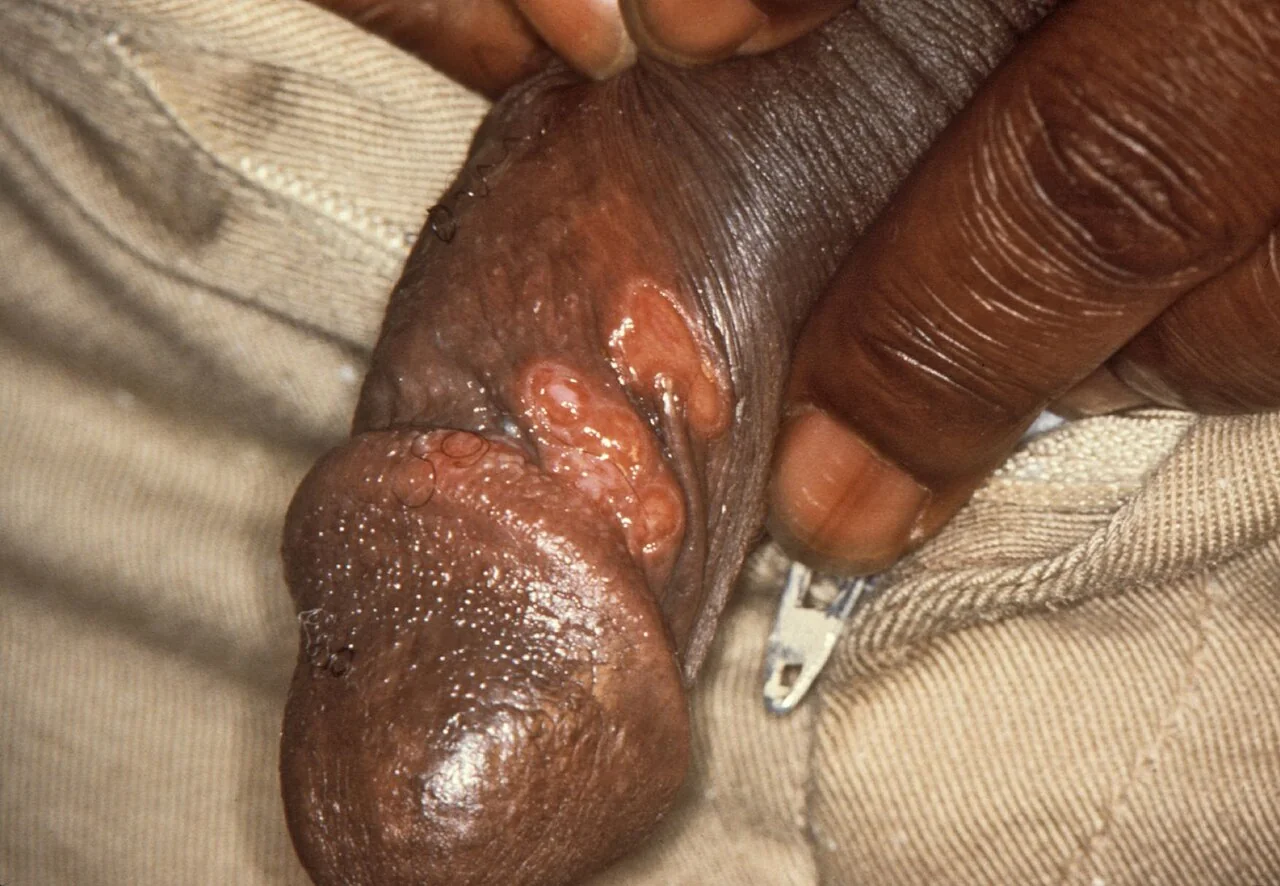
The primary stage develops 9-90 days (typically around 3 weeks) after exposure, and is marked by a chancre: a single, painless, indurated ulcer at the site of inoculation, most often the genitals, but also the anus, rectum or oropharynx depending on sexual practices. It is accompanied by non-tender regional lymphadenopathy, and heals spontaneously within 3-6 weeks even without treatment - which is precisely why it is easy to miss.1
Secondary syphilis
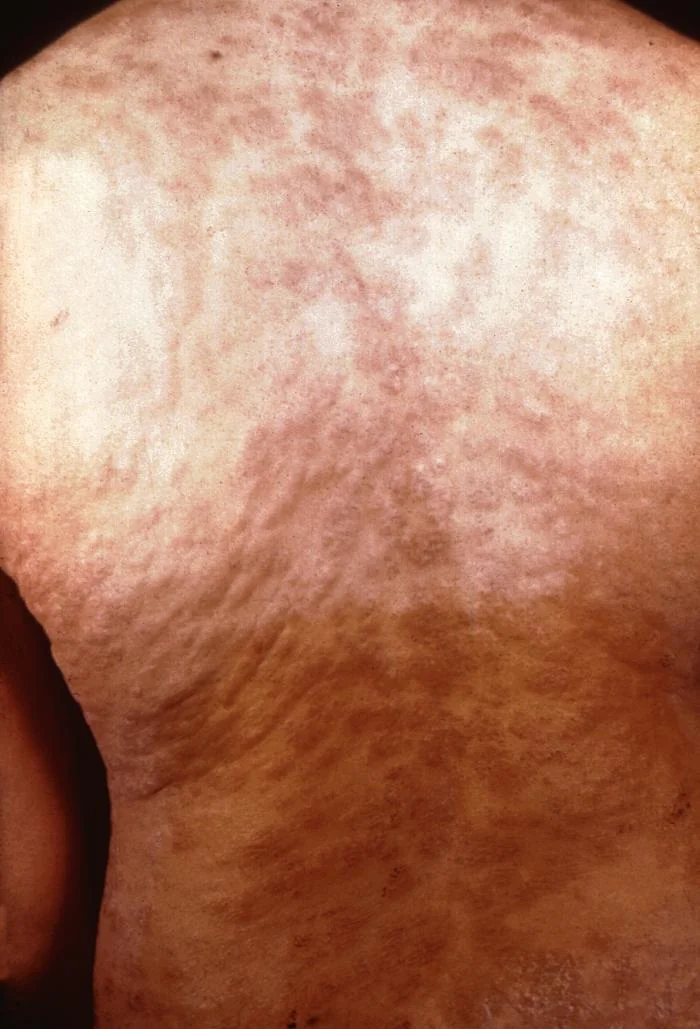
Secondary syphilis develops weeks to a few months after the chancre, sometimes overlapping with it, and reflects haematogenous spread. The hallmark is a symmetrical, non-itchy maculopapular rash that classically involves the palms and soles - an unusual distribution that should always raise the possibility of syphilis.1 Other features include generalised lymphadenopathy, condylomata lata (broad, moist, highly infectious warty plaques in warm, moist areas such as the perineum), mucous patches in the mouth, patchy alopecia, and constitutional symptoms such as fever, malaise and headache.
Latent syphilis
Latent syphilis is defined by positive serology in the absence of clinical signs. It is divided into early latent (within 2 years of infection, still potentially infectious) and late latent (beyond 2 years, much less infectious), a distinction that matters because it determines the treatment regimen.
Tertiary syphilis
Tertiary disease develops in a minority of untreated patients, often decades after initial infection, and includes three broad patterns: gummatous disease (granulomatous, destructive lesions of skin, bone and viscera), cardiovascular syphilis (aortitis, leading to aortic regurgitation and aneurysm, typically of the ascending aorta), and neurosyphilis (which can occur at any stage, but classically presents late as tabes dorsalis, dementia, or general paresis).3
Neurosyphilis
Neurological involvement can occur early (meningovascular syphilis, causing stroke-like presentations in a young patient) or late (tabes dorsalis with sensory ataxia and lightning pains; general paresis with progressive cognitive decline and personality change). Argyll Robertson pupils - which accommodate but do not react to light - are a classic, though now rare, finding.
Differential diagnosis
- Genital herpes: painful, grouped vesicles/ulcers rather than a single painless chancre
- Chancroid: painful genital ulcer with ragged edges, rare in the UK
- Lymphogranuloma venereum: transient painless ulcer followed by painful inguinal lymphadenopathy
- Pityriasis rosea or viral exanthem: can mimic the secondary rash but spares palms/soles
- Psoriasis: can affect palms and soles, but is chronic and scaly rather than acute and maculopapular
Investigations
Serology is the mainstay of diagnosis, combining a treponemal test (e.g. T. pallidum particle agglutination (TPPA) or enzyme immunoassay (EIA)), which remains positive for life once infected, with a non-treponemal test (e.g. rapid plasma reagin (RPR) or VDRL), whose titre correlates with disease activity and falls with successful treatment.1
Most services now screen with a treponemal EIA first, confirming a reactive result with a second treponemal test and an RPR/VDRL titre. Where a chancre is present, dark-field microscopy or PCR of lesion exudate can give an immediate diagnosis, though this is rarely available outside specialist centres.
| Treponemal test | Non-treponemal test (RPR/VDRL) | Interpretation |
|---|---|---|
| Negative | Negative | No infection (or too early - repeat if high suspicion) |
| Positive | Positive | Active infection, or recently treated |
| Positive | Negative | Successfully treated in the past, or very early/late infection |
| Negative | Positive | False positive - consider pregnancy, autoimmune disease, or other infection |
As with all STIs, a positive result should prompt testing for other infections, including HIV, and a full sexual history for partner notification.
Management
Early syphilis (primary, secondary or early latent): a single intramuscular dose of benzathine benzylpenicillin 2.4 million units.4
Late latent syphilis (or latent of unknown duration) and cardiovascular syphilis: benzathine benzylpenicillin 2.4 million units weekly for three doses.
Neurosyphilis requires a drug that crosses the blood-brain barrier: intravenous benzylpenicillin (or procaine penicillin with probenecid) for 14 days, usually with specialist input and lumbar puncture to confirm CSF involvement.
Penicillin allergy is managed with doxycycline as an alternative in non-pregnant patients; in pregnancy, penicillin allergy requires desensitisation rather than substitution, because doxycycline and other alternatives are not reliably effective at preventing congenital transmission.4
Pregnancy and congenital syphilis
Syphilis is included in the routine antenatal booking screen precisely because untreated maternal infection can cross the placenta at any gestation, causing miscarriage, stillbirth, hydrops fetalis, or a spectrum of congenital disease in the surviving infant, including rash, hepatosplenomegaly, bone abnormalities (e.g. saber shins), and later features such as Hutchinson's teeth and sensorineural deafness.3 Maternal treatment with penicillin before 28 weeks substantially reduces this risk, which is why prompt antenatal detection and treatment matters so much.
Red flags
Follow-up and prognosis
Response to treatment is monitored with serial non-treponemal titres (RPR/VDRL) at intervals over the following 12 months; a four-fold decline in titre (e.g. 1:32 to 1:8) confirms an adequate response, while a rising titre suggests treatment failure or reinfection.1 Treponemal tests typically remain positive for life and are not useful for monitoring response.
Early syphilis treated appropriately has an excellent prognosis with no lasting sequelae. The prognosis worsens with each stage the diagnosis is delayed: tertiary complications (cardiovascular and neurological) can cause irreversible damage even after the infection itself is eradicated, which is the central argument for opportunistic testing and antenatal screening.
References
- BASHH. UK national guidelines on the management of syphilis. 2015. Available here
- UK Health Security Agency. Sexually transmitted infections and screening in England, annual report. Available here
- Peeling RW, Mabey D, Kamb ML et al. Syphilis. Nature Reviews Disease Primers. 2017. Available here
- NICE Clinical Knowledge Summaries (CKS). Syphilis. Available here
This article is written for revision and education. It is not clinical guidance and must not be used to make decisions about the care of a patient. Always check current NICE guidance and local protocols.