
Croup: Acute Laryngotracheobronchitis
Key points
- Definition: acute laryngotracheobronchitis - viral inflammation of the larynx, trachea and bronchi producing subglottic narrowing.
- Cause: parainfluenza virus in around 75% of cases, with a peak in autumn and a smaller one in spring.
- Who gets it: children aged 6 months to 6 years, with a peak at about 2 years, when the subglottis is at its narrowest relative to the body.
- Classic triad: a barking, seal-like cough, inspiratory stridor and a hoarse voice, preceded by a coryzal prodrome and worse at night.
- Diagnosis: entirely clinical. Do not examine the throat, and do not request imaging - the steeple sign is a radiological curiosity, not a diagnostic requirement.
- Treatment for everyone: a single dose of oral dexamethasone 0.15 mg/kg, given whatever the severity, including in mild croup managed at home.
- Severe croup: nebulised adrenaline buys 2 hours while the steroid takes effect - it is a bridge, not a cure, so the child must be observed for rebound.
- The key differential: epiglottitis and bacterial tracheitis - a toxic, drooling child who cannot swallow and has no barking cough is not croup.
Introduction
Croup is an acute viral illness causing inflammation of the larynx, trachea and bronchi. The clinical picture - a barking cough, inspiratory stridor and a hoarse voice in a young child, worst in the small hours - is one of the most recognisable in paediatrics.1
It affects around 3% of children a year, most commonly between 6 months and 6 years, and the great majority are managed at home or discharged from the emergency department after a single dose of steroid. Fewer than 5% of those attending hospital are admitted, and intubation is now very rare.
Croup is nevertheless worth taking seriously, and it is worth understanding as a lesson in airway physiology. The child's presentation is entirely explained by where the swelling is and how narrow that part of the airway already was.
Aetiology and pathophysiology
Parainfluenza virus, chiefly types 1 and 3, causes around three-quarters of cases and drives the characteristic autumn epidemic. Other agents include respiratory syncytial virus, rhinovirus, influenza A and B, adenovirus, human metapneumovirus and SARS-CoV-2. Influenza A tends to produce more severe disease.
The virus infects the nasopharyngeal epithelium and spreads to the larynx and trachea, where it produces mucosal inflammation, oedema and a fibrinous exudate. The crucial anatomical point is that the subglottis is the narrowest part of the paediatric airway, and it is encircled by the cricoid cartilage - the only complete ring in the airway, which cannot expand outwards. Oedema there therefore has nowhere to go except into the lumen.
Because airway resistance is inversely proportional to the fourth power of the radius, the arithmetic is brutal. A 2-year-old has a subglottic diameter of roughly 4-5 mm; 1 mm of circumferential oedema halves the diameter and increases resistance by a factor of sixteen. The same 1 mm in an adult trachea produces no symptoms at all.
- Turbulent airflow through the narrowed subglottis produces the inspiratory stridor
- Oedema of the vocal cords produces the hoarse voice or cry
- Tracheal inflammation produces the harsh, barking cough
- Crying and agitation increase inspiratory flow rate, worsening turbulence and stridor - which is why keeping the child calm is a therapeutic intervention rather than just good manners
- Nocturnal worsening is thought to reflect a combination of recumbency, lower endogenous cortisol overnight, and cooler drier air
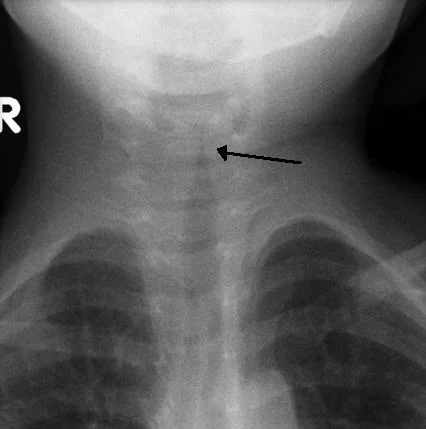
Clinical features
A coryzal prodrome of 12-72 hours with a low-grade fever is followed by the abrupt onset - often overnight - of the characteristic features:
- Barking, seal-like cough - the single most useful feature, and its absence should make you question the diagnosis
- Inspiratory stridor, initially only on exertion or crying, and at rest as severity increases
- Hoarse voice or cry
- Low-grade fever, usually below 38.5°C
- Increased work of breathing - suprasternal, intercostal and subcostal recession, and tracheal tug
- Symptoms worse at night and when the child is upset, and typically fluctuating in severity through the illness
The child usually remains alert, interested and able to swallow their own secretions. That combination is important: the toxic, drooling, immobile child who will not lie down is describing a different disease.
Grading severity
Assessment is by observation from the end of the bed. Do not distress the child, and do not attempt to examine the throat with a spatula.
| Severity | Features | Action |
|---|---|---|
| Mild | Occasional barking cough, no stridor at rest, no or mild recession, child is happy and feeding | Oral dexamethasone and discharge home with safety netting |
| Moderate | Frequent barking cough, audible stridor at rest, recession at rest, but no agitation or distress | Oral dexamethasone, observe for improvement, consider admission |
| Severe | Prominent inspiratory and sometimes expiratory stridor at rest, marked recession, agitation or lethargy, tachycardia | Dexamethasone plus nebulised adrenaline, oxygen, senior and anaesthetic review |
| Impending respiratory failure | Increasing fatigue with paradoxically decreasing stridor and recession, drowsiness, pallor, cyanosis, oxygen saturation below 92% | Emergency airway management by an anaesthetist or ENT surgeon |
Differential diagnosis
Stridor in a child has a short and important differential, and distinguishing croup from the alternatives is where the marks are.
| Diagnosis | Distinguishing features |
|---|---|
| Croup | Barking cough, hoarse voice, coryzal prodrome, low-grade fever, gradual onset over hours, child able to swallow |
| Epiglottitis | No cough or a muffled cough, drooling, high fever, toxic appearance, sitting forward in the tripod position, rapid onset over hours, muffled hot-potato voice |
| Bacterial tracheitis | Looks like croup but with a high fever, toxic appearance and no response to adrenaline or steroid - usually staphylococcal, and needs antibiotics and often intubation |
| Inhaled foreign body | Sudden onset in a previously well child, often a witnessed choking episode, no fever or prodrome, may have unilateral chest signs |
| Anaphylaxis | Sudden onset after an exposure, urticaria, angio-oedema, wheeze, hypotension |
| Retropharyngeal abscess | Fever, neck stiffness or reluctance to move the neck, drooling, torticollis, swelling on lateral neck imaging |
| Laryngomalacia | Chronic intermittent stridor from the first weeks of life, worse when supine or feeding, child otherwise well |
| Diphtheria | Now vanishingly rare in the UK, but consider in an unimmunised child - a grey adherent pseudomembrane over the pharynx |
Investigations
Croup is a clinical diagnosis and no investigations are needed in a typical case. Actively avoiding investigation is part of the management, because upsetting a child with a marginal airway can precipitate complete obstruction.
- Do not examine the throat with a tongue depressor if epiglottitis is a possibility
- Pulse oximetry is reasonable, but a normal saturation is common even in severe croup and is falsely reassuring - hypoxaemia is a late sign
- Neck radiograph is not required. The AP film may show the steeple sign of subglottic narrowing, but this is present in only about half of cases and can also occur in other conditions.
- Blood tests and blood gases are not routine and are best avoided, since venepuncture distresses the child
- Nasopharyngeal viral PCR may be sent in admitted children for infection control purposes, but does not change management
Investigate only when the presentation is atypical - a child outside the usual age range, an unusually high fever, no barking cough, no response to treatment, or a suspicion of foreign body or abscess - and then in a setting where the airway can be secured.
Management
General principles
- Keep the child calm and with a parent. Agitation increases inspiratory flow and worsens obstruction. Let the child sit on a parent's lap and defer anything distressing.
- Do not examine the throat, do not cannulate, and do not lay the child flat
- Give oxygen if saturations are below 92%, ideally wafted rather than by a mask that upsets the child
- Antipyretics for comfort if the child is distressed by fever
- Encourage fluids, but do not force them
Corticosteroids - for every child
A single dose of oral dexamethasone 0.15 mg/kg is given to every child with croup, regardless of severity. This is the single most important point in the topic and is very commonly examined.1,3
- It reduces the severity and duration of symptoms, the need for adrenaline, the rate of admission and the rate of re-attendance
- Benefit begins within 1-2 hours, well before the peak anti-inflammatory effect, and lasts 24-48 hours because of dexamethasone's long half-life - so a single dose is usually enough
- Oral prednisolone 1-2 mg/kg is an acceptable alternative where dexamethasone is unavailable, though the evidence base is weaker and a second dose the following day is often needed
- Nebulised budesonide 2 mg is used if the child is vomiting or will not take oral medication, but is no more effective and is considerably more expensive
- Dexamethasone is given even in mild croup managed at home - the Bjornson trial showed a reduction in return visits and in ongoing symptoms in this group3
Nebulised adrenaline - for severe croup
Nebulised adrenaline 1:1000, 0.5 mL/kg to a maximum of 5 mL, is given for moderate to severe croup with stridor and recession at rest.5 It acts through alpha-adrenergic vasoconstriction of the inflamed subglottic mucosa, physically reducing the oedema.
- Onset within 10-30 minutes
- Duration only about 2 hours, after which the effect wears off
- It does not alter the natural history of the illness - it buys time while the steroid works
- Any child given adrenaline must be observed for at least 2-4 hours afterwards for rebound deterioration before being considered for discharge
- It can be repeated, but a child needing repeated doses needs senior review and admission to a high dependency setting
Disposition
- Discharge a child with mild croup after dexamethasone, with clear safety-netting advice
- Observe for 2-4 hours after adrenaline, and after any moderate presentation
- Admit any child with moderate or severe croup that has not settled, and consider admission for age under 6 months, an underlying airway abnormality or chronic lung disease, inadequate fluid intake, a long distance from hospital, or parental anxiety and previous severe episodes
- Escalate to intensive care for a child needing repeated adrenaline or showing signs of exhaustion
Safety netting
- Explain that symptoms typically last 48 hours to a week and are worse at night for the first 2-3 nights
- Advise fluids, comfort, paracetamol if distressed, and keeping the child upright and calm
- Advise a 999 call for stridor at rest that is worsening, recession or difficulty breathing, blue or grey colour, drowsiness, or the child struggling to swallow
- Advise checking on the child through the night
- Warn that croup is contagious and to keep the child off nursery until they are better
Complications
Complications are uncommon and most children recover completely.
- Respiratory failure requiring intubation - now under 1% of hospital presentations, largely because of routine steroid use
- Secondary bacterial tracheitis - suspect if a child with croup develops a high fever and a toxic appearance, or deteriorates after an initial improvement. It requires intravenous antibiotics covering Staphylococcus aureus and usually intubation.
- Pneumonia, either viral or secondary bacterial
- Post-obstructive pulmonary oedema - rare, occurring after relief of a severe obstruction
- Dehydration from poor oral intake during the illness
- Subglottic stenosis as a late consequence of prolonged intubation, which is itself a cause of recurrent croup
Prognosis
Croup is self-limiting. Most children are markedly better within 48 hours and fully recovered within a week, and severity does not predict the severity of any future episode. Recurrence is common in the preschool years and does not indicate that anything was missed.
The exception worth acting on is the child with frequent or unusually severe recurrent episodes, particularly outside the typical age range, without a viral prodrome, or with a history of neonatal intubation. These children should be referred to ENT for laryngotracheal assessment to look for subglottic stenosis, a haemangioma or another fixed narrowing that makes each viral illness disproportionately dangerous.6
Deaths from croup in the UK are now exceptionally rare. That improvement is almost entirely attributable to two cheap interventions - a single oral steroid dose for every child, and nebulised adrenaline for the few who need a bridge to safety - which is worth remembering when the question asks what you would do first.
References
- NICE Clinical Knowledge Summaries. Croup. Available here
- Westley CR, Cotton EK, Brooks JG. Nebulized racemic epinephrine by IPPB for the treatment of croup. American Journal of Diseases of Children. 1978. Available here
- Bjornson CL, Klassen TP, Williamson J et al. A randomized trial of a single dose of oral dexamethasone for mild croup. New England Journal of Medicine. 2004. Available here
- Aregbesola A, Tam CM, Kothari A et al. Glucocorticoids for croup in children. Cochrane Database of Systematic Reviews. 2023. Available here
- Bjornson C, Russell K, Vandermeer B, Klassen TP, Johnson DW. Nebulised epinephrine for croup in children. Cochrane Database of Systematic Reviews. 2013. Available here
- BNF for Children. Dexamethasone. Available here
This article is written for revision and education. It is not clinical guidance and must not be used to make decisions about the care of a patient. Always check current NICE guidance and local protocols.