
Myeloproliferative Disorders
Key points
- Myeloproliferative neoplasms (MPNs): clonal disorders of a haematopoietic stem cell causing overproduction of one or more mature myeloid lineages - red cells, platelets, granulocytes, or a combination. Polycythaemia vera (covered separately) is the red-cell-predominant MPN.
- Philadelphia-negative MPNs: essential thrombocythaemia (ET) and primary myelofibrosis (PMF), driven by mutations in JAK2, CALR or MPL, which converge on the same JAK-STAT signalling pathway.
- Philadelphia-positive MPN: chronic myeloid leukaemia (CML), driven by the BCR-ABL1 fusion gene from the t(9;22) translocation (the Philadelphia chromosome), producing a constitutively active tyrosine kinase.
- Essential thrombocythaemia: massively raised platelet count, with a risk of both thrombosis and, paradoxically, bleeding (acquired von Willebrand-like defect at very high counts).
- Primary myelofibrosis: progressive bone marrow fibrosis driving cytopenias, massive splenomegaly and constitutional symptoms; the film shows leukoerythroblastic change with teardrop poikilocytes.
- Chronic myeloid leukaemia: presents with a very high white cell count showing the full spectrum of granulocyte maturation, often with massive splenomegaly; the natural history moves from chronic phase through accelerated phase to blast crisis if untreated.
- CML treatment revolution: tyrosine kinase inhibitors (imatinib and successors) target BCR-ABL1 directly, transforming CML from a fatal disease into one with near-normal life expectancy for most patients.
- Shared risks: all MPNs carry an increased risk of thrombosis and of transformation to acute myeloid leukaemia, and management (aspirin, cytoreduction) is risk-stratified accordingly.
Introduction
The myeloproliferative neoplasms (MPNs) are a family of clonal disorders arising from a single haematopoietic stem cell, causing overproduction of one or more mature blood cell lineages without the maturation arrest seen in acute leukaemia. They are grouped by a shared molecular logic: each is driven by a mutation that constitutively activates growth signalling that would normally require a growth factor.1
The classical MPNs are polycythaemia vera (covered in its own article, given its distinct EPO-driven presentation), essential thrombocythaemia, primary myelofibrosis, and chronic myeloid leukaemia. The first three share overlapping JAK2/CALR/MPL mutations and are termed "Philadelphia-negative"; CML is defined by the Philadelphia chromosome and is treated in a fundamentally different way.
Essential thrombocythaemia
A clonal proliferation of megakaryocytes causing a persistently and markedly raised platelet count (often above 600 x10^9/L, sometimes into the millions), typically in patients over 50 and more common in women.
Molecular drivers
- JAK2 V617F - around 50-60% of cases
- CALR mutations - around 20-30%, and associated with a lower thrombotic risk than JAK2-mutated disease
- MPL mutations - a small minority
- Triple-negative disease (none of the above) in a smaller remaining group
Clinical features
- Often asymptomatic, found incidentally on a routine FBC
- Thrombosis - arterial or venous, including at unusual sites, and the major cause of morbidity
- Bleeding - paradoxically, very high platelet counts can cause an acquired von Willebrand-like syndrome, since large von Willebrand multimers are adsorbed onto the excess platelets and cleared
- Erythromelalgia - burning pain and redness of the extremities, relieved by aspirin
- Headache, visual disturbance from microvascular occlusion
- Mild splenomegaly in some patients
Management
- Low-dose aspirin for most patients to reduce thrombotic risk
- Cytoreductive therapy for higher-risk patients (age over 60, prior thrombosis, or extreme thrombocytosis) - hydroxycarbamide first line, anagrelide (which selectively reduces platelet production) or interferon-alpha (preferred in younger patients or pregnancy) as alternatives2
- Risk stratification (e.g. IPSET-thrombosis score) guides intensity of treatment, since low-risk younger patients without a driver mutation-related high-risk profile may need only aspirin or observation
Primary myelofibrosis
Progressive replacement of the bone marrow by fibrous tissue, driven by the same JAK2/CALR/MPL mutations, with reactive fibroblast proliferation triggered by abnormal megakaryocytes releasing cytokines (e.g. PDGF, TGF-beta). It may arise de novo, or as a late transformation of polycythaemia vera or essential thrombocythaemia.
Clinical features
- Cytopenias - as marrow fibrosis progresses, normal haematopoiesis fails, causing anaemia (often the earliest problem), and eventually thrombocytopenia and neutropenia
- Massive splenomegaly - from extramedullary haematopoiesis taking over as the marrow fails, frequently causing early satiety, abdominal discomfort and a palpable mass
- Constitutional ("B") symptoms - fever, night sweats, weight loss - reflecting the high cytokine burden
- Bone pain, gout (from high cell turnover), and bleeding from thrombocytopenia in advanced disease
Investigations
The blood film is highly characteristic: a leukoerythroblastic picture (immature white and red cell precursors in the peripheral blood, which should not normally be there) with teardrop-shaped red cells (dacrocytes), reflecting the marrow's disrupted architecture forcing cells out in abnormal shapes and at abnormal stages of maturation.
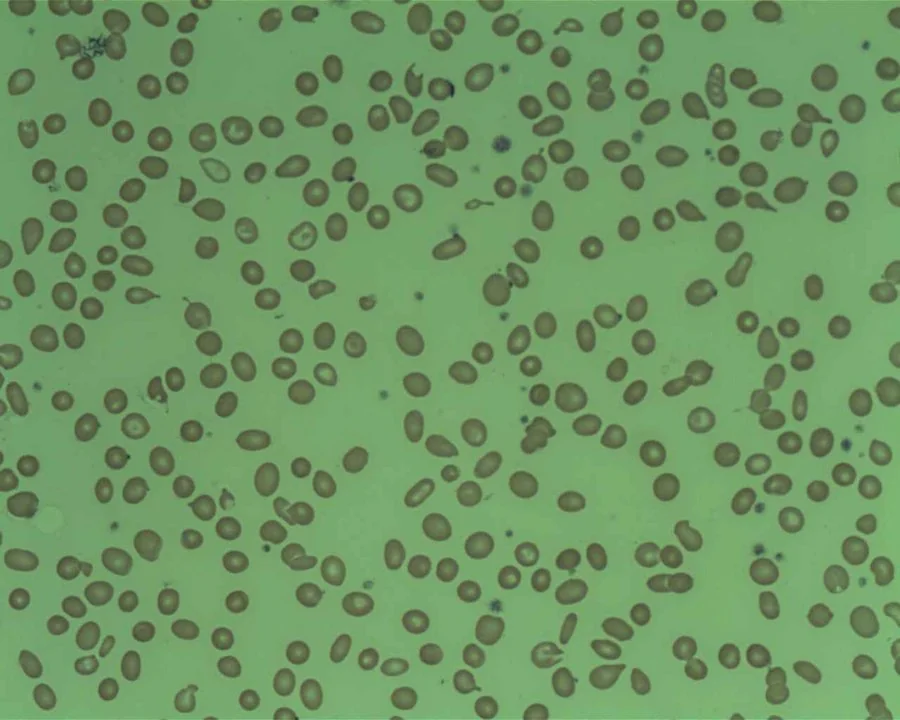
Bone marrow trephine biopsy is usually required to confirm the diagnosis, since aspiration often fails ("dry tap") because of the fibrosis - the trephine shows increased reticulin/collagen fibrosis on special staining.
Management
- Allogeneic stem cell transplant is the only curative option and is considered in eligible higher-risk (assessed by prognostic scores such as DIPSS) younger patients
- Ruxolitinib (a JAK1/2 inhibitor) is first-line drug therapy for symptomatic splenomegaly and constitutional symptoms in intermediate/high-risk disease, though it does not cure the underlying clone3
- Supportive care - transfusion for anaemia, treatment of complications; splenectomy or splenic irradiation is occasionally used for symptomatic splenomegaly refractory to drug therapy, though with significant procedural risk in this group
Chronic myeloid leukaemia
CML is defined by the Philadelphia chromosome - the reciprocal translocation t(9;22) that fuses the BCR and ABL1 genes, producing a constitutively active BCR-ABL1 tyrosine kinase that drives uncontrolled proliferation of the granulocyte lineage. It typically presents in the 40s-60s.
Clinical features
- Often detected incidentally on a routine blood count showing a markedly raised white cell count
- Splenomegaly, sometimes massive, causing abdominal discomfort and early satiety
- Constitutional symptoms - fatigue, weight loss, night sweats
- Gout from increased cell turnover
- Rarely, symptoms of hyperviscosity or priapism with extreme white cell counts
Investigations
- FBC - markedly raised white cell count, characteristically showing the full spectrum of granulocyte maturation in the peripheral blood (myelocytes, metamyelocytes, band forms, neutrophils), rather than the maturation arrest seen in acute leukaemia. Basophilia is also typical
- Cytogenetics/FISH for the Philadelphia chromosome t(9;22), and PCR for the BCR-ABL1 transcript, which confirms the diagnosis and is used to monitor treatment response
- Bone marrow biopsy to assess blast percentage and stage disease phase
Natural history and phases
| Phase | Blast percentage | Features |
|---|---|---|
| Chronic phase | <10% | Often asymptomatic or mild symptoms; the phase in which most patients are diagnosed and treated |
| Accelerated phase | 10-19%, or other high-risk features | Increasing symptoms, worsening counts, additional cytogenetic abnormalities |
| Blast crisis | ≥20% | Behaves like acute leukaemia (myeloid or lymphoid blasts); historically fatal within months without treatment |
Management
Tyrosine kinase inhibitors (TKIs) - imatinib and successors (dasatinib, nilotinib, bosutinib, ponatinib) - target the BCR-ABL1 kinase directly and have transformed CML from a rapidly fatal disease into one with near-normal life expectancy for most chronic-phase patients.4 Response is monitored by serial BCR-ABL1 PCR, aiming for progressively deeper molecular responses; allogeneic stem cell transplant is reserved for TKI-resistant disease or advanced phase (accelerated/blast crisis).
Complications common to the myeloproliferative disorders
- Thrombosis (arterial and venous, including unusual sites) - the dominant risk across all Philadelphia-negative MPNs
- Progressive marrow failure (myelofibrosis) - either as a primary presentation or as late transformation from ET or PV
- Transformation to acute myeloid leukaemia - a risk across all MPNs, generally low but present, and higher with certain drug exposures and in myelofibrosis
- Gout and urate nephropathy from high cell turnover
- In CML specifically, progression to blast crisis if untreated or if resistance develops
Red flags
Prognosis
Essential thrombocythaemia carries a near-normal life expectancy for many patients, particularly with CALR-mutated, lower-risk disease, though thrombotic events remain the main cause of morbidity.2 Primary myelofibrosis has the most variable and generally the worst prognosis of the Philadelphia-negative MPNs, with survival ranging from several years to over a decade depending on risk score, and allogeneic transplant remaining the only curative option for eligible patients.
Chronic myeloid leukaemia has been transformed by tyrosine kinase inhibitors: most patients diagnosed in chronic phase and treated appropriately now have life expectancy approaching that of the general population, a dramatic contrast to the pre-TKI era.4 Across all these disorders, long-term monitoring continues indefinitely, given the ongoing risks of thrombosis, progression and transformation to acute leukaemia.
References
- Vainchenker W, Kralovics R. Genetic basis and molecular pathophysiology of classical myeloproliferative neoplasms. Blood. 2017. Available here
- Harrison CN, Bareford D, Butt N et al. Guideline for investigation and management of essential thrombocythaemia. Br J Haematol. 2010. Available here
- McLornan DP, Percy M, Harrison CN. Myelofibrosis: management of the classic myeloproliferative neoplasm. Br J Haematol. 2021. Available here
- Hochhaus A, Baccarani M, Silver RT et al. European LeukemiaNet 2020 recommendations for treating chronic myeloid leukemia. Leukemia. 2020. Available here
- Osaretin, CC BY-SA 4.0, via Wikimedia Commons. Available here
This article is written for revision and education. It is not clinical guidance and must not be used to make decisions about the care of a patient. Always check current NICE guidance and local protocols.