
Alzheimer Disease
Key points
- Commonest dementia subtype: Alzheimer's disease accounts for around 60-70% of dementia cases, alone or as part of mixed pathology with vascular disease.
- Pathology: extracellular amyloid-beta plaques and intracellular neurofibrillary tangles of hyperphosphorylated tau, with progressive neuronal loss and cholinergic deficit.
- Presentation: insidious, progressive impairment of episodic memory first, with other domains (language, visuospatial, executive) affected as the disease advances.
- Imaging: MRI classically shows medial temporal lobe (hippocampal) atrophy, supporting but not required for diagnosis.
- Cholinesterase inhibitors: donepezil, rivastigmine or galantamine - first-line symptomatic treatment for mild-to-moderate disease, targeting the cholinergic deficit.
- Memantine: an NMDA receptor antagonist used for moderate-to-severe disease, or when cholinesterase inhibitors are not tolerated or are contraindicated.
- No disease modification (in routine UK practice): current licensed drugs treat symptoms, not the underlying pathology; newer anti-amyloid antibodies exist but are not yet part of routine NHS care.
- Non-pharmacological management: cognitive stimulation therapy, structured activity, and carer support are core components, not adjuncts to drug treatment.
Introduction
Alzheimer's disease is the commonest cause of dementia, accounting for around 60-70% of cases either alone or as the dominant pathology in mixed dementia (commonly co-occurring with vascular disease). It is a primary neurodegenerative disease characterised pathologically by extracellular amyloid-beta plaques and intracellular neurofibrillary tangles of hyperphosphorylated tau protein, leading to progressive synaptic and neuronal loss, particularly affecting the hippocampus and temporoparietal cortex early in the disease course.1
For general assessment, screening and the process of reaching a dementia diagnosis, see 2; this article focuses on the features, investigation and management specific to Alzheimer's disease itself.
Pathophysiology
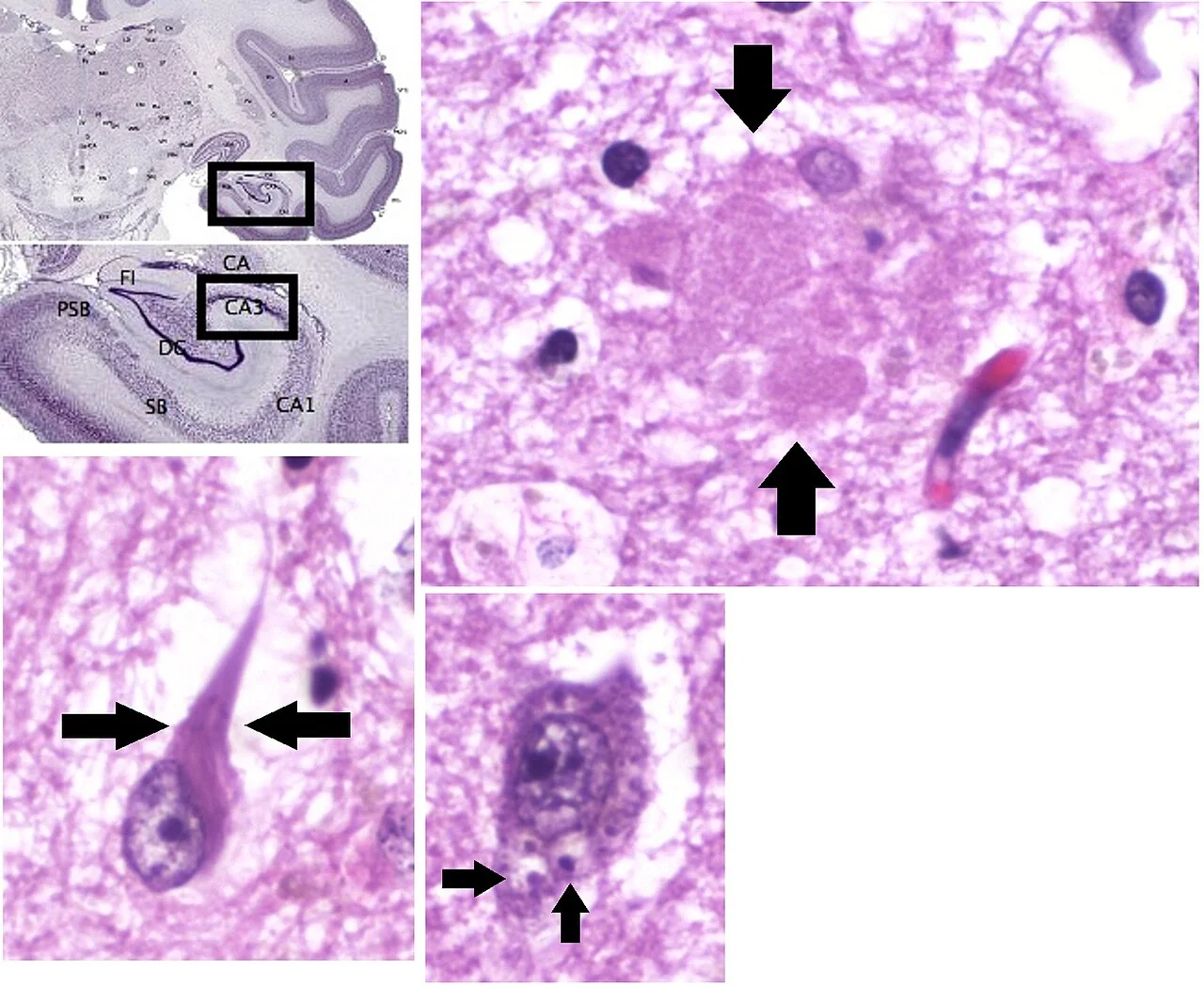
- Amyloid-beta plaques: extracellular deposits derived from abnormal cleavage of amyloid precursor protein, thought to trigger a cascade of neuronal injury (the 'amyloid hypothesis', though increasingly understood as one part of a more complex process)
- Neurofibrillary tangles: intracellular aggregates of hyperphosphorylated tau protein, disrupting the neuronal cytoskeleton and axonal transport
- Cholinergic deficit: loss of cholinergic neurons, particularly in the basal forebrain, correlating with the severity of cognitive impairment - the rationale for cholinesterase inhibitor treatment
- Regional pattern: pathology characteristically begins in the medial temporal lobe (entorhinal cortex, hippocampus), explaining the early prominence of episodic memory impairment, before spreading to temporoparietal and eventually frontal association cortex as the disease advances
| Category | Examples |
|---|---|
| Non-modifiable | Increasing age (the strongest risk factor), family history, Down syndrome (near-universal Alzheimer pathology by middle age), APOE ε4 allele |
| Modifiable (cardiovascular/lifestyle) | Hypertension, diabetes, obesity, physical inactivity, smoking, hearing loss, social isolation, low educational attainment, depression, traumatic brain injury |
Genetics
The overwhelming majority of Alzheimer's disease is sporadic and polygenic, with genetics contributing risk rather than certainty. A small minority is autosomal dominant, and distinguishing the two matters for counselling and for the age at which the diagnosis should be suspected.
| Category | Genes | Implication |
|---|---|---|
| Susceptibility (sporadic, late-onset) | APOE ε4 allele | One copy increases risk severalfold, two copies more so; ε2 is protective. Not diagnostic and not routinely tested, since it alters probability rather than determining outcome |
| Autosomal dominant (early-onset familial) | APP, PSEN1, PSEN2 | Rare, typically causing onset in the 30s-50s with near-complete penetrance; warrants genetic counselling and specialist referral |
| Chromosomal | Trisomy 21 (Down syndrome) | The APP gene lies on chromosome 21, so the extra copy leads to lifelong amyloid overproduction and near-universal Alzheimer pathology by middle age |
Clinical features
The characteristic pattern is an insidious, gradually progressive decline led by episodic memory impairment, in contrast to the stepwise course of vascular dementia or the early behavioural change of frontotemporal dementia.
- Early: short-term memory loss (repeating questions, losing items, forgetting recent events) with relative preservation of remote memory and personality/insight sometimes reduced but social skills often superficially intact
- Middle: progressive impairment of language (word-finding difficulty, reduced fluency), visuospatial skills (getting lost, difficulty judging distances), and executive function (planning, managing finances); increasing dependence in instrumental activities of daily living
- Late: impairment of basic activities of daily living (washing, dressing, continence), significant behavioural and psychological symptoms (agitation, psychosis, wandering), and eventually loss of mobility, swallowing difficulty and profound dependence
Atypical presentations
A minority of patients - particularly those with younger onset - present with a non-amnestic syndrome, where memory is relatively spared early and another cognitive domain fails first. These are genuinely Alzheimer's disease pathologically, but are frequently misdiagnosed because they do not fit the expected memory-led picture.
- Posterior cortical atrophy: progressive visuospatial and visuoperceptual failure - difficulty reading, judging distances, recognising objects, or navigating - with normal eyes and normal ophthalmic examination. Patients are often referred to ophthalmology repeatedly before the diagnosis is recognised
- Logopenic variant primary progressive aphasia: word-finding difficulty and impaired sentence repetition with relatively preserved single-word comprehension and grammar; usually Alzheimer pathology, in contrast to the other progressive aphasias which are more often frontotemporal
- Frontal (dysexecutive) variant: prominent executive dysfunction and behavioural change, overlapping clinically with frontotemporal dementia but with Alzheimer pathology underlying it
Investigations
As with dementia generally, first-line investigation excludes reversible causes (see 2 for the standard panel), followed by structural imaging and, in the specialist setting, more detailed assessment to support a specific Alzheimer's diagnosis.
Imaging
MRI is preferred over CT where available, classically showing medial temporal lobe (hippocampal) atrophy, which supports the diagnosis and helps distinguish Alzheimer's from other causes of cognitive decline. Imaging is not required to make a clinical diagnosis but is useful where the picture is atypical, where the patient is younger, or where there is diagnostic uncertainty.
Specialist and research investigations
- Cerebrospinal fluid biomarkers (reduced amyloid-beta 42, raised total and phosphorylated tau) - used in specialist centres, particularly for atypical or younger-onset presentations
- Amyloid PET imaging - demonstrates amyloid deposition directly; largely a specialist/research tool in current UK practice
- Neuropsychological testing (e.g. ACE-III) - characterises the specific pattern of cognitive deficit, supporting subtype diagnosis
Management
Pharmacological: cholinesterase inhibitors
Donepezil, rivastigmine and galantamine are acetylcholinesterase inhibitors, first-line for mild-to-moderate Alzheimer's disease, working by increasing synaptic acetylcholine to partially compensate for the cholinergic deficit.3
| Drug | Notes |
|---|---|
| Donepezil | Once daily, generally well tolerated; the most commonly prescribed |
| Rivastigmine | Available as a transdermal patch, useful where oral adherence or tolerability is a problem |
| Galantamine | Also has some nicotinic receptor modulating activity; similar side effect profile to the others |
Common side effects reflect increased cholinergic activity: nausea, vomiting, diarrhoea, and bradycardia - caution and ECG review are advised in patients with cardiac conduction abnormalities or on other rate-limiting drugs.
Pharmacological: memantine
Memantine, an NMDA receptor antagonist, reduces glutamate-mediated excitotoxicity and is used for moderate-to-severe Alzheimer's disease, or for patients who cannot tolerate or have a contraindication to cholinesterase inhibitors. It can also be added to a cholinesterase inhibitor as disease progresses, rather than only substituted.
Monitoring and stopping cognitive drugs
Response is assessed clinically - by the patient's and carer's report of function and symptoms - rather than by chasing a target score on a cognitive test. A modest slowing of decline, or stabilisation, counts as benefit; a drug should not be judged ineffective simply because the patient has not improved back towards their previous baseline, since these agents are symptomatic and do not reverse the underlying neurodegeneration.
- Review after initiation and titration to check tolerability, then periodically thereafter
- Continue while there is judged to be ongoing benefit, including into severe disease where it is helping - NICE does not mandate stopping at a particular severity threshold
- Consider stopping if there are intolerable side effects, if adherence is poor, or if the drug is judged to be providing no benefit
- If stopping, do so as a planned trial with review, since decline after withdrawal may reveal a benefit that was not obvious while the drug was being taken
Managing behavioural and psychological symptoms
Agitation, aggression, psychosis and sleep disturbance are common as the disease progresses. Non-pharmacological approaches are first-line: identifying and addressing triggers (pain, constipation, infection, an unmet need such as hunger or boredom), environmental modification, structured activity and consistent routine. Antipsychotics are used only when non-pharmacological measures fail and there is significant risk or distress, at the lowest effective dose for the shortest time, because of an increased risk of stroke and mortality in this population - a well-documented, examinable safety concern.4
Non-pharmacological management
- Cognitive stimulation therapy: structured group activity shown to have a modest positive effect on cognition and quality of life
- Structured routine and meaningful activity, tailored to the person's interests and remaining abilities
- Carer education and support, since carer wellbeing directly affects the quality of care the patient receives - see 5
- Environmental adaptation: signage, reduced clutter, consistent routines to support orientation and reduce distress
- Advance and anticipatory care planning initiated while capacity allows, as discussed in 2 and 6
Emerging disease-modifying treatments
Monoclonal antibodies targeting amyloid-beta (e.g. lecanemab, donanemab) have shown modest slowing of cognitive decline in trials of early, biomarker-confirmed Alzheimer's disease, but as of current UK practice are not part of routine NHS treatment, require intensive monitoring (including for amyloid-related imaging abnormalities, a recognised side effect), and access remains limited and evolving - useful context to be aware of but not yet a first-line answer in UK exam settings.
Red flags
Prognosis
Alzheimer's disease is progressive over a typical course of several years to over a decade from diagnosis to death, though the rate varies considerably between individuals. Current licensed treatments provide modest symptomatic benefit and do not halt the underlying neurodegenerative process, which is why realistic goal-setting - focused on quality of life, function and carer support - is as important a part of management as the drugs themselves.
In advanced disease, patients become fully dependent, lose mobility, and develop swallowing difficulty with a consequent risk of aspiration pneumonia, which is a common terminal event. Recognising advanced dementia as a terminal illness is important and frequently done too late: it shifts the focus towards comfort, symptom control and avoiding burdensome interventions, and it is the point at which decisions about hospital admission, antibiotics and artificial feeding should be revisited against the patient's previously expressed wishes rather than made by default in a crisis.
References
- Alzheimer's Society. What is Alzheimer's disease? Available here
- NICE NG97. Dementia: assessment, management and support for people living with dementia and their carers. 2018. Available here
- NICE TA217. Donepezil, galantamine, rivastigmine and memantine for the treatment of Alzheimer's disease. Available here
- Schneider LS, Dagerman KS, Insel P. Risk of death with atypical antipsychotic drug treatment for dementia: meta-analysis. JAMA. 2005. Available here
- Care Act 2014. Carer's assessment provisions. Available here
- Mental Capacity Act 2005 Code of Practice. Available here
This article is written for revision and education. It is not clinical guidance and must not be used to make decisions about the care of a patient. Always check current NICE guidance and local protocols.