
Familial Hypercholesterolaemia: Diagnosis and Cascade Testing
Key points
- Familial hypercholesterolaemia: an autosomal dominant disorder of LDL clearance causing very high LDL cholesterol from birth and premature atherosclerotic disease.
- Genetics: LDLR variants account for most cases, with APOB and gain-of-function PCSK9 variants making up the remainder.
- Prevalence: heterozygous FH affects around 1 in 250 people, making it one of the commonest inherited conditions - yet most cases in the UK remain undiagnosed.
- Suspect it when: total cholesterol is above 7.5 mmol/L, there are tendon xanthomata, or there is premature coronary disease in the family.
- Diagnosis: clinical, using the Simon Broome or Dutch Lipid Clinic Network criteria, ideally confirmed by genetic testing.
- QRISK3 does not apply: risk calculators are invalid in FH and must not be used to decide on treatment - everyone with FH gets a high-intensity statin.
- Cascade testing: systematic testing of relatives from an index case is the single most effective way to find undiagnosed FH, and is NICE-recommended.
- Homozygous FH: rare (~1 in 300,000), with LDL often above 13 mmol/L and coronary disease in childhood; needs apheresis and specialist drugs.
Introduction
Familial hypercholesterolaemia (FH) is an autosomal dominant disorder in which impaired clearance of low-density lipoprotein (LDL) from the circulation produces a very high LDL cholesterol from birth. Because the exposure is lifelong rather than acquired in middle age, the cumulative burden of LDL on the arterial wall is enormous, and untreated FH causes coronary artery disease decades earlier than it would otherwise occur.1
Heterozygous FH affects roughly 1 in 250 people, which makes it one of the commonest inherited conditions in medicine - considerably commoner than cystic fibrosis, Huntington's disease and all the chromosomal syndromes combined. Despite this, the great majority of people with FH in the UK have never been diagnosed, and many are identified only after a premature myocardial infarction that effective treatment would have prevented.2
This article approaches FH from the genetics side: the molecular basis, how the diagnosis is made, and above all cascade testing, which is the mechanism by which one diagnosed patient leads to a family's worth of prevented heart attacks. The broader assessment and drug management of raised cholesterol is covered in Hyperlipidaemia.
Genetics and pathophysiology
The LDL receptor on the hepatocyte surface binds circulating LDL particles via apolipoprotein B-100 and internalises them for degradation, after which the receptor is recycled back to the cell surface. Anything that reduces the number or function of these receptors reduces LDL clearance and raises plasma LDL cholesterol. All three FH genes act on some step in this pathway.
| Gene | Share of cases | Mechanism |
|---|---|---|
| LDLR | ~85-90% | Loss of function of the LDL receptor itself - reduced receptor number or defective binding, internalisation or recycling. Over 2,000 pathogenic variants described. |
| APOB | ~5-10% | Loss of function in apolipoprotein B-100, the ligand on the LDL particle, so LDL cannot bind the (normal) receptor. Usually a milder phenotype. |
| PCSK9 | ~1-3% | Gain of function. PCSK9 targets the LDL receptor for degradation instead of recycling, so an overactive PCSK9 depletes receptors. |
| No variant identified | ~20-40% of clinically diagnosed cases | Either an undetected variant, or a polygenic cause - a high burden of common LDL-raising variants producing an FH-like phenotype. |
The PCSK9 mechanism is worth understanding because it explains a whole drug class. If a gain-of-function PCSK9 variant causes high cholesterol by destroying LDL receptors, then pharmacologically inhibiting PCSK9 preserves receptors and lowers LDL - which is exactly what the monoclonal antibodies alirocumab and evolocumab do. This is one of the clearest examples in medicine of human genetics directly generating a therapeutic target.
Inheritance and gene dosage
- Autosomal dominant - a single variant allele produces the phenotype, so each child of an affected parent has a 50% risk, and male-to-male transmission occurs
- More precisely the inheritance is co-dominant, because gene dosage matters: heterozygotes have roughly half the normal number of functioning LDL receptors and a moderately raised LDL, while homozygotes have almost none and a dramatically higher LDL
- Penetrance is essentially complete for the biochemical phenotype - a person with a pathogenic variant will have a raised LDL from birth - though the age at which clinical cardiovascular disease appears varies with other risk factors
- Heterozygous FH affects around 1 in 250; untreated LDL cholesterol is typically in the range of 5-13 mmol/L
- Homozygous (or compound heterozygous) FH affects around 1 in 300,000; LDL cholesterol is often above 13 mmol/L, with xanthomas and coronary disease appearing in childhood
Clinical features
FH is asymptomatic until it presents with cardiovascular disease, which is precisely why it must be sought actively rather than waited for. Physical signs, when present, are highly suggestive, but their absence does not exclude the diagnosis - many people with genetically confirmed FH have no clinical signs at all.
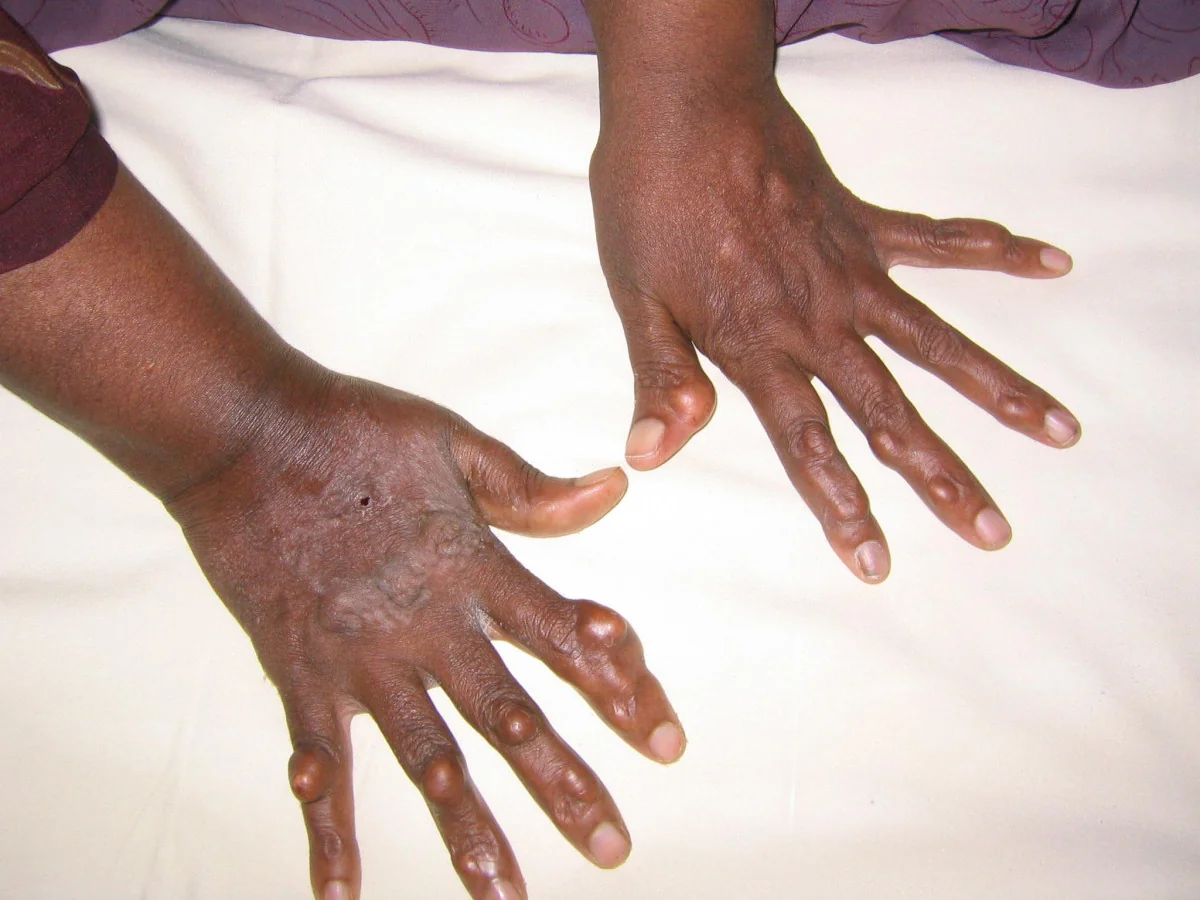
- Tendon xanthomata - firm, non-tender nodules within tendons, classically the Achilles tendon and the extensor tendons over the knuckles. These are the most specific sign and carry the greatest diagnostic weight
- Corneal arcus before the age of 45 - a grey-white ring at the corneal margin. Common and meaningless in the elderly, but a genuine pointer in a young adult
- Xanthelasma - yellowish periorbital cholesterol deposits; less specific, as it occurs with normal lipids too
- Premature atherosclerotic disease - angina, myocardial infarction, stroke or peripheral arterial disease, often in the fourth or fifth decade and sometimes earlier
- Aortic stenosis and supravalvular aortic narrowing - from cholesterol deposition, particularly in homozygous disease
- Cutaneous and tuberous xanthomas over knees, elbows and buttocks - suggest homozygous FH, especially if present in childhood
Who to suspect and how to diagnose
NICE advises suspecting FH in an adult with a total cholesterol above 7.5 mmol/L, or with a personal or family history of premature coronary heart disease, and in a child with a total cholesterol above 6.7 mmol/L where a parent has known FH.3 Before applying diagnostic criteria, exclude secondary causes of hypercholesterolaemia - hypothyroidism, nephrotic syndrome, cholestatic liver disease, and drugs - with thyroid function, renal and liver profiles and urinalysis.
Diagnostic criteria
Two systems are used in UK and European practice. The Simon Broome criteria classify FH as 'definite' or 'possible' by combining a cholesterol threshold with tendon xanthomata, DNA confirmation, or family history. The Dutch Lipid Clinic Network (DLCN) criteria are points-based, scoring family history, personal history of premature vascular disease, physical signs, LDL level and DNA result to place the patient in a probability category.
| Category | Requirements |
|---|---|
| Definite FH | Total cholesterol above the age-specific threshold (or LDL above threshold), PLUS tendon xanthomata in the patient or a first- or second-degree relative, OR DNA-confirmed pathogenic LDLR, APOB or PCSK9 variant |
| Possible FH | The same cholesterol threshold, PLUS a family history of myocardial infarction before 50 in a second-degree relative or before 60 in a first-degree relative, OR a family history of raised total cholesterol above the threshold in an adult first- or second-degree relative |
Genetic testing
- Offer DNA testing to anyone meeting criteria for possible or definite FH, since a confirmed variant makes cascade testing of relatives far simpler and more definitive
- A negative genetic test does not exclude FH - a pathogenic variant is found in only about 60-80% of clinically definite cases, and the clinical diagnosis and its treatment implications stand regardless
- Where no variant is found, relatives are screened by LDL cholesterol measurement instead, using age- and sex-specific cut-offs, which is less precise but still effective
- A negative test in a relative of someone with a known familial variant is genuinely reassuring, and that relative can be discharged from further FH surveillance
Cascade testing
Cascade testing is the systematic identification and testing of the biological relatives of an index case, working outwards from first-degree relatives to second- and third-degree relatives as each new case is found. It is the highest-yield intervention in FH: because the condition is autosomal dominant, half of every affected person's first-degree relatives will also have it, and each one identified is a premature cardiovascular event that can be prevented rather than treated.
- NICE recommends cascade testing using DNA where the familial variant is known, and LDL cholesterol measurement where it is not3
- Testing extends to children, who should be tested by around age 10 - early enough to start statin treatment during adolescence, late enough to be a meaningful decision
- Because relatives cannot be contacted directly without consent, the index case is normally asked to inform them, supported by written information from the lipid service to pass on
- Reverse cascade also matters: a child found to have FH on screening should prompt testing of both parents, one of whom will usually be affected and undiagnosed
- Dedicated FH nurse-led cascade services exist across the NHS and substantially outperform ad hoc case-finding
Investigations
- Full lipid profile - total cholesterol, LDL, HDL and triglycerides; two separate measurements are used to confirm a persistently raised level before committing to a diagnosis
- Secondary cause screen - TFTs, HbA1c or fasting glucose, LFTs, U&Es and urinalysis for proteinuria, to exclude hypothyroidism, nephrotic syndrome and cholestasis
- Genetic testing - LDLR, APOB and PCSK9 sequencing with deletion/duplication analysis, arranged through a lipid clinic or genetics service
- Baseline liver function and creatine kinase - before starting a high-intensity statin
- Cardiovascular assessment - clinical review for angina and peripheral vascular disease, with echocardiography where aortic stenosis is suspected, and consideration of imaging for subclinical atherosclerosis in higher-risk individuals
- Family pedigree - a three-generation family history documenting cholesterol levels, cardiovascular events and ages, which both supports the diagnosis and maps out who needs cascade testing
Management
Treatment is lifelong and begins at diagnosis. The principle is straightforward - lower LDL cholesterol as far as reasonably achievable, as early as possible - and the drug sequence follows the same logic as in other high-risk lipid management, but is applied more aggressively and without reference to risk scores.
- High-intensity statin - typically atorvastatin, aiming for at least a 50% reduction in LDL cholesterol from baseline in adults with FH
- Add ezetimibe if the target reduction is not achieved on the maximum tolerated statin dose, or use it alone where statins are genuinely not tolerated
- PCSK9 inhibitor (alirocumab or evolocumab) where LDL remains above threshold on maximal oral therapy, subject to NICE eligibility criteria that differ for primary and secondary prevention and for heterozygous versus homozygous disease4
- Specialist therapies for homozygous FH - lipoprotein apheresis, and drugs such as lomitapide and evinacumab, delivered through designated specialist centres
- Address all other cardiovascular risk factors - smoking cessation is especially important, since smoking and FH are powerfully synergistic; also blood pressure, weight, diet, activity and diabetes
Additional considerations
- Children with FH are usually started on a statin from around age 10, managed through specialist paediatric lipid services
- Pregnancy - statins, ezetimibe and PCSK9 inhibitors are stopped before conception and during pregnancy and breastfeeding; women of childbearing age need this discussed at diagnosis and contraception considered, and treatment is resumed afterwards
- Referral to a specialist lipid clinic is recommended for all confirmed FH, and is mandatory for homozygous disease, children, and anyone not reaching target on standard therapy
- Annual review covering lipid profile, adherence, side effects, cardiovascular symptoms and the ongoing progress of cascade testing in the family
Homozygous familial hypercholesterolaemia
Where a child inherits a pathogenic variant from both parents - true homozygous, or compound heterozygous with two different variants - LDL receptor function is nearly or completely absent. It occurs in roughly 1 in 300,000 and is far more common where both parents are known to have FH or where there is consanguinity.
- LDL cholesterol frequently above 13 mmol/L, and sometimes far higher
- Cutaneous and tendon xanthomata in early childhood, often the presenting feature
- Coronary and supravalvular aortic disease in the first two decades, with myocardial infarction reported in childhood in untreated cases
- Statins alone are insufficient, since they work largely by upregulating LDL receptors that these patients do not have
- Lipoprotein apheresis - the mainstay, physically removing LDL from plasma at regular intervals, typically fortnightly
- Lomitapide (a microsomal triglyceride transfer protein inhibitor) and evinacumab (an anti-ANGPTL3 antibody) act by receptor-independent mechanisms and are effective where receptor-dependent drugs are not
Prognosis
Untreated heterozygous FH historically led to coronary artery disease in around 50% of men by age 50 and 30% of women by age 60, with a substantially reduced life expectancy. Treatment changes this dramatically: cohort studies show that FH patients on effective statin therapy have a cardiovascular risk approaching that of the general population, and the earlier treatment starts, the closer that approximation becomes.5
This is the argument for aggressive case-finding. FH is common, silent, easily diagnosed with a blood test and a family history, and highly treatable with cheap, well-established drugs - and yet most affected people in the UK do not know they have it. The clinical failure in FH is almost never one of treatment; it is one of diagnosis. Every index case identified is an opportunity to find several more relatives, which is why cascade testing, rather than any particular drug, is the intervention that defines good FH care.
References
- Youngblom E, Pariani M, Knowles JW. Familial Hypercholesterolemia. GeneReviews, NCBI Bookshelf. Available here
- Nordestgaard BG, Chapman MJ, Humphries SE et al. Familial hypercholesterolaemia is underdiagnosed and undertreated in the general population: consensus statement of the European Atherosclerosis Society. European Heart Journal. 2013. Available here
- NICE CG71. Familial hypercholesterolaemia: identification and management. 2008, updated 2019. Available here
- NICE TA393 and TA394. Alirocumab and evolocumab for treating primary hypercholesterolaemia and mixed dyslipidaemia. Available here
- Versmissen J, Oosterveer DM, Yazdanpanah M et al. Efficacy of statins in familial hypercholesterolaemia: a long term cohort study. BMJ. 2008. Available here
This article is written for revision and education. It is not clinical guidance and must not be used to make decisions about the care of a patient. Always check current NICE guidance and local protocols.