
Folliculitis and Hidradenitis Suppurativa
Key points
- Folliculitis: inflammation centred on the hair follicle, most often infective (typically Staphylococcus aureus) but also caused by irritation, occlusion, or other organisms including Pseudomonas and Malassezia.
- Hidradenitis suppurativa: a chronic, relapsing inflammatory disease of hair follicles in flexural, apocrine gland-bearing skin (axillae, groin, perianal and inframammary areas), driven primarily by follicular occlusion rather than primary infection.
- Not primarily infective: hidradenitis suppurativa was once called acne inversa; bacteria are secondary colonisers of an already-occluded, ruptured follicle, which is why long-term antibiotics alone rarely produce a cure.
- Hurley staging: grades hidradenitis suppurativa from I (isolated abscesses, no sinus tracts or scarring) to III (diffuse, interconnected tracts and abscesses across a region), and directly guides the choice between medical and surgical treatment.
- Hot tub folliculitis: a classic, self-limiting Pseudomonas aeruginosa folliculitis following exposure to inadequately chlorinated hot tubs or pools.
- Folliculitis management: address the underlying trigger (shaving technique, occlusion, hot tub exposure) and use topical or oral antibiotics matched to extent and organism.
- Hidradenitis suppurativa management: lifestyle measures (smoking cessation, weight loss) and topical or oral antibiotics for mild disease, biologic therapy (adalimumab) for moderate-to-severe disease, and surgery for fixed sinus tracts that will not resolve medically.
- Red flag: long-standing hidradenitis suppurativa sinus tracts carry a small but recognised risk of squamous cell carcinoma developing within them, and any non-healing, indurated or rapidly changing area needs biopsy.
Introduction
Folliculitis and hidradenitis suppurativa both centre on the hair follicle, which is why they are considered together, but they differ substantially in mechanism, severity and management. Folliculitis is usually a superficial, self-limiting infection or irritation of individual follicles that responds quickly to simple measures. Hidradenitis suppurativa is a chronic, often severely disabling disease of follicular occlusion in specific flexural sites, requiring a much more sustained, staged approach to treatment.1,4
Confusing the two matters clinically: treating hidradenitis suppurativa as if it were simple folliculitis - a short course of antibiotics and reassurance - under-treats a progressive, scarring disease and delays the point at which more effective therapy is started.
Folliculitis
Aetiology and classification
Folliculitis can be infective or non-infective, and superficial or deep.
| Cause | Notes |
|---|---|
| Staphylococcus aureus | The commonest infective cause; superficial pustules centred on hair follicles, anywhere hair-bearing skin is shaved, occluded or traumatised |
| Pseudomonas aeruginosa ('hot tub folliculitis') | Follows exposure to inadequately chlorinated hot tubs, pools or wetsuits; an itchy, papulopustular eruption appearing 8-48 hours after exposure, classically under swimwear |
| Malassezia (Pityrosporum) folliculitis | Itchy, monomorphic follicular papules and pustules on the upper trunk and back, often in young adults, mistaken for acne but without comedones |
| Demodex mites | Can provoke a folliculitis-like eruption on the face, particularly in the context of immunosuppression |
| Herpes simplex or varicella zoster | Occasionally produce a follicular pattern of vesicles rather than the more typical grouped vesicles |
| Irritant or mechanical (shaving, waxing, occlusion) | Non-infective, from direct follicular trauma or blockage; commonly seen in the beard area (pseudofolliculitis barbae) and the legs after shaving |
| Drug-induced | Topical or systemic corticosteroids, and epidermal growth factor receptor inhibitors, are recognised causes |
Clinical features
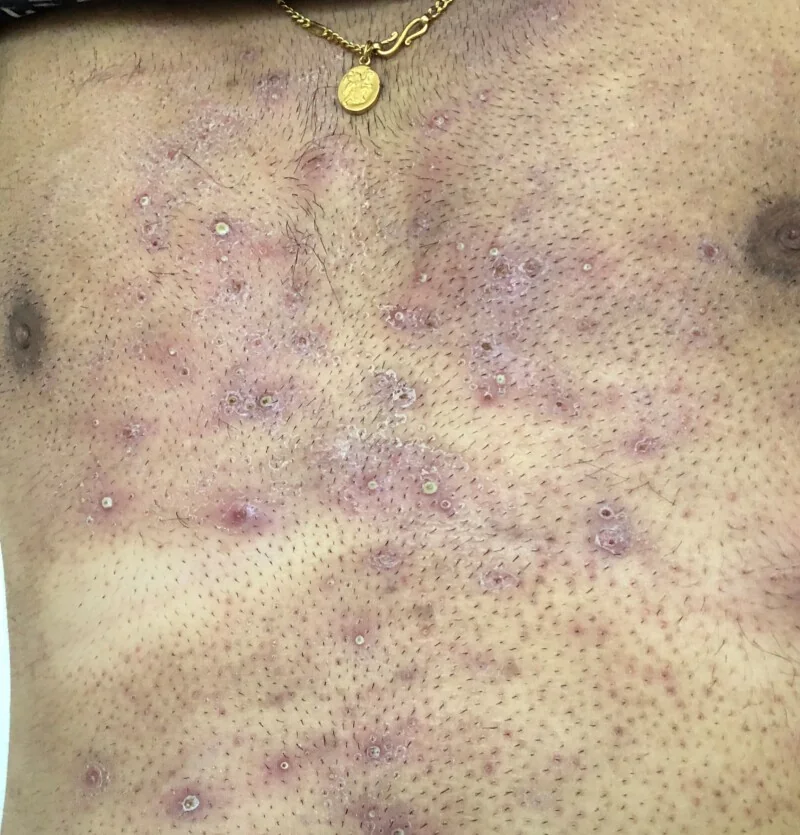
Folliculitis presents as small, discrete, erythematous papules or pustules, each centred on a hair follicle - a useful distinguishing feature from other papulopustular rashes. Lesions are often mildly itchy or tender rather than severely painful, and typically affect the scalp, beard area, trunk, buttocks and limbs. A deeper, more painful, fluctuant lesion (a furuncle or 'boil') represents infection extending into and around the follicle into the surrounding dermis, and multiple confluent furuncles form a carbuncle, which is often accompanied by fever and malaise.
Management
- Address the underlying trigger - improve shaving technique (shave in the direction of hair growth, use a sharp single-blade razor, avoid excessively close shaving), avoid prolonged occlusion, and stop or change a causative hot tub exposure
- Mild, localised bacterial folliculitis - often resolves with simple hygiene measures alone, or a short course of a topical antibiotic
- More extensive disease, furuncles or carbuncles - oral flucloxacillin (or an alternative in penicillin allergy); incision and drainage for a fluctuant abscess
- Hot tub folliculitis - generally self-limiting within 7-10 days without antibiotics, since it reflects a robust but short-lived exposure rather than an established infection; symptomatic treatment is usually all that is needed3
- Recurrent staphylococcal folliculitis or furunculosis - consider nasal, axillary and perineal swabs for S. aureus carriage, with topical decolonisation if confirmed1
- Malassezia folliculitis - responds to topical or oral antifungal treatment rather than antibacterial therapy, an important distinction from acne, which it can otherwise resemble
Hidradenitis suppurativa - pathophysiology
Hidradenitis suppurativa (formerly called acne inversa) affects apocrine gland-bearing, flexural skin - the axillae, groin, perianal and perineal region, and inframammary folds. The primary event is follicular occlusion: keratin plugging of the hair follicle causes it to dilate and eventually rupture, releasing follicular contents (keratin, hair fragments, bacteria) into the surrounding dermis and provoking an intense inflammatory response.5
Bacteria are then found within the resulting abscesses and sinus tracts, but this is understood as secondary colonisation of already-damaged tissue rather than the primary cause, which is the key reason long-term antibiotics alone, though clinically helpful, do not reliably cure the disease. Repeated cycles of follicular rupture, inflammation and healing lead to dermal tunnels (sinus tracts) lined with inflammatory and sometimes epithelialised tissue, and ultimately to fibrosis and scarring.6
A genetic contribution is recognised, with mutations in genes encoding gamma-secretase components found in some familial cases, and there is a clear hormonal influence - the disease typically begins after puberty, can fluctuate with the menstrual cycle, and often improves after menopause, though the exact hormonal mechanism is not fully defined.
Hidradenitis suppurativa - risk factors
- Smoking - one of the strongest and most consistently identified risk factors, present in the majority of patients at diagnosis8
- Obesity - increases mechanical friction and occlusion in flexural sites and is strongly associated with more severe disease
- Female sex - somewhat more common in women, though disease in men tends to be more severe
- Family history - a first-degree relative is affected in a significant minority of patients
- Onset after puberty, typically in the second or third decade
- Metabolic syndrome and polycystic ovary syndrome - recognised associations
- Mechanical friction and tight clothing
Hidradenitis suppurativa - clinical features
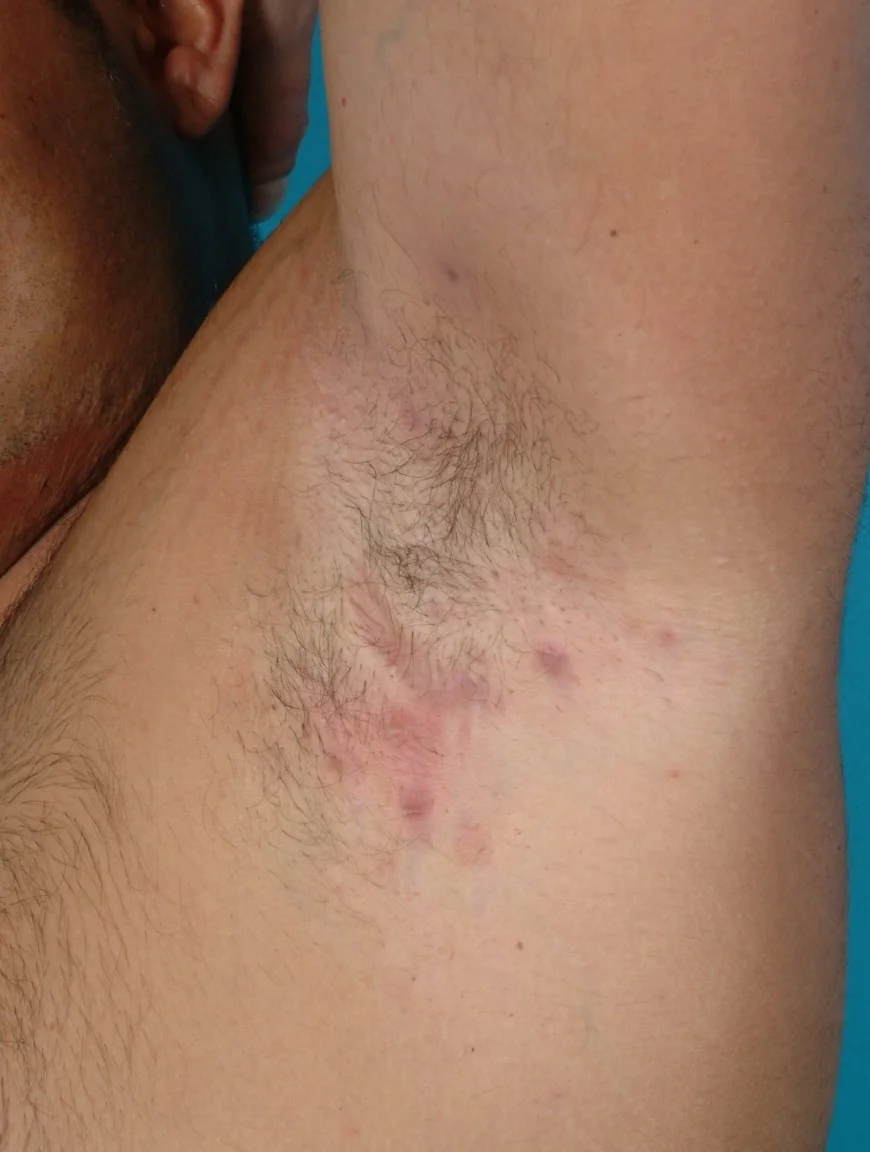
Disease begins with painful, deep-seated, inflamed nodules in the axillae, groin, perianal area or inframammary folds, which can rupture to discharge malodorous, purulent material. Recurrent lesions at the same sites lead to sinus tract formation (interconnected tunnels beneath the skin), double-ended (bridged) comedones, and progressive fibrosis and rope-like scarring.
Hurley staging
| Stage | Features | Typical management |
|---|---|---|
| I | Single or multiple isolated abscesses, without sinus tracts or scarring | Topical or oral antibiotics, lifestyle measures, hormonal therapy |
| II | Recurrent abscesses with sinus tract formation and scarring, but discrete, separated lesions | As above, plus consideration of biologic therapy or localised surgery |
| III | Diffuse or near-diffuse involvement, with multiple interconnected sinus tracts and abscesses across an entire region | Biologic therapy and wide surgical excision |
Pain is often disproportionate to the visible extent of disease, and lesions characteristically flare and partially resolve over days to weeks, following a genuinely chronic, relapsing course rather than a single acute infective episode.
Clinical examination
- Distribution - axillae, groin, perianal/perineal area and inframammary folds for hidradenitis suppurativa, versus any hair-bearing site for folliculitis
- Lesion type and stage - inflamed nodules, discharging sinus tracts, scarring, and double-ended comedones
- Hurley stage - discrete versus interconnected lesions, and the overall extent of scarring within the affected region
- Signs of systemic upset - fever or lymphadenopathy, which are unusual in uncomplicated hidradenitis suppurativa and should prompt consideration of secondary infection
- Impact on movement and function - particularly axillary and groin disease, which can restrict arm movement or walking
- Body mass index and smoking status, given their central role in disease severity
Differential diagnosis
- Furunculosis/carbunculosis - typically a single or few discrete boils rather than the chronic, interconnected, flexural pattern of hidradenitis suppurativa
- Acne conglobata - severe nodulocystic acne with interconnecting sinuses, but affecting acne-typical sites (face, chest, back) rather than flexures specifically
- Perianal Crohn's disease - fistulating perianal disease can closely mimic perianal hidradenitis suppurativa, and the two conditions can coexist; gastrointestinal symptoms and endoscopic findings help distinguish them
- Pilonidal disease - a sinus in the natal cleft related to ingrowing hair, which can be considered a related but distinct condition, sometimes occurring alongside hidradenitis suppurativa
- Lymphogranuloma venereum and other infective causes of inguinal buboes - considered where groin disease follows a clear sexual exposure history
- Infected epidermoid (sebaceous) cysts - a single, discrete, inflamed cyst rather than a chronic, recurrent, multifocal process
Investigations
Both folliculitis and hidradenitis suppurativa are diagnosed clinically in the great majority of cases.
- Skin swab for culture - useful in folliculitis to identify the organism (particularly if Pseudomonas or an atypical cause is suspected) and its antibiotic sensitivities, though secondary bacterial colonisation in hidradenitis suppurativa makes swabs there less useful for guiding definitive treatment
- Ultrasound or MRI - used in hidradenitis suppurativa to map the extent of sinus tracts before surgery, particularly for extensive or perianal disease
- Biopsy - not routinely needed, but performed if the diagnosis is in doubt or if a chronic, non-healing area raises concern for malignant change
- Hidradenitis Suppurativa Sartorius/IHS4 severity scoring - used in specialist clinics to quantify disease activity and monitor response to treatment, alongside the simpler Hurley stage
Hidradenitis suppurativa - management
Management is staged according to Hurley grade and combines lifestyle measures, medical therapy and, for fixed structural disease, surgery.4
General measures for everyone
- Smoking cessation - one of the most impactful modifiable factors available
- Weight loss where relevant, to reduce friction and occlusion in flexural sites
- Loose-fitting clothing and avoidance of other mechanical irritation
- Antiseptic washes as an adjunct, though evidence for a major effect is limited
Mild disease (Hurley I, mild II)
- Topical clindamycin for mild, localised disease
- Combined oral antibiotics (for example a tetracycline, or combined clindamycin and rifampicin for more resistant disease) for a defined course
- Hormonal therapy (combined oral contraceptive, spironolactone) - can help in women with a clear hormonal pattern to their flares
Moderate-to-severe disease (Hurley II-III)
- Adalimumab (anti-TNF biologic) - approved by NICE for moderate-to-severe hidradenitis suppurativa not responding to conventional systemic therapy, and now central to management of more severe disease7
- Other biologics (for example secukinumab) - increasingly used as further options where anti-TNF therapy is ineffective or not tolerated
- Intralesional corticosteroid injection - can settle an acutely inflamed individual nodule
- Incision and drainage - provides short-term relief of an acutely painful abscess but does not address the underlying sinus tract and is not a definitive treatment
- Surgery (deroofing, wide local excision) - the only definitive treatment for established sinus tracts, reserved for fixed, chronic Hurley II-III disease that will not resolve with medical therapy alone; wide excision with the wound left to heal by secondary intention or reconstructed gives the lowest recurrence rates for severe, localised disease
Complications
- Progressive scarring and sinus tract formation, which can restrict movement (particularly in the axilla) and cause chronic pain
- Chronic malodorous discharge, with a substantial impact on self-esteem, relationships and sexual health
- Depression and anxiety - the psychological burden of hidradenitis suppurativa is considerable and often under-recognised relative to disease visibility
- Anaemia of chronic disease and hypoalbuminaemia in severe, longstanding disease
- Lymphoedema of the affected limb in chronic axillary or groin disease from lymphatic scarring
- Squamous cell carcinoma - a rare but recognised complication arising within long-standing sinus tracts, particularly in perianal and gluteal disease of many years' duration
- Fistulae to the urethra, bladder or rectum in severe, longstanding perianal or groin disease
Red flags
Prognosis
Most folliculitis, whatever the cause, resolves quickly with simple measures and rarely causes lasting problems, though recurrent disease should prompt a search for an underlying trigger or staphylococcal carriage.
Hidradenitis suppurativa follows a genuinely chronic course, typically over decades, with a tendency to improve after menopause in women but otherwise persisting despite treatment in a significant proportion of patients. Earlier, more assertive treatment - including a lower threshold for biologic therapy and definitive surgery once Hurley II-III disease is established - improves both symptom control and long-term functional outcome, and delaying treatment while cycling through repeated short courses of antibiotics alone tends to allow more extensive, harder-to-treat scarring to accumulate.6
References
- NICE Clinical Knowledge Summaries. Boils, carbuncles and staphylococcal carriage. Available here
- DermNet NZ. Folliculitis. Available here
- Ratnam S, Hogan K, March SB, Butler RW. Whirlpool-associated folliculitis caused by Pseudomonas aeruginosa: report of an outbreak and review. Journal of Clinical Microbiology. 1986. Available here
- Ingram JR, Collier F, Brown D et al. British Association of Dermatologists guidelines for the management of hidradenitis suppurativa 2018. British Journal of Dermatology. 2019. Available here
- Jemec GB. Clinical practice. Hidradenitis suppurativa. New England Journal of Medicine. 2012. Available here
- van der Zee HH, Laman JD, Prens EP. Hidradenitis suppurativa: viewpoint on clinical phenotyping, pathogenesis and novel treatments. Experimental Dermatology. 2012. Available here
- NICE TA392. Adalimumab for treating moderate to severe hidradenitis suppurativa. 2016. Available here
- Revuz JE, Canoui-Poitrine F, Wolkenstein P et al. Prevalence and factors associated with hidradenitis suppurativa: results from two case-control studies. Journal of the American Academy of Dermatology. 2008. Available here
This article is written for revision and education. It is not clinical guidance and must not be used to make decisions about the care of a patient. Always check current NICE guidance and local protocols.