
Obsessive-Compulsive Disorder
Key points
- OCD: recurrent obsessions and/or compulsions that are time-consuming (over an hour a day) or cause marked distress or functional impairment.
- Obsessions: intrusive, unwanted, ego-dystonic thoughts, images or urges that the person tries to resist or suppress and recognises as their own, not imposed from outside.
- Compulsions: repetitive behaviours or mental acts performed to reduce the distress caused by an obsession, or according to rigid rules, that are excessive and not realistically connected to what they are meant to prevent.
- Insight: usually good - most people recognise the obsessions and compulsions as excessive or irrational, which distinguishes OCD from a psychotic disorder.
- Severity tool: the Yale-Brown Obsessive Compulsive Scale (Y-BOCS) grades severity and monitors treatment response.
- Stepped care: low-intensity CBT (including ERP) for mild impairment; more intensive CBT/ERP and/or an SSRI for moderate; combination treatment and specialist referral for severe or treatment-resistant disease.
- SSRI dosing: OCD often needs higher doses and a longer trial (up to 12 weeks) than for depression before response is judged.
- Prognosis: a chronic, often lifelong tendency, but the majority achieve meaningful and durable improvement with ERP and/or medication.
Introduction
Obsessive-compulsive disorder (OCD) is characterised by recurrent obsessions, compulsions, or both, that are time-consuming or cause marked distress or significant impairment in daily functioning.1 It typically presents in adolescence or early adulthood, though onset in childhood is well recognised, and affects around 1-2% of the population.
OCD is frequently misunderstood as a preference for tidiness. The reality is a distressing and disabling condition in which unwanted thoughts intrude despite the person's efforts to resist them, and compulsive rituals - far from being pleasurable - are performed reluctantly to relieve mounting anxiety. Recognising the ego-dystonic nature of the symptoms (the person finds the thoughts alien and unwanted, not something they want or endorse) is central to both diagnosis and to distinguishing OCD from psychosis.
Onset is often gradual, and there is frequently a substantial delay - historically many years - between symptom onset and diagnosis, driven by shame and secrecy about the content of obsessions, particularly those involving violence, sex or contamination.
Aetiology
OCD has a stronger genetic and neurobiological basis than most anxiety disorders, alongside a well-characterised cognitive-behavioural maintaining cycle.
- Genetics: heritability of around 40-50%; higher concordance in monozygotic than dizygotic twins, and a higher rate in first-degree relatives
- Neurobiology: dysfunction in the cortico-striato-thalamo-cortical circuit, particularly the orbitofrontal cortex, anterior cingulate and caudate nucleus, which mediates error-detection and repetitive checking behaviour
- Serotonergic dysfunction: supported indirectly by the specific efficacy of serotonergic (but not purely noradrenergic) antidepressants
- PANDAS/PANS: an abrupt-onset paediatric variant proposed to follow streptococcal infection via an autoimmune mechanism - uncommon and still debated, but a recognised exam topic
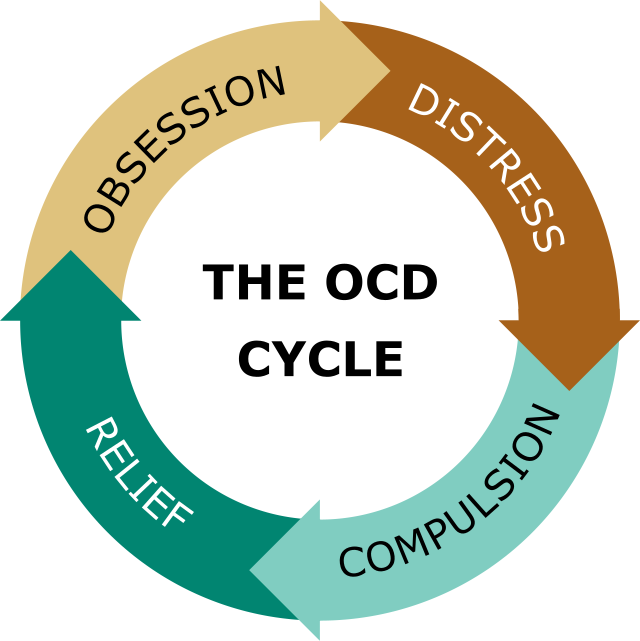
- Cognitive-behavioural model: intrusive thoughts occur in everyone, but in OCD they are catastrophically misinterpreted as meaningful, dangerous, or reflecting the person's true character (thought-action fusion - believing that having a thought is as bad as acting on it). Compulsions temporarily relieve the resulting anxiety, which negatively reinforces the ritual and entrenches the cycle.
- Why it self-perpetuates: because the compulsion is always followed by relief, the brain learns that the ritual prevented the feared outcome - so the belief is never disconfirmed and the cycle strengthens with every repetition
- Personality: perfectionism and an inflated sense of responsibility for preventing harm are common premorbid traits
Risk factors
- Family history of OCD or tic disorders
- Personal or family history of tic disorder, including Tourette syndrome
- Perfectionistic or highly conscientious premorbid personality traits
- Childhood adversity or trauma
- Pregnancy and the postnatal period - a recognised time of new onset or exacerbation
- Streptococcal infection preceding abrupt paediatric onset (PANDAS), though this remains a minority and contested cause
Clinical features
Obsessions
Recurrent, persistent thoughts, images or urges that are intrusive and unwanted, cause marked anxiety or distress, and that the person attempts to ignore, suppress or neutralise with another thought or action. Crucially, the person recognises the obsessions as a product of their own mind, however unwelcome (distinguishing them from thought insertion in psychosis).
| Theme | Example |
|---|---|
| Contamination | Fear of germs, dirt or illness from touching objects or people |
| Harm | Fear of accidentally or deliberately harming oneself or others, for example leaving the gas on or stabbing a loved one |
| Symmetry and order | A need for objects to be arranged exactly, or actions repeated until they feel 'just right' |
| Unwanted taboo thoughts | Intrusive sexual, blasphemous or violent images that are deeply at odds with the person's values |
| Doubt | Persistent uncertainty about whether a door was locked or an appliance switched off |
Compulsions
Repetitive behaviours (washing, checking, ordering) or mental acts (counting, praying, silently repeating a phrase) that the person feels driven to perform in response to an obsession, or according to rigid rules. They are aimed at preventing or reducing distress or a feared event, but are excessive and not realistically connected to what they are meant to neutralise, or are clearly excessive.
- Washing and cleaning - handwashing, showering or cleaning rituals, often to the point of skin damage
- Checking - repeatedly checking locks, appliances or that no harm has occurred
- Ordering and arranging - until objects feel symmetrical or 'just right'
- Mental rituals - counting, repeating words or prayers silently
- Reassurance-seeking - repeatedly asking others to confirm safety or that harm has not occurred
- Avoidance - of triggers for obsessions, which can become as disabling as the rituals themselves
Severity
The Yale-Brown Obsessive Compulsive Scale (Y-BOCS) is the standard tool, separately scoring the time occupied, distress, resistance, and interference caused by obsessions and by compulsions, and is used both to grade severity and to track treatment response.
Mental state examination
| Domain | Typical findings |
|---|---|
| Appearance and behaviour | May show visible rituals (repeated handwashing, checking); skin changes from excessive washing |
| Speech | Normal, though may be hesitant discussing taboo obsessional content through shame |
| Mood and affect | Anxious, often low mood secondary to the burden of symptoms |
| Thought form | Normal |
| Thought content | Intrusive, ego-dystonic obsessions; person recognises them as excessive and resists them |
| Perception | Normal - no hallucinations |
| Cognition | Normal, though concentration can be impaired by intrusive thoughts |
| Insight | Usually good; a minority have poor or absent insight, which is graded formally alongside the Y-BOCS |
Differential diagnosis
- Generalised anxiety disorder: worry about real-life concerns, without discrete obsessions or ritualised compulsions
- Psychotic disorder: thought insertion and delusions are held with conviction and without resistance, unlike the ego-dystonic, resisted obsessions of OCD - though OCD with poor insight can blur this distinction
- Body dysmorphic disorder: obsessional preoccupation specifically with a perceived defect in appearance
- Illness anxiety disorder: obsessional preoccupation specifically with having or developing a serious illness
- Autism spectrum disorder: repetitive behaviours and routines are usually experienced as calming or preferred, not as ego-dystonic and distressing
- Depression: ruminations are typically mood-congruent and about guilt or worthlessness, rather than the specific, often bizarre content of OCD obsessions, though the two frequently coexist
- Hoarding disorder: classified separately in ICD-11 - persistent difficulty discarding possessions, without necessarily the intrusive obsession/compulsion structure of OCD
- Tic disorders and Tourette syndrome: motor and vocal tics rather than goal-directed compulsions performed to neutralise an obsession, though the two frequently co-occur
Investigations
OCD is diagnosed clinically. There is no diagnostic test, and investigations are used only to exclude organic mimics or assess comorbidity.
- Y-BOCS to establish baseline severity and monitor treatment response3
- History of onset - abrupt paediatric onset, particularly following a sore throat, raises the possibility of PANDAS and warrants paediatric review
- Screen for comorbid depression, other anxiety disorders and tic disorders, all of which are common
- Physical examination for skin damage from excessive washing
Asking about obsessions people are ashamed of
OCD has a median delay of many years between onset and diagnosis, and shame about symptom content is the main reason. Patients with violent, sexual or blasphemous intrusive thoughts frequently believe they are dangerous, perverted or evil, and will not volunteer them - so they must be asked about directly, with explicit normalisation.
- Normalise first, then ask: 'Many people with these difficulties get unwanted thoughts that they find horrible and that go against everything they believe. Does that happen to you?'
- Name the categories explicitly, since patients often will not: thoughts about harming others including children, unwanted sexual thoughts, blasphemous thoughts, and fears of having done something terrible without remembering
- Clarify the quality - are the thoughts unwanted and distressing (obsessional), or wanted and endorsed? This distinction determines whether this is OCD or a genuine risk concern
- Ask about mental compulsions, which are invisible and frequently missed - silent counting, praying, reviewing memories to check nothing happened, mentally 'undoing' a thought
- Ask about reassurance-seeking and avoidance, which are compulsions in a less obvious form
- Quantify the time lost - hours per day is the most useful single measure of severity
Management
NICE recommends a stepped-care approach based on the degree of functional impairment.2
| Impairment | Treatment |
|---|---|
| Mild | Low-intensity psychological treatment: brief individual CBT (including exposure and response prevention) using structured self-help materials, or group CBT |
| Moderate | A choice of more intensive CBT (including ERP), or an SSRI, or both together |
| Severe | Combined treatment - intensive CBT with ERP plus an SSRI - with referral to a specialist OCD/anxiety disorder service, particularly if there is no response to initial treatment |
Exposure and response prevention (ERP)
ERP is the specific, most effective form of CBT for OCD. The person is systematically exposed to situations that trigger obsessions, while being supported to resist performing the accompanying compulsion, allowing anxiety to rise and then naturally fall (habituate) without the ritual. Repeated practice breaks the negative reinforcement cycle that maintains the disorder.
A worked example makes the mechanism clear. A patient with contamination obsessions who washes for 40 minutes after touching a door handle would work up a hierarchy - touching a clean handle, then a public one, then a bin lid - and at each step touch the object and then not wash, remaining with the anxiety until it falls of its own accord. The learning is not that the object was clean, but that the anxiety subsides without the ritual and that the feared catastrophe does not occur.
- The compulsion, not the obsession, is the treatment target - obsessions cannot be suppressed directly, and trying to do so increases them
- Include mental compulsions and reassurance-seeking in response prevention, or treatment will appear to fail while the ritual simply goes underground
- Involve the family in reducing accommodation, since a relative who continues to provide reassurance or perform the checking undermines the whole intervention
- Anxiety must be allowed to peak - a session that ends while the person is still at peak anxiety, or where they ritualise afterwards, can reinforce rather than reduce the fear
Medication
An SSRI is first-line pharmacological treatment. Clomipramine, a TCA with potent serotonergic activity, is an effective alternative, usually reserved for cases not responding to an SSRI because of its side-effect burden.
| Drug | Notes |
|---|---|
| Sertraline, fluoxetine, fluvoxamine, paroxetine, citalopram | All effective; typically titrated to the upper end of the licensed range |
| Clomipramine | A TCA with strong serotonergic action; effective but anticholinergic, sedating and cardiotoxic in overdose - requires ECG monitoring |
| Antipsychotic augmentation | Low-dose aripiprazole or risperidone added to an SSRI in treatment resistance, particularly with comorbid tics - specialist initiation |
For treatment-resistant OCD, options include switching to a different SSRI or to clomipramine, augmenting an SSRI with an antipsychotic, or referral for more intensive specialist input, which may include intensive outpatient or inpatient treatment in severe, function-limiting cases. Effective medication is continued for at least 12 months after response before any attempt at withdrawal, and relapse on stopping is common, so some patients remain on long-term treatment.
Complications
OCD causes substantial functional impairment - lost time to rituals, disrupted relationships and employment, and social withdrawal driven by shame about symptom content. Comorbid depression is very common and is associated with an increased risk of suicidal ideation. Skin damage from excessive washing, and family accommodation of rituals (family members participating in or facilitating compulsions to reduce the person's distress) are both frequent and worth asking about directly, as they can maintain the disorder and need to be addressed in treatment.
Red flags
Prognosis
OCD tends to follow a chronic course if untreated, often waxing and waning in severity in relation to life stress, but the majority of patients achieve significant and durable improvement with ERP, an SSRI, or the combination. Early treatment, good engagement with ERP, and limiting family accommodation of rituals are all associated with better outcomes.
A substantial minority experience relapse, particularly if medication is stopped abruptly, so continuation treatment for at least 12 months after response is standard, with some patients requiring longer-term or indefinite treatment for a chronic, relapsing course.
References
- World Health Organization. ICD-11 for Mortality and Morbidity Statistics. Obsessive-compulsive or related disorders. 2024. Available here
- NICE CG31. Obsessive-compulsive disorder and body dysmorphic disorder: treatment. 2005, updated 2019. Available here
- NICE CKS. Obsessive-compulsive disorder. Available here
This article is written for revision and education. It is not clinical guidance and must not be used to make decisions about the care of a patient. Always check current NICE guidance and local protocols.