
Bipolar Affective Disorder
Key points
- Bipolar disorder: a mood disorder featuring episodes of mania or hypomania, almost always with episodes of depression as well, separated by periods of relatively normal mood.
- Mania vs hypomania: mania causes severe functional impairment, may include psychotic features, and usually needs hospital admission; hypomania is milder, does not include psychosis, and does not markedly impair function.
- Bipolar I: at least one manic episode (depressive episodes are common but not required for the diagnosis).
- Bipolar II: at least one hypomanic episode and at least one major depressive episode, with no full manic episode.
- Acute mania: manage with an antipsychotic first-line; stop any antidepressant.
- Acute bipolar depression: manage with an agent with mood-stabilising properties (e.g. quetiapine, olanzapine plus fluoxetine, or lamotrigine) - avoid antidepressant monotherapy, which risks precipitating mania.
- Long-term prophylaxis: lithium is the gold standard, with regular monitoring of levels, renal and thyroid function; valproate and other options are used but valproate is contraindicated in women of childbearing potential.
- Course: chronic and relapsing - relapse prevention and monitoring for early warning signs are as important as treating acute episodes.
Introduction
Bipolar affective disorder is a chronic mood disorder characterised by episodes of abnormally and persistently elevated mood and energy (mania or hypomania), almost always interspersed with episodes of depression, separated by periods of comparatively normal mood (euthymia).1
It affects around 1-2% of the population, with onset typically in late adolescence or early adulthood. It is a major cause of morbidity: people with bipolar disorder spend, on average, far more time unwell with depressive symptoms than with manic or hypomanic ones, which is a frequently examined and clinically important point, since it means the disorder is easily misdiagnosed and treated as unipolar depression until a manic or hypomanic episode is elicited or occurs.
Correctly distinguishing bipolar disorder from unipolar depression matters enormously in practice, because antidepressant monotherapy in bipolar disorder can precipitate mania or rapid cycling.
Aetiology
Bipolar disorder has one of the strongest genetic contributions of any psychiatric disorder, modulated by neurobiological and environmental factors.
- Genetics: heritability estimated at 60-80%; a first-degree relative with bipolar disorder confers a markedly increased risk, and there is genetic overlap with schizophrenia
- Neurotransmitter dysregulation: dysfunction of dopaminergic, serotonergic and noradrenergic systems, with mania associated with relative dopaminergic and noradrenergic excess
- Circadian and sleep disruption: disturbed sleep-wake regulation is both a trigger for, and a symptom of, episodes - sleep deprivation is a well-recognised precipitant of mania
- Structural and functional brain changes: altered prefrontal-limbic connectivity affecting emotional regulation
- Kindling hypothesis: each mood episode is thought to lower the threshold for the next, so episodes can become more frequent and less clearly tied to external triggers over time if untreated
- Psychosocial triggers: major life events, postpartum period, substance misuse and disrupted routine can all precipitate episodes in a genetically vulnerable individual
Risk factors
- Family history of bipolar disorder - the single strongest risk factor
- Postpartum period - a recognised high-risk window for a first manic or psychotic episode
- Sleep deprivation or major disruption to circadian rhythm
- Substance misuse, particularly stimulants
- Antidepressant use without a mood stabiliser in someone with undiagnosed bipolar vulnerability
- High-stress life events, though episodes can also occur without an obvious trigger
- Younger age of onset in those with a strong family history
Clinical features
Mania
An extreme, persistent mood state - elevated, expansive or irritable - lasting at least a week (or any duration if hospital admission is required), with increased activity or energy, that markedly impairs day-to-day function and may include psychotic features.
- Elevated, expansive or irritable mood
- Increased energy and activity, with a decreased need for sleep
- Grandiosity - inflated self-esteem, which may become delusional in intensity
- Pressured speech and flight of ideas - rapid, tangential speech that is difficult to interrupt
- Distractibility
- Disinhibition - excessive spending, sexual indiscretion, reckless driving or business decisions
- Reduced insight, often profound
- Psychotic symptoms - mood-congruent grandiose delusions (special powers, wealth, religious significance) or, less commonly, auditory hallucinations
Hypomania
A milder version of the same picture - elevated or irritable mood and increased energy lasting at least several days, noticeable to others as a change from usual functioning, but without marked impairment of function, without psychotic features, and not requiring admission.
| Feature | Hypomania | Mania |
|---|---|---|
| Duration | At least several days | At least a week, or any duration if admission needed |
| Functional impairment | Noticeable change, but function largely maintained | Marked - unable to work or maintain usual responsibilities |
| Psychotic features | Absent | May be present (mood-congruent delusions or hallucinations) |
| Insight | Usually retained, at least partially | Often severely impaired or absent |
| Admission | Not usually needed | Frequently needed, sometimes under the Mental Health Act |
Bipolar depression
Depressive episodes in bipolar disorder meet the same criteria as unipolar depression (see the article on depression), but are on average more frequent and longer-lasting than manic/hypomanic episodes, and can include atypical features such as hypersomnia and increased appetite.
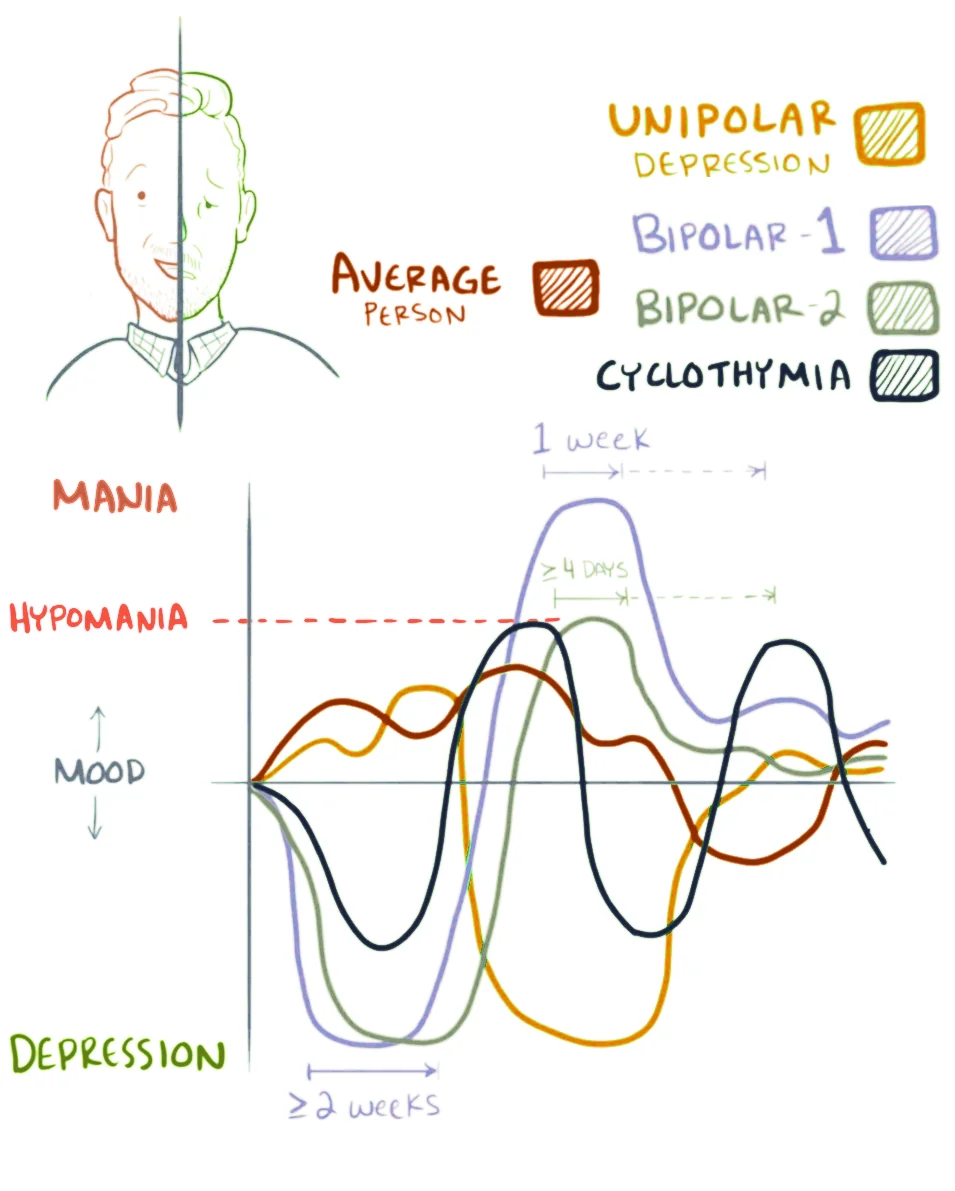
Rapid cycling describes four or more mood episodes within a year, and mixed features describes an episode with prominent symptoms of both mania and depression simultaneously (for example agitation and pressured speech alongside depressed mood and suicidal ideation) - both carry a higher risk and are harder to manage.
Mental state examination
| Domain | Mania |
|---|---|
| Appearance and behaviour | Overactive, disinhibited, flamboyant or bizarre dress, poor sleep evident, may be irritable or aggressive |
| Speech | Pressured, loud, rapid, difficult to interrupt |
| Mood and affect | Elevated, expansive or irritable; labile |
| Thought form | Flight of ideas - rapid shifts between topics linked by clang associations or superficial connections |
| Thought content | Grandiose plans and beliefs, which may become delusional |
| Perception | Usually normal; mood-congruent hallucinations possible in severe mania |
| Cognition | Distractible; formal testing often difficult because of overactivity |
| Insight | Characteristically poor or absent |
Differential diagnosis
- Unipolar depression: a depressive episode without any personal history of mania/hypomania - always ask specifically
- Schizoaffective disorder: psychotic symptoms present for a substantial period without prominent mood symptoms, not just during mood episodes
- Cyclothymia: chronic, milder mood instability with numerous periods of subthreshold hypomanic and depressive symptoms over at least 2 years, never meeting full criteria for either
- Substance-induced mood disorder: stimulant intoxication (cocaine, amphetamines) can closely mimic mania
- Hyperthyroidism: overactivity, irritability, weight loss and tachycardia can mimic mania - check TFTs
- Delirium: acute confusion with fluctuating consciousness, distinguished from mania by disorientation and impaired attention rather than by mood elevation alone
- Personality disorder (particularly emotionally unstable/borderline): mood instability is present but fluctuates over hours in response to interpersonal triggers, rather than in sustained days-to-weeks episodes
- ADHD: overactivity and distractibility are lifelong and stable rather than episodic
- Steroid-induced mood change: corticosteroids can cause mania, hypomania, or depression
Investigations
Bipolar disorder is a clinical diagnosis. Investigations exclude organic mimics and establish a baseline before starting mood-stabilising medication.
- TFTs - to exclude thyrotoxicosis and as a baseline before lithium
- FBC, U&Es, LFTs - baseline before mood stabilisers, and to look for evidence of substance misuse or self-neglect
- Calcium - baseline before lithium, and hypercalcaemia can itself cause mood disturbance
- Urine drug screen - stimulant intoxication is an important differential
- ECG - baseline before certain antipsychotics (QTc prolongation)
- Collateral history is essential - patients in a manic episode frequently lack insight and cannot give a reliable account of their own symptoms or risk
- Pregnancy test in women of childbearing potential, since it changes the entire treatment plan given the teratogenicity of both lithium and valproate
Eliciting a history of hypomania
Bipolar disorder is under-diagnosed for a specific and avoidable reason: patients present when depressed, and are rarely asked about past elevated mood. Hypomania in particular is not remembered as illness - it is remembered as a period of feeling well, productive and confident - so open questions such as 'have you ever been manic?' reliably produce a no.
- Ask about behaviour rather than mood: 'Has there ever been a time when you needed much less sleep than usual but still felt full of energy?'
- 'Have you had periods where you were much more talkative, or people struggled to keep up with you?'
- 'Have you ever spent much more money than you could afford, or made decisions that seemed a good idea at the time and later did not?'
- 'Has anyone close to you ever said you seemed unusually high, irritable or out of character?' - collateral history is often the only way this is established
- Ask about antidepressant-induced switching: 'Did any antidepressant ever make you feel unusually energetic, irritable or unable to sleep?'
- The Mood Disorder Questionnaire (MDQ) can support screening but does not replace a careful history
Management
Acute mania or hypomania
- Stop any antidepressant - it can be driving or worsening the episode
- Antipsychotic first-line - haloperidol, olanzapine, quetiapine or risperidone
- If an antipsychotic alone is insufficient, add lithium or valproate
- Severe mania, particularly with psychosis, risk to self or others, or inability to engage voluntarily, usually requires hospital admission, sometimes under the Mental Health Act
- Benzodiazepines short-term for agitation and to restore sleep, which is itself therapeutic given the role of sleep deprivation in sustaining mania
- Reduce stimulation - a quiet environment, limited visitors, and where possible restricting access to money, phones and social media to limit lasting financial and reputational harm
Acute bipolar depression
- Quetiapine (monotherapy) is a common first choice, with mood-stabilising and antidepressant properties
- Olanzapine plus fluoxetine combination, or lamotrigine, are alternatives
- Avoid antidepressant monotherapy - without an antimanic agent on board it risks precipitating a switch into mania or hypomania, or rapid cycling
Long-term prophylaxis
Maintenance treatment aims to prevent relapse and reduce the frequency and severity of future episodes. Lithium is the gold-standard, first-line long-term mood stabiliser.2
| Parameter | Detail |
|---|---|
| Therapeutic range | 0.6-0.8 mmol/L typically (up to 1.0 in some cases); narrow therapeutic index |
| Level timing | 12 hours post-dose |
| Frequency | Weekly after starting/dose change until stable, then every 3 months once stable |
| Renal and thyroid function | Every 6 months - lithium can cause hypothyroidism and nephrogenic diabetes insipidus/renal impairment |
| Toxicity features | Coarse tremor, ataxia, confusion, vomiting, diarrhoea - precipitated by dehydration, NSAIDs, ACE inhibitors/ARBs, diuretics |
- Valproate is an effective alternative or add-on, but is contraindicated in women of childbearing potential because of major teratogenicity, and requires a pregnancy prevention programme when used4
- Lamotrigine is particularly useful where depressive relapses predominate
- Antipsychotics (olanzapine, quetiapine, aripiprazole) also have a maintenance role, particularly where psychotic features have occurred
- Psychoeducation - relapse-signature planning (recognising early warning signs), sleep hygiene, regular routine, and avoiding recreational drugs and alcohol are all central to reducing relapse3
The relapse signature and advance planning
Most patients have an identifiable, individual relapse signature - a reproducible sequence of early changes that precedes a full episode, typically by days to weeks. Reduced need for sleep is the commonest early sign of impending mania, alongside increased spending, more phone calls or messages, new projects, increased sociability and irritability. Identifying this sequence collaboratively, writing it down, and agreeing in advance what will happen when it appears - who is contacted, what medication changes are permitted, what practical safeguards are enacted - is among the most effective relapse-prevention interventions available.
An advance statement made while the person is well, setting out their treatment preferences and who should be involved should they become unwell and lose insight, is good practice and improves engagement even where it is not legally binding.
Complications
Bipolar disorder carries a substantially increased risk of suicide, particularly during depressive and mixed episodes. Manic episodes can cause severe social, financial, occupational and legal harm through disinhibited behaviour, which can be difficult to recover from even after the episode resolves. Comorbid substance misuse is common, and physical health - especially cardiometabolic risk from antipsychotic use and from the illness itself - is often neglected. Relationship breakdown and loss of employment are frequent consequences of repeated relapse.
Red flags
Prognosis
Bipolar disorder is a chronic, relapsing condition. Most people experience multiple episodes over their lifetime, and depressive symptoms - including subthreshold depressive symptoms between full episodes - account for far more of the total time unwell than mania or hypomania.
Long-term prophylaxis, particularly with lithium, meaningfully reduces relapse frequency and severity, and also reduces suicide risk specifically. Poor prognosis is associated with rapid cycling, mixed episodes, comorbid substance misuse, poor treatment adherence and limited social support. With sustained treatment and psychoeducation, many people achieve long periods of stability and maintain good functioning between episodes.
References
- World Health Organization. ICD-11 for Mortality and Morbidity Statistics. Bipolar or related disorders. 2024. Available here
- NICE CG185. Bipolar disorder: assessment and management. 2014, updated 2020. Available here
- NICE CKS. Bipolar disorder. Available here
- BNF. Lithium carbonate - monitoring requirements. Available here
This article is written for revision and education. It is not clinical guidance and must not be used to make decisions about the care of a patient. Always check current NICE guidance and local protocols.